


Family Memory: The 6 Layers and How to Save Each One

Most people think family memory is just photos in the cloud and a few stories told at dinner. When both my parents had serious health scares, I realised how much of our lives lived only in their heads, and how quickly it could vanish.
Family memory goes far beyond photos. It has six distinct layers, and most families lose half of them without ever realising what they had.
The good news is that once you understand these layers, it becomes much easier to save them. This post explains each layer, shows which ones disappear fastest, discusses why traditional methods miss important parts, and offers steps you can take.
Try the quiz below to find out how your family is doing.
Jump to section:
What Is Family Memory? (And Why Stories Aren’t Enough)
Family memory is everything a family carries forward about who they are: their stories, the sound of their voices, the places that shaped them, the objects they kept, the rituals they repeated, and the language they shared.
Many people treat “family memory” and “family stories” as if they mean the same thing. They don’t.
A family story is something you can narrate. The time your grandfather missed his flight and drove through the night. The Thanksgiving your aunt forgot to defrost the turkey. The summer your dad rewired the basement himself. Events with a beginning, middle and end.
Family memory is much broader. It includes the stories, but also the voices that shared them, the kitchen where they were told, the sound of your grandmother’s laugh, the objects she pointed to, the way your dad still says “right then” before standing up, and the Sunday lunch your family has had the same way for thirty years.
Family memory is everything that makes your family yours: the stories, voices, places, objects, rituals, and language that, when combined, no other family has in exactly the same way.
Stories are just one layer. There are six in total.
For a deeper look at why family stories specifically matter, and why photos alone never capture them, read why stories are important for families.
Next, let’s look at the full picture.
The Six Layers of Family Memory
Here is the overview: six clear layers of family memory, each with its own feel, its own importance, and its own rate of fading.
Most families are strong in one or two layers. Very few manage to cover all six. Once you know the layers, it’s easier to spot what might be missing.
Layer 1 — Stories (the events and what they meant)
Stories are the layer everyone thinks of first. The events of your family’s life, with a beginning, middle and end. The first house your parents bought. The week your sister came home from college and changed her major. The funeral that brought everyone back together for the first time in twenty years.
Stories carry meaning, not just facts. A photo of your grandfather can show what he looked like. A story can show who he was: what he believed, what he stood for, what made him laugh.
Most families have plenty of stories floating around in conversations and memory. The challenge is getting them written down or recorded somewhere they’ll survive.
For more on this: how to record family stories, and why sharing family stories matters.
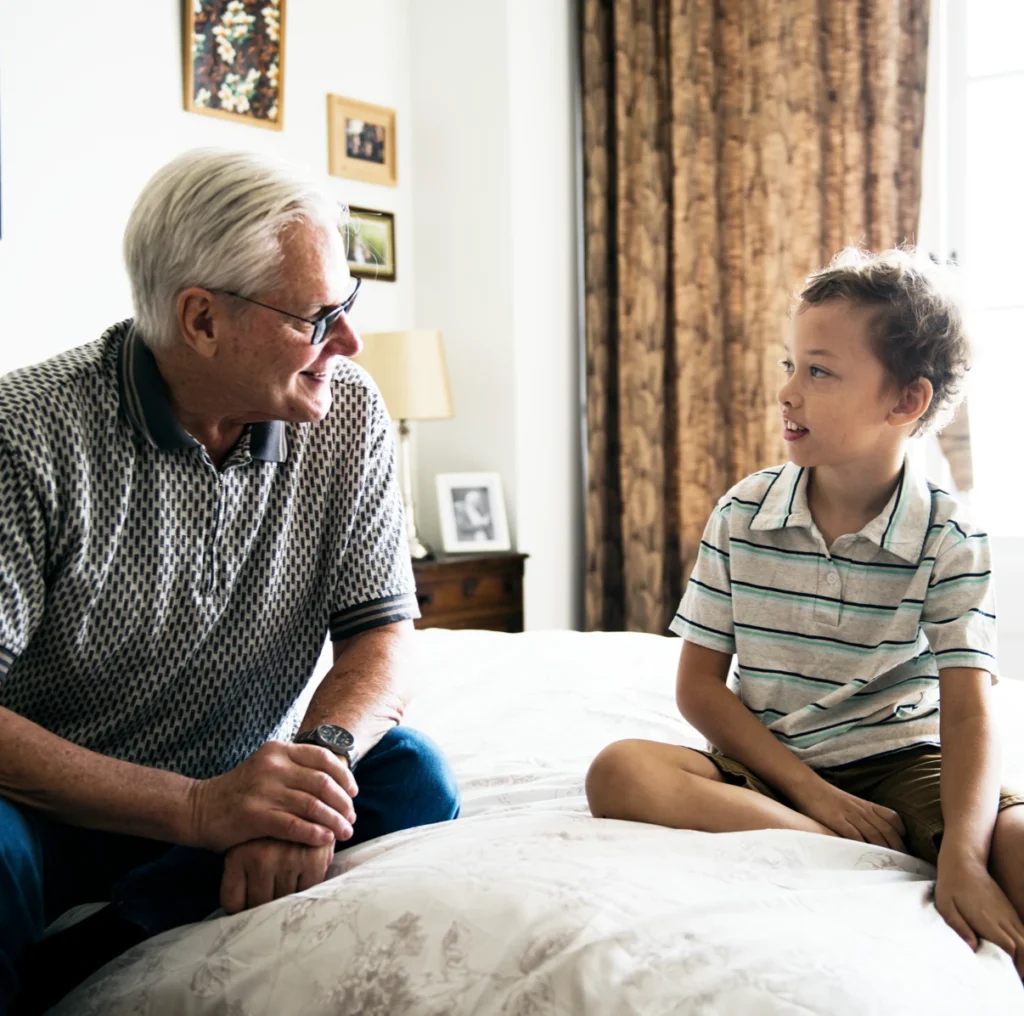
Layer 2 — Voices (the sound of who they were)
Voices are the layer that most families overlook until it is too late.
The exact sound of your grandmother saying your name. The way your dad clears his throat before delivering bad news. The laugh your brother had at fifteen, which is different from the one he has now. The story your mother always tells, told in her own voice, with her own pauses.
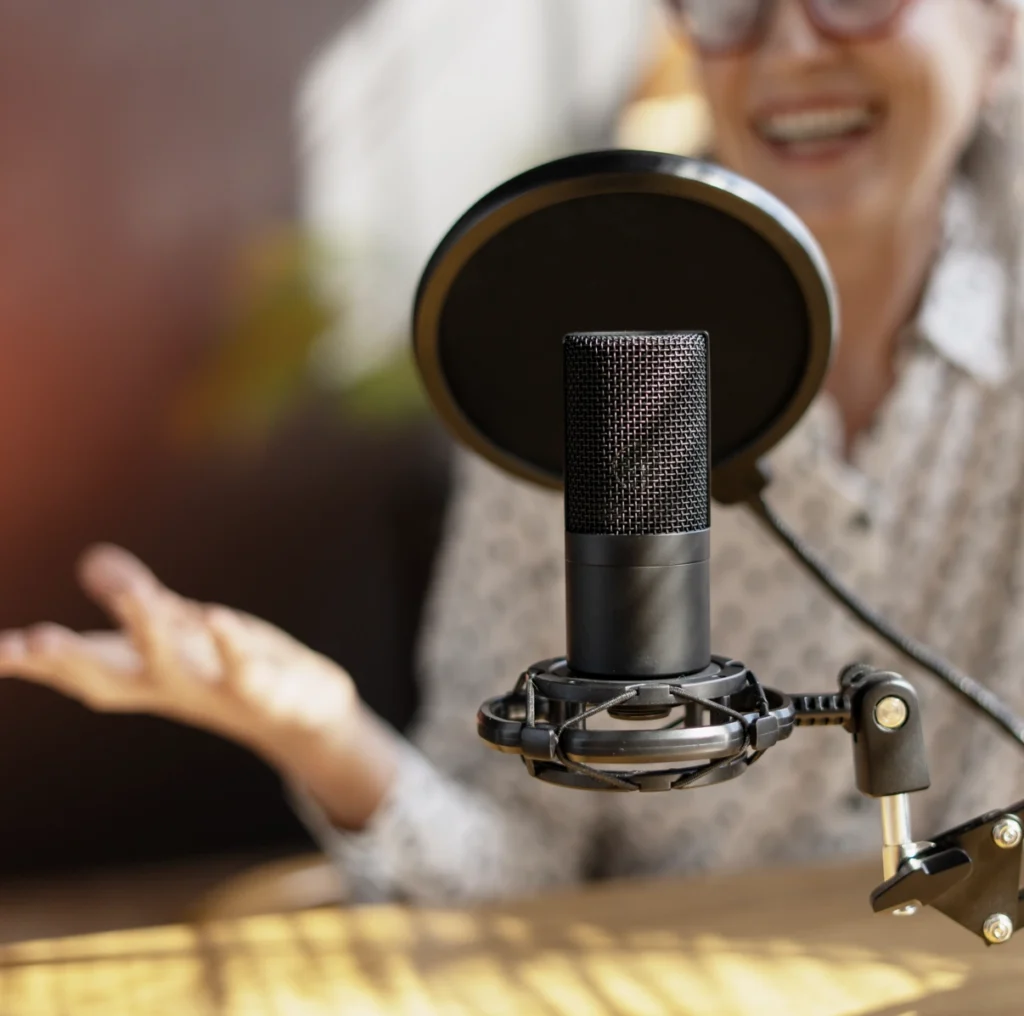
Photos or written stories cannot capture these things. Once a person is gone, these sounds disappear completely. There is no way to get them back.
I’ve heard it again and again from families who’ve lost someone: the most precious thing they still have is an old voicemail or casual voice note. A throwaway message about being late for dinner becomes one of the most treasured items they own. There are two tragedies in that. The first is that those clips are locked inside an app that may not exist in twenty years. The second is they’re not about anything that mattered. Nobody thought to record the bigger conversations while there was still time.
The solution is simple and quick: open the voice memo app on your phone and ask a parent or grandparent to share a five-minute story about something important. Do it today. Even a rough recording becomes priceless.
For more on this: voice recording memories.
Layer 3 — Places (where life happened)
Places are often the quiet backdrop of family memory.
The house your mother grew up in. The lake you went to every August. The kitchen where Sunday lunch always happened. The hospital where your sister was born. The corner of your grandfather’s porch where he sat every evening.
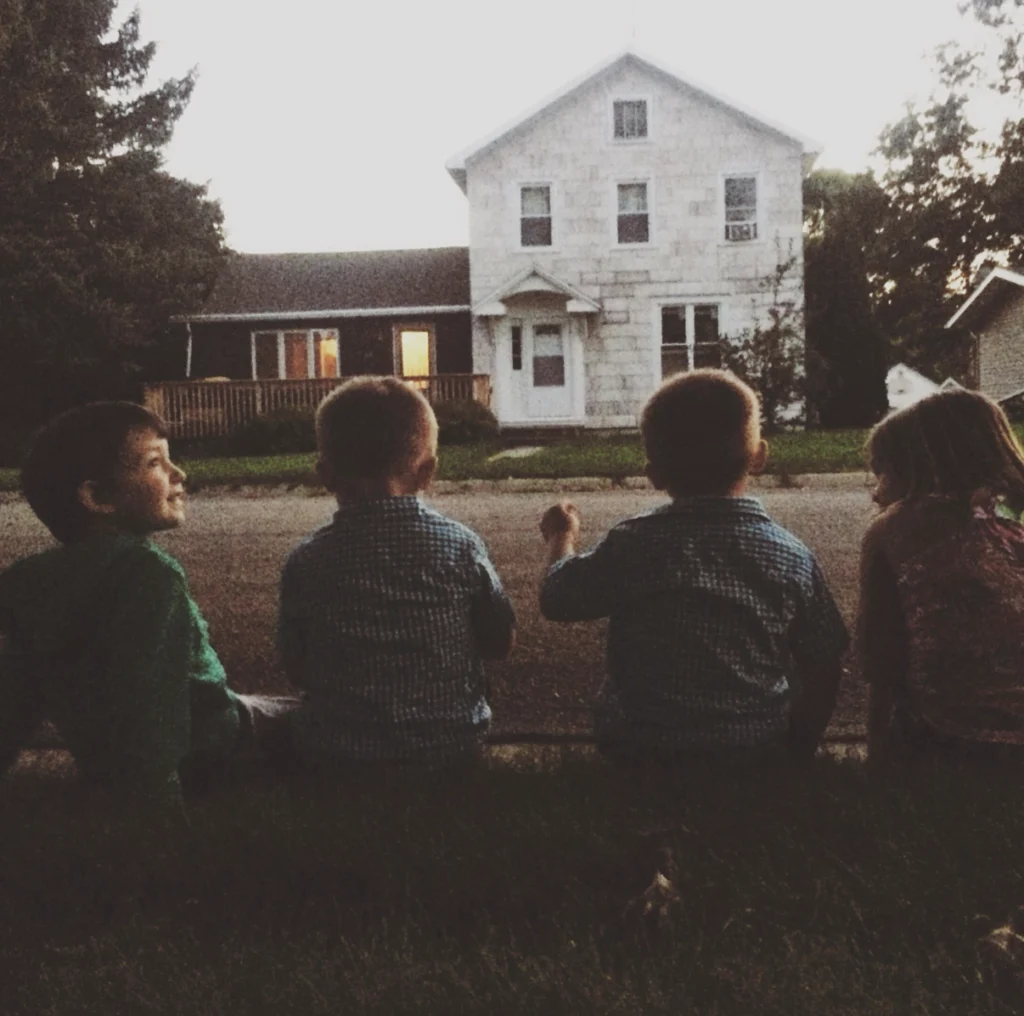
Places become meaningful as soon as something happens there. But their importance can fade in two ways.
First, families move, houses are sold, and neighbourhoods change. Second, if no one explains why a place mattered, its meaning fades for the next generation.
There’s something specific worth capturing that most families miss. Not just “the lake we went to” but the exact dock at the north end where your father liked to read. Not just “Grandma’s village in Ireland” but the actual house she grew up in. When place memories are preserved at that level of detail, future family members can stand on the same ground you stood on, and look out at the same view.
Many people travel far to visit the village their great-grandparents once called home. This urge is universal. Remembering specific places makes these trips meaningful.
Layer 4 — Objects (what survived physically)
Objects last the longest of all the layers, but they are also the most likely to be misunderstood.
The furniture handed down from a grandparent’s house. The paintings on the wall that nobody questions. The ornaments brought out every December. The dining table the family has eaten at for three generations.
Often, they are worth almost nothing in financial terms.
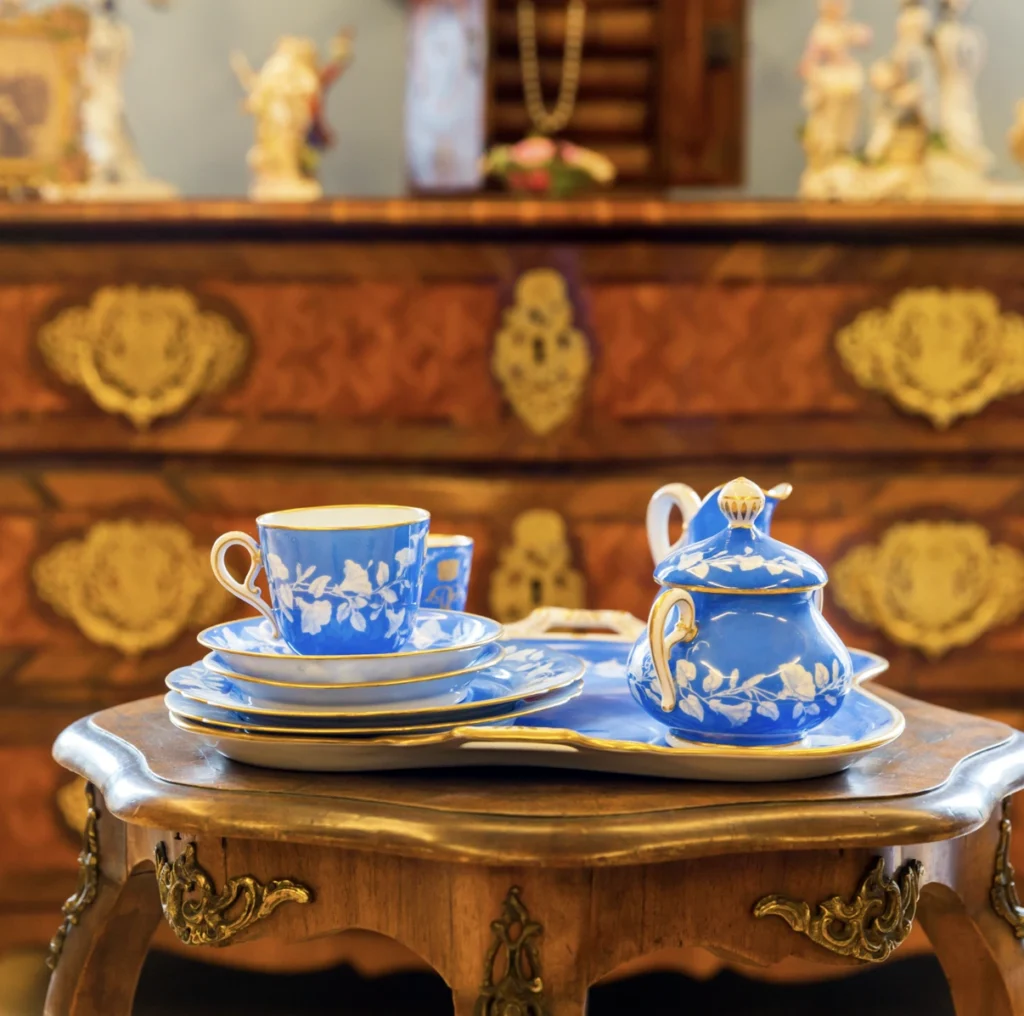
But for the family who knows their history, these items are among the most valuable things in the home. The story behind them makes all the difference.
A painting becomes priceless the moment you know which uncle painted it, in which year, after which difficult chapter of his life. A dining table becomes irreplaceable the moment someone documents that it was the first thing your great-grandparents bought together when they married.
Without those stories, objects pass to the next generation as anonymous things. Furniture gets sold. Paintings get given away. Ornaments end up in a thrift store run by someone who has no idea what they’re handling. The objects survive the family. The meaning rarely does.
When an object has a story, it becomes an heirloom. Without its story, it eventually becomes just another item.
Layer 5 — Rituals (what was done repeatedly)
Rituals are the things your family does naturally, without planning. Birthday traditions, special holiday foods, and the places you visit each year all count as rituals.
What most families don’t capture is where these rituals came from. The tradition you observe today probably didn’t start with you. It was handed down, often two or three generations back, by someone who started it for a reason that has since been forgotten.
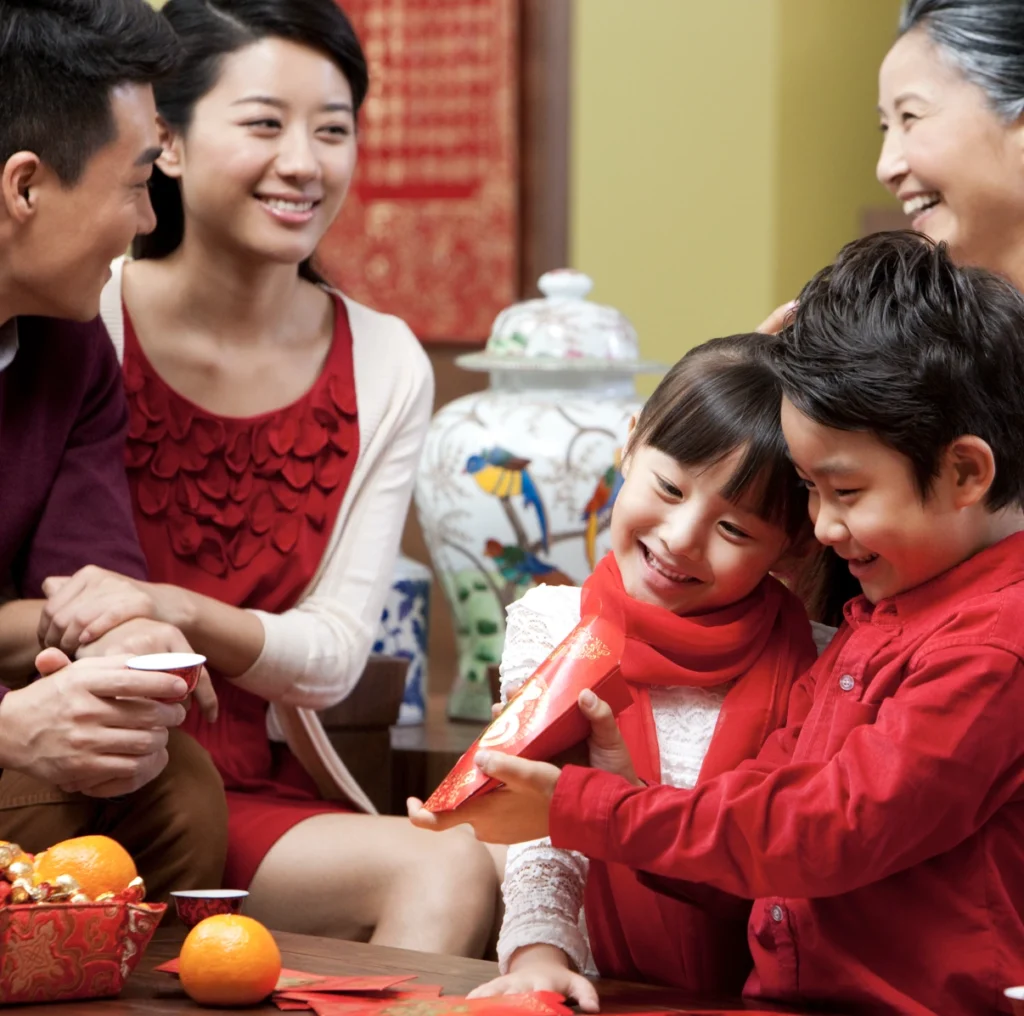
That’s the real story worth preserving. Not just what you do, but who began it, when, and why.
The grandmother who insisted everyone come home for one specific weekend each year. The great-uncle who started the rule about no phones at the dinner table. The cousin who decided one summer that the whole family should rent the same lake house, and somehow forty years later they still do.
When you learn where a ritual began, it becomes more meaningful. It is no longer just something your family does, but something passed down. The next generation is much more likely to continue it when they know its story.
Layer 6 — Language (the sayings, in-jokes, family vocabulary)
Language is the layer most families don’t notice, even though they use it every day.
Every family develops its own way of speaking. Specific phrases. Particular nicknames. Words that mean nothing outside the household. Expressions that get repeated so often nobody notices anymore.
Try this: ask your family what phrases you say all the time. Their answers may surprise you. Most people don’t notice their own catchphrases, since these expressions become automatic and are obvious only to others.
Now do the same exercise on your parents. Some of their expressions will turn up in your own list. The vocabulary of a family passes down through generations, often without anyone deciding it should. You inherited words and phrases from a parent who inherited them from a parent before that.
This is why language is the easiest layer to lose. The person saying the phrase doesn’t notice it, and others take it for granted. One day, the person who always said it is gone, and the words disappear too.
At first, writing these phrases down might feel odd, as if they aren’t important. But fifty years from now, your grandchildren will read them and get a sense of who you were by the way you spoke. The best way to save this layer is through audio, along with voices from Layer 2.
Which Layers Fade Fastest (and Why That Matters)
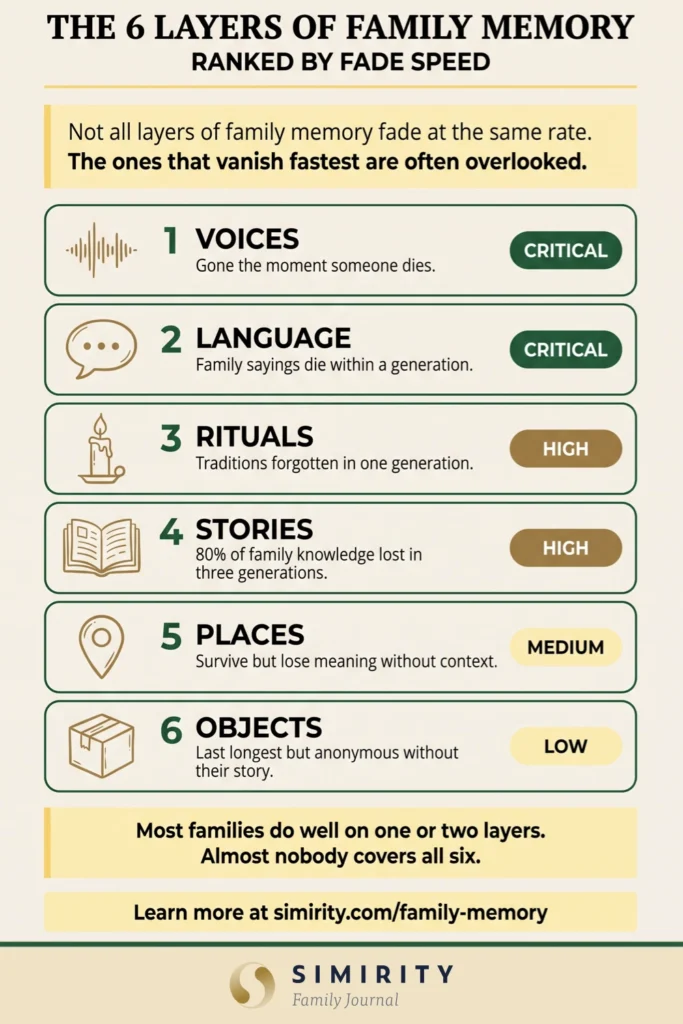
Each layer fades at a different speed. Some disappear as soon as someone passes away. Others slowly fade within a generation. Some last for centuries, but their meaning can be lost over time.
Knowing which layers fade the fastest helps you decide where to begin. The chart below ranks the six layers by how quickly each one becomes impossible to recover if it is not saved.
Why voices fade fastest
There is no machine that can recreate the sound of a person who didn’t leave a recording behind. Photos can be repaired. Stories can be reconstructed from other people’s memories. Objects can be inherited.
A voice, once the person is gone, is gone. There is no version of it that survives in someone else’s head. Recordings made before they died are the only way the sound persists.
This is why voices are the most urgent layer to save. Other layers can sometimes be recovered, but voices can’t.
If you do just one thing after reading this post, let it be this: record a parent or grandparent speaking sometime this week.
Why language and rituals follow
After voices, the next two layers fade together: language and rituals.
A family saying lasts only as long as someone keeps using it. After the person who said it most is gone, the phrase might last for one or two generations before it disappears. Grandchildren who only heard it a few times won’t repeat it, and by the time their children grow up, it is forgotten.
Rituals follow the same pattern. A tradition kept by your grandmother becomes optional for your mother, then forgotten by your children, unless someone writes down what it was, where it came from, and why it stuck. Without that record, traditions that lasted three generations can vanish in one.
Both layers go unnoticed until they’re gone. That is what makes them easy to lose. People don’t miss them right away, since they always seemed like background noise. The loss is only felt years later, when someone tries to remember and can’t.
Why stories, places and objects last longer (but still need help)
The last three layers fade more slowly, but they are not guaranteed to last.
Stories can survive for centuries, if anyone records them. The stories don’t disappear suddenly. They drift, blur, simplify, and eventually nobody remembers them well enough to retell them.
Oral family history can vanish in just three generations. The US National Archives notes it takes only that long to lose a story for good, unless someone records it.
Places persist physically for far longer than the people who knew them. A house stands. A lake stays where it is. But places lose their family meaning quickly. Within a generation or two, “where Grandpa grew up” becomes a town nobody in the family has been to.
Objects last longest. A piece of furniture can outlive four or five generations. But without the story attached, an heirloom becomes inventory. Most furniture, paintings and ornaments are eventually sold or given away by descendants who never knew what they were holding.
The pattern with these three layers is clear: the physical items last, but their meaning can disappear. Saving the meaning is what turns survival into a true legacy.
Why Most Family Memories Get Lost (The Medium Problem)
Most families lose most of their memory not because they don’t care, but because the medium they’re using cannot hold it.
Photos stored online, a printed memoir, a box of letters in the attic, or a WhatsApp group from years ago, each one saves something, but none captures all six layers. The parts they miss are often the ones that disappear the fastest.
No single traditional medium captures all six layers
Here’s how the common mediums compare across the six layers:
| Medium | Stories | Voices | Places | Objects | Rituals | Language |
|---|---|---|---|---|---|---|
| Photos (album or cloud) | ||||||
| Printed books or journals | ||||||
| Chat apps (WhatsApp etc.) | ||||||
| Voice recorders | ||||||
| A purpose-built family journal |
fully capturespartialcannot capture
Two things are clear. First, every traditional method has big gaps. There is no ready-made option that covers all six layers. Second, the missing parts are usually voices and language, which are also the hardest to save and fade the fastest.
- Photos capture moments but no narrative, no sound, no language
- Books capture stories but no voices, no living rituals
- Chat apps capture casual exchanges but lose them in endless feeds
- Voice recorders capture sound but offer no structure, no places, no objects
The result is easy to see. Families end up with pieces of memory scattered across different places. The best stories are stuck in a chat app they can’t access, photos are in a folder no one opens, and voice recordings are on an old phone. Nothing is connected.
The case for a purpose-built medium
If you want to keep all six layers together, you need something built for that purpose. A photo app with extra features, a chat platform with file storage, or a book with QR codes will not do the job.
A purpose-built family journal does several things at once that no traditional medium can manage. It holds stories in text, voices in audio, and places on maps in the same entry. It treats objects, rituals and language as proper categories, not afterthoughts. It connects everything to the people involved, so a reader fifty years from now can trace any story back to who told it and who it was about.
This is the gap left by traditional methods. Only a tool designed for this purpose can fill it.
How to Capture All Six Layers in One Place
This is why I created the Simirity Family Journal.
I saw that no existing tool covered all six layers, and my own family was losing memories because of these gaps.
What comes next is the method I’d recommend, not a sales pitch. If Simirity works for you, there’s a demo link at the end. If not, you can still use the ideas below.
Start with voices first
Out of all six layers, voices disappear the quickest. The other layers can wait a while without much loss, but voices can’t.
If a parent or grandparent is still here, recording them is the single highest-value action you can take this week. A five-minute voice memo about anything, how they met your other parent, what their first job was, what their own grandparents were like, becomes irreplaceable the moment it’s saved.
Don’t wait for the perfect questions or setup. Just open the voice memo app on your phone and begin. You can move the recording to Simirity or another place later. The important thing is to capture the audio while you have the chance. Read more about voice recording memories.
Build the habit small and often
Building family memory is a long-term habit, not something you can finish in a weekend. Trying to do everything at once usually means you will not get much done. The people who succeed are the ones who do small things regularly.
A useful target: one story or voice clip per week. Fifteen minutes. Less if you can keep it shorter.
In a year, you will have 52 moments saved. In five years, that is 260. Over a generation, it is enough to give your grandchildren a true sense of who you and your parents were. The habit adds up over time.
If you want help turning this into a regular practice, see our guide to family journaling: how to start, what to write, and why it matters.
Use the right tool for the right layer
Each layer works best in a different format. Photos are great for places and objects. Audio is best for voices and language. Written stories work well for events and rituals. A good family journal brings all these formats together, so everything is connected instead of scattered.
For the detailed how-to on capturing stories properly, see our guide on how to record family stories. For the broader method, see our overview of digital storytelling for families.
Why I built Simirity for all six layers
Simirity is a private family journal built to keep all six layers together.
- You can save stories with text, photos, and voice in one entry
- Places are marked on maps
- Objects are recorded with their stories
- Rituals are tracked with their origins
- Family sayings are saved as audio clips with context
- Everyone in the family can add to it, and nothing is shared publicly. Your stories stay within your family.
See for yourself with an example story:

If this sounds like what you need, you can try the demo to see it in action. Most families know after a few entries if it is the right place for their memories.

Start your family journal today, and save all six layers of family memory in one place with Simirity.
Frequently Asked Questions
What is family memory?
Family memory is everything that makes a family identifiable as itself: the stories, voices, places, objects, rituals and language that, taken together, no other family has in quite the same shape. It’s broader than family history, which focuses on names, dates and lineage, and broader than family stories, which focus on specific events. Family memory is the full texture of family life across generations, including the parts treated as ordinary at the time that only feel valuable in hindsight.
What’s the difference between family memory and family stories?
A family story is a specific event you can narrate: who, when, where, what happened. Family memory is everything that surrounds that event: the voices of the people telling it, the places it happened, the objects involved, the rituals connected to it, the family expressions used to refer to it. Stories are one layer of family memory. There are six in total: stories, voices, places, objects, rituals and language. Most families do well on stories. Far fewer cover all six.
Why are family memories important?
Family memories shape identity. They give children a sense of where they come from, what their family believes, and what makes them part of something bigger than themselves. Research consistently shows that children with strong knowledge of their family’s history have higher self-esteem, stronger resilience, and better emotional regulation. For older generations, sharing family memories provides meaning and connection. For the family as a whole, captured memories become a legacy: the values, stories and personality that survive long after the people who lived them.
Which layer of family memory fades fastest?
Voices fade fastest. Once a person dies, the exact sound of their voice is gone, and no other layer of memory can reconstruct it. After voices, the next two layers to disappear are language (family-specific sayings and expressions) and rituals (traditions that get skipped and forgotten within a single generation). Stories, places and objects last longer but lose their meaning if the context isn’t recorded. The most urgent action you can take is to record a parent or grandparent talking while you still can.
Why isn’t a shared photo album enough to preserve family memory?
Photos capture moments visually, but they can’t hold voices, language, rituals or the context behind objects. A photo of your grandmother’s wedding day doesn’t include her voice, the songs that played, the in-jokes that were repeated, or what the dress meant to her. Family memory has six distinct layers, and photographs only partially cover three of them. To preserve all six, you need a medium designed to hold stories in text, voices in audio, places on maps, and objects with their backstories attached.
How do I start capturing my family’s memory if I don’t know where to begin?
Start with voices. They fade fastest, and recording them is the easiest action to take immediately. Open the voice memo app on your phone and ask a parent or grandparent to tell you a five-minute story about something specific: how they met your other parent, what their first job was, what they remember about their own grandparents. You don’t need the perfect questions or the perfect setup. The recording, however rough, becomes irreplaceable the moment it’s saved. Build from there, one entry per week.
How do you get older relatives to share their memories?
Ask specific questions rather than open ones. ‘Tell me about your childhood’ feels overwhelming. ‘What was your kitchen like when you were ten?’ gets a real answer. Old photographs are excellent prompts: pull out a picture and ask who’s in it and what was happening that day. Keep early sessions short, ten or fifteen minutes. Many people who say they have nothing to share end up talking for hours once a specific memory is triggered. The hardest part is starting.
When should you start preserving family memories?
Now. The most urgent layer, voices, disappears the moment someone dies, and there is no way to recover it later. Even if older relatives seem healthy, a single voice recording made this week is irreplaceable. The same logic applies to family rituals and language: every year you delay, the chances increase that something will be lost. Capturing family memory works best as a small, consistent habit started today, not a big project planned for later.
Your family’s past, present & future—woven together in Simirity.
