


Facts About the Modern Family: 10 Ways Family Life Has Changed (2026)

What are the facts about the modern family — and how much has family life really changed in your lifetime?
The answer is, things have changed a lot. Marriage isn’t always the first step for families now. Households are smaller. Parents spend more time with their kids than ever before, but many of us feel more stressed and stretched than we’d like to admit. We might be glued to our phones, but a lot of families feel further apart than they did before.
We wanted to build the ultimate go-to resource for facts about the modern family — gathering the most compelling data from the most trusted sources, and presenting it not as a dry list of numbers, but as a story that families will recognise from their own lives.

Jump to section:
How Is the Modern Family Different From 60 Years Ago?
The biggest change in family life is how families are made up. What used to be normal — a married couple, two or three kids, staying together for life — looks very different now. Families come in all shapes and sizes.
Here are the facts about the modern family that tell that story most clearly.
Marriage is no longer the starting point
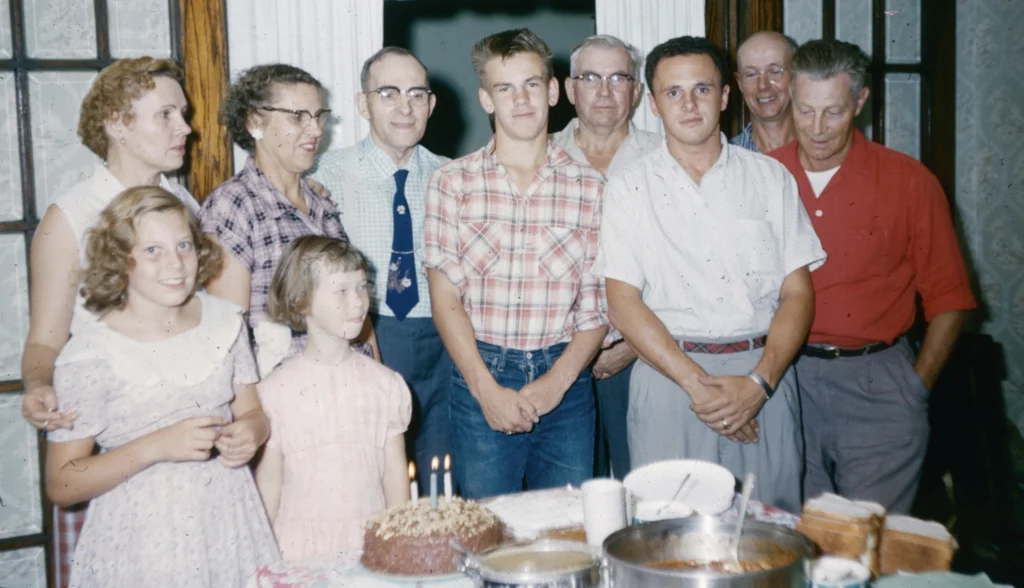
In 1960, 72% of US adults were married. Today, that figure is closer to 50%. The median age at which Americans marry has risen by nearly 8 years — women now typically marry at 28.6, men at 30.2, compared with 20.3 and 22.8, respectively, in 1960.
For the first time in recorded history, the typical American groom is thirty years old.
Meanwhile, cohabitation has surpassed marriage as a life experience for younger adults. Among Americans aged 18 to 44, 59% have cohabited — more than the 50% who have ever been married. That crossover simply would not have seemed possible a generation ago.
Diverse family structures are now the norm
Fewer adults live in what we used to call a ‘traditional’ family — married, kids at home — than before. Now, there are more single parents, blended families, people living with grandparents, and couples who live together but don’t get married.
The US now has the highest rate of children living with a single parent of any country in the world — nearly 23%, more than three times the global average of 7%. And more than a third of all Americans — an estimated 114.5 million people — now have some form of step-relationship.
At the same time, multigenerational living is making a comeback.
The number of Americans living in multigenerational households has quadrupled since 1971 — from 15 million to nearly 60 million, driven by housing costs, student debt, and the needs of an ageing population.
Families Are Getting Smaller — and Starting Later
It is not just the shape of the family that has changed. Its size has shrunk dramatically within a single lifetime.
The US total fertility rate — the average number of children a woman will have — hit an all-time low of 1.6 in 2024. In the early 1960s, it was approximately 3.5. Having two or more children is no longer the statistical default.

Having children later, and sometimes not at all
The average age of first-time mothers in the US has risen from 21.4 years in 1970 to 27.5 years in 2023.
Women in cities now typically become first-time mothers at 28.5. First births to women aged 35 and over increased by 25% between 2016 and 2023 alone.
Childlessness is also rising among younger women — though, interestingly, it declined among women aged 45 to 50 between 2014 and 2024, suggesting the shift is largely about when, not whether, women become mothers.
The rise of the one-child family
The share of women completing their childbearing years with only one child doubled from 11% in 1976 to 22% in 2015. Meanwhile, the share with four or more children collapsed from 40% to 14% over the same period. Average household size fell from 3.33 people in 1960 to approximately 2.5 today — even as the average house has grown 20% larger since 1990.
Today’s Family Is More Diverse Than Ever
One of the most quietly remarkable changes in modern family life is the shift towards greater diversity — in race, identity, and family form. And the data shows that public attitudes have largely kept pace.

Interracial families are now mainstream
In 1967, just 3% of US newlyweds married someone of a different race or ethnicity. Today, one in six newlyweds or 17%, is in an interracial or interethnic marriage, a fivefold increase.
One in seven babies born in the US is now multiracial.
Public acceptance has shifted just as dramatically. In 1958, only 4% of Americans approved of interracial marriage. By 2021, 94% did — one of the most complete opinion reversals in polling history.
LGBTQ+ families are a growing part of the picture
Since the 2015 legalisation of same-sex marriage in the US, the number of married same-sex couples has more than doubled to over 820,000. Nearly 300,000 children are being raised by married same-sex couples.
Support for same-sex marriage has followed a similarly steep trajectory — rising from 27% in 1996 to a record 71% in 2023.
Modern Parents Are More Involved, and More Stressed, Than Ever…
Here’s the odd thing about parenting today. We do more with our kids than any parents before us. But many of us still feel overwhelmed, guilty, and worried.

Parents are more hands-on than any previous generation
In 1965, mothers spent an average of 54 minutes per day on childcare. Fathers averaged just 16 minutes. By 2012, those figures had nearly doubled and nearly quadrupled respectively — to 104 minutes for mothers and 59 minutes for fathers. Dads today spend three times as much time with their children as their own fathers did.
Work has changed too. Most families with kids now have both parents working. Three out of four mums with children under 18 have jobs. Even so, dads spend more time with their children than before. Parents today are doing more than ever.
Yet parenting has never felt harder
Despite that extra investment, 62% of US parents say parenting has been harder than they expected. A further 40% say they are extremely or very worried about their child’s mental health, making it the number one parental concern.
The structural conditions are not helping. The United States is the only OECD country with no national paid parental leave. Only 27% of private-sector workers have access to paid family leave, and 95% of the lowest-wage workers have none at all.
Screens have changed family life in ways we’re still figuring out
US teenagers now spend an average of 8 hours and 39 minutes per day on entertainment screens — excluding school use. By age two, 40% of children already have their own tablet.
And it is not just children. Nearly half of teenagers say their parent is distracted by their phone when they are trying to talk to them. The device problem runs in both directions.
Families Are More Spread Out Than Ever
One of the defining characteristics of the modern family is geography. Work, education, and the rising cost of housing have pulled families apart across towns, regions, and continents.

The data is perhaps more nuanced than the narrative suggests: most Americans still live within an hour of at least some extended family. Around 55% of US adults live within an hour’s drive of a relative. But those figures mask a stark class divide — only 42% of college-educated adults live near extended family, compared to 63% of those without a degree.
Economic opportunity pulls people away from their roots.
And even when individual family members are close by, whole families — grandparents, parents, adult children — are rarely all within reach. Only about one in five three-generation families have everyone living nearby.
A world on the move
For millions of families, the distance is not just a town or two away — it spans entire continents. According to the United Nations, there are now 304 million international migrants in the world — people living in a country other than the one they were born in. That number has nearly doubled since 1990.
To put it in perspective: if the world’s international migrants formed their own country, it would be the fourth largest on the planet, bigger than the United States.
For those families, staying close is not a matter of driving across town. It means navigating time zones, expensive flights, and the particular ache of watching children grow up on a screen rather than in person.
There are now 63 million family caregivers in the US — one in four adults — a 45% increase since 2015. More than 6.9 million of those are long-distance caregivers, supporting a parent or relative who lives over an hour away. As the population ages, that figure will only grow.
The Connection Gap: Phyisically Together but Feeling Apart
Perhaps the most striking finding in all of this data is not about structure, size, or location. It is about feeling.
In 2023, the US Surgeon General issued an advisory declaring loneliness a national epidemic, warning that lacking social connection carries health risks equivalent to smoking 15 cigarettes a day. About one in two US adults reported experiencing loneliness even before COVID-19.
Families feel this too. Research from the University of Oxford found that UK families were spending more time physically in the same room in 2015 than in 2000 — but all the extra time was “alone-together” time: in the same space, on separate devices, not interacting.
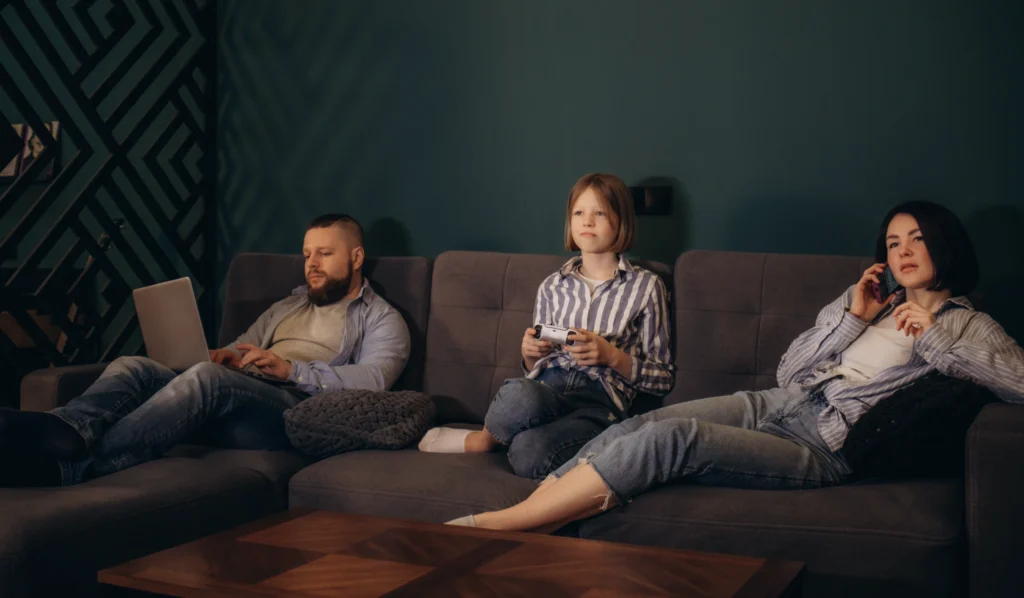
AARP research found that 59% of adults said communicating online made them feel lonelier, not closer. And nearly two in five Americans say they avoid relatives they disagree with during holidays.
When asked what they most blamed for loneliness, 73% of adults pointed to technology — and 66% said families not spending enough meaningful time together. We have the tools to stay in touch. What many of us are losing is the depth.
The engineers who built social media platforms have documented the methods they use to monetise them in detail. The Social Dilemma offers the clearest explanation of why they work as they do — and our discussion guide can help your family start addressing this together and adopt healthy usage habits.
How Modern Families Can Feel More Connected
When I read these statistics, I see my own family in many of them.
I’m a Brit who’s lived in Europe for more than twenty years. My parents are still in the UK and my sister’s family live out in Asia. Life is busy, the way it is for most families these days. The distance means we’re often trying to catch up with the latest news, and having deeper conversations to feel close are hard to come by.

For a long time, we did what most families do: WhatsApp messages, regular video calls, a stream of photos that gave us a sense of each other’s days without really telling us much about each other’s lives. It felt like we were ‘connected’, but it all felt a little superficial—like we were missing out on something better.
What we missed, and what the research points to, is the importance of sharing stories that go a little deeper. It’s great knowing what my sister, parents, or cousins are up to, but it’s their authentic thoughts and emotions about it that have the power to truly connect us.
And in addition to stories connecting our family in a more rewarding way, they also ensure that our thoughts and experiences are passed on to future generations.
That is what led my family to build Simirity — a private family journal designed to help families share stories across generations. Not a social media feed, not a group chat — something quieter and more intentional. A place where the stories that matter can be told, kept, and passed on.

Ready to bring your family closer through storytelling?
Or check out our demo app and imagine the stories your family could share.
This article is part of our family statistics collection — if you’d like to explore the broader picture, our roundup of statistics about family brings together the most interesting findings in one place.
FAQs About The Modern Family
How is the modern family different from 60 years ago?
The biggest change is structure. Only about 14% of US households now fit the traditional breadwinner-father, stay-at-home-mother model, and married couples have fallen from 71% of households in 1970 to 47% today, according to the US Census Bureau. Single-parent, blended and multigenerational families are now mainstream.
Are people starting families later than they used to?
Yes, markedly. The median age at first marriage has risen to 30.2 for men and 28.6 for women, up from around 21 to 23 in 1960. The average first-time mother is now 27.5, six years older than in 1970, and the US fertility rate has fallen to a record 1.6.
Do modern parents spend less time with their children?
The opposite is true. Today’s parents are the most hands-on in history. Mothers’ daily childcare time has roughly doubled since 1965, and fathers now spend about three times as long with their children as their own fathers did — even though most households now have both parents working.
If parents are doing more, why does modern parenting feel so hard?
If parents are doing more, why does modern parenting feel so hard?
Effort isn’t the problem; support is. 62% of US parents say parenting is harder than they expected, and 40% are deeply worried about their child’s mental health. The US is the only OECD country with no national paid parental leave, and screens add pressure on both sides.
Are modern families less connected than past generations?
Often, despite being in constant contact. University of Oxford research found families spend more time in the same room but increasingly “alone-together” on separate devices. The US Surgeon General has declared loneliness an epidemic, and most people blame technology and a lack of meaningful time together.

Feel together, even when you can’t be together with Simirity.
