


Statistics About Family Relationships: How Family Bonds Change Over a Lifetime

Statistics about family relationships rarely tell the whole story — but there is one chart that might be the exception.
This chart uses a decade of American time-use data to show who we spend our time with as we move through life: our children, our partners, our friends, and — increasingly — ourselves. The patterns are sometimes comforting, often surprising, and occasionally unsettling. What they all point to is the same truth: family relationships are not fixed. They change, grow, and ask different things of us at every stage.
If you’ve ever wondered how your family relationships will evolve over your lifetime, the statistics about family relationships in this article will help you explore what the future holds.
Jump to section:
The Relationships That Define Us
Family relationships are, for most people, the most important bonds they will ever have. Pew Research surveys consistently show that family is the primary source of meaning and support in most people’s lives — ahead of work, friendships, and community.
But the same data reveals something easy to miss: these relationships don’t stay the same.
They shift in depth, frequency, and character as we move through life.
The chart below, based on the Our World in Data American Time Use Survey from 2009 to 2019, shows this more clearly than almost any other data I’ve seen. Take a look before you keep reading.
In the sections that follow, I’ll explore the story behind each curve and bring in the wider research on family relationships.
Parent and Child Statistics: Peak Connection
If you’re in your thirties or forties with children at home, the chart has a clear message: this is your peak.
Time spent with children climbs quickly through your twenties and thirties, hits its highest point in the early forties, and then drops sharply, reaching almost zero by the time most people turn sixty.
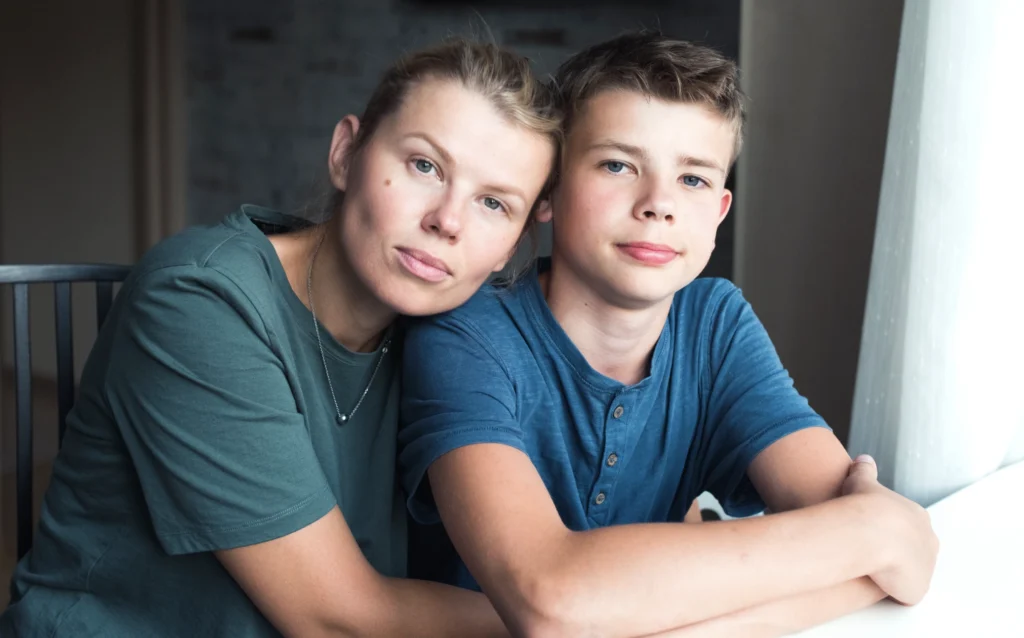
I find it hard to accept that I’m on a slippery slope to less and less time with my children. But it’s just the natural rhythm of family life. It was like that for my parents, it will be like that for me, and one day, perhaps for your children with their own kids too. It is worth sitting with that thought for a moment: this is the peak. Make the most of it.
A solid foundation for their future
Research from the Harvard Study of Adult Development, one of the longest studies on happiness, found that the quality of our close relationships is the single strongest predictor of well-being in later life.
Not wealth, not career success, not even physical health: relationships.
The parent-child bond sits at the heart of that finding. All those busy, unglamorous years of being present are quietly building the foundation your children will stand on for the rest of their lives.
When children become adults
The numbers also show what happens after children move out.
Pew Research finds that most adult children still keep in touch with their parents, but now it’s mostly through texts and short calls.
There’s a quiet irony in that: the moment life finally becomes a little more manageable, the conversations tend to get shorter.

Preserve their childhood memories in media-rich stories.
Siblings Statistics: The Longest Relationship
For most people, their relationship with a sibling is the longest one they’ll ever have.
It starts before most friendships and often lasts longer than relationships with parents, partners, or even the family home.
But if you look at the chart, time with extended family — including siblings — rarely goes above 40 to 50 minutes a day for most adults. And that number includes all extended family combined.
Research in the Journal of Marriage and Family shows that sibling closeness tends to dip during the busiest child-rearing years — when everyone is stretched thin and available to no one. Sometimes that closeness returns in later adulthood, but not always.
The siblings who stay genuinely close are usually the ones who kept making the effort during the busy years, not just when life was calm.
Estrangement is also more common than most people realise. Karl Pillemer’s research at Cornell found that around 27% of Americans are estranged from a family member, with sibling estrangement among the most frequently cited causes.
I have one sibling, a sister who lives a long way away in Asia. Maintaining that feeling of closeness is most definitely tricky, what with busy careers, children to look after and time zone challenges. I hope once we are past this busy hump in life, we will find the time to connect.

Grandparents and Grandchildren Statistics: The Underrated Bond
The extended family line on the chart is one of the quietest — but also one of the most consequential. Hidden within it is a relationship many families underinvest in without realising: the bond between grandparents and grandchildren.
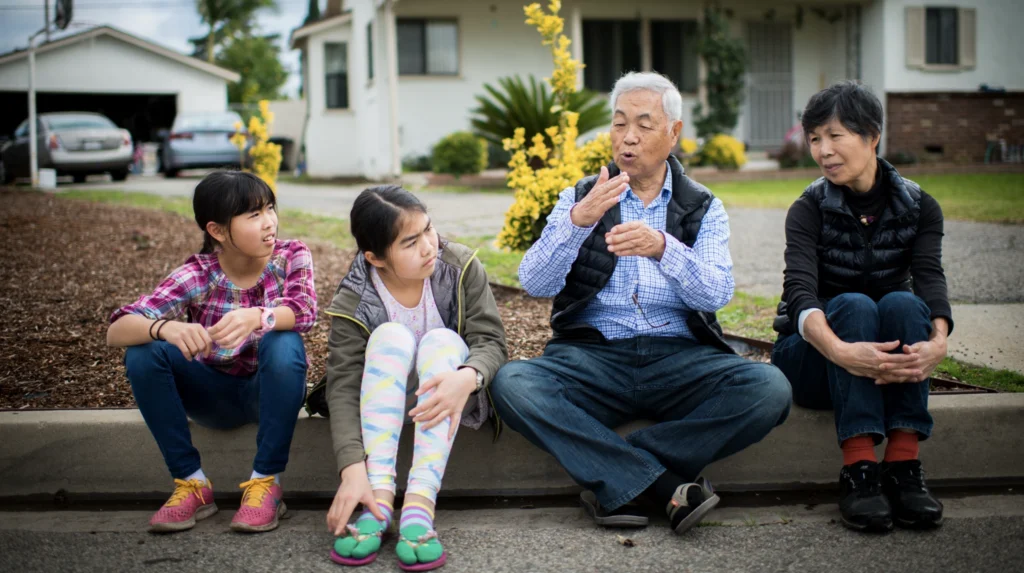
Research from Emory University by Marshall Duke and Robyn Fivush found something very interesting. They developed a simple set of questions — things like: do you know where your grandparents grew up? Do you know about a time they faced real hardship? This became the “Do You Know?” scale. And when they tested it, they found that children who could answer more of those questions scored significantly higher on measures of emotional resilience, self-esteem, and well-being.
The “Do You Know” scale turned out to be the single best predictor of children’s psychological health — more than any other factor they tested.
Intuitively, that makes sense. Kids who know their family’s stories have a stronger sense of who they are, where they belong, and that they’re part of something bigger. In most families, grandparents are the main storytellers.
The family chain analogy
When I talk with my kids about family members from the past, I like to use the idea of a family chain.
Each person is one link. My boys are the newest — but they didn’t appear from nowhere, and they won’t be the last. Behind them is a chain that stretches back through grandparents, great-grandparents, and people whose names we’re only now beginning to piece together. Understanding that changes something.
It’s the difference between a child who feels like they’re facing life on their own, and one who knows — in a deep, quiet way — that they are part of something much bigger than themselves. A family with a history, a future, and a thread of shared experience running through all of it.
Actively strengthen children’s link to their family’s past
Sadly, the data shows that grandchildren don’t see their grandparents as often as you might expect. Part of the reason is distance, but another reason is the belief that these relationships will just happen on their own. Usually, they don’t.
Going back to the family chain analogy — the chain only matters when each link means something to the child. That requires more than occasional visits. It requires children spending real time with grandparents: hearing their stories, asking about their lives, and learning about the people who came before them.

Keep your kids connected to their family & cultural roots.
Extended Family Statistics: An Underutilised Source of Strength
Beyond grandparents, there’s the wider family network — cousins, aunts, uncles, and others your kids might barely know.
Pew Research shows that even though most people say extended family is important, actual contact has dropped as families have spread out. About one in three Americans now lives more than 100 miles from where they grew up, according to the US Census Bureau. The wider family network is still there, but in many families, it’s almost invisible.
It’s harder to measure the impact, but researchers who study identity and community say extended family networks are a real source of strength. This is especially true for children, who benefit from knowing they’re part of a bigger story than just their immediate family.
My experience with extended family
My boys are lucky — they have over a dozen extended family members within a ten-minute drive. It was different for me growing up; I was lucky to see extended family once a year. Watching my children with their cousins, aunts, uncles and grandparents, I can see the positive influence those relationships have on them. They’ve become role models for my boys and it gives them the sense that there are more people in their corner than just their parents.
I’m so happy for them, and regret not knowing my own aunt, uncle and cousins like they do. Thinking about it now, perhaps it’s time for me to address that!


Feel together, even when you can’t be together with Simirity.
Statistics About Time Spent Alone
There’s one line on the chart that keeps rising. Starting around age forty, time spent alone goes up steadily, and by our eighties, it’s the main part of daily life — over 400 minutes a day.
Spending time alone isn’t always a bad thing. But when it comes to family, it makes you wonder: when the busy years are over and the house is quiet, what fills that space?
- In 2023, the US Surgeon General declared loneliness a public health crisis, warning that social isolation carries health risks equivalent to smoking 15 cigarettes a day
- Harvard research found that around half of American adults reported feeling lonely even before COVID-19.
- AARP found that 59% of adults said communicating online made them feel lonelier — not more connected.
None of this is inevitable. But it does suggest that closeness requires more deliberate effort than most of us are making.
Shifting Focus: You, Them, Us
Looking at the chart as a whole, I think it maps onto something most parents would recognise. Life for parents tends to move through three phases:
- You — in your childhood and young adult years, it’s all about you. Learning, discovering, figuring out who you are. Everything else feels like background noise.
- Them — the moment children arrive, the focus shifts completely. Now life is about helping them grow, keeping them safe, and giving them the best start you can. I had my time; now it’s theirs.
- Us — somewhere around sixty, when retirement arrives and children no longer need you in the same way, attention shifts back — this time to you and your partner together. The chart captures this beautifully, with the partner line recovering through the sixties and seventies.
There is something quietly satisfying about that shape. And something genuinely hopeful about what the later years can hold.
How Your Family Can Feel Closer
Family is at the core of my life. But just having a family isn’t enough — to fully experience what family can give you, you need to actually feel close to them. We are technically more connected than any previous generation — video calls, messaging apps, photo sharing — and yet genuine closeness doesn’t follow automatically.
To feel connected, you have to go beyond superficial updates and share authentic stories from your lives.
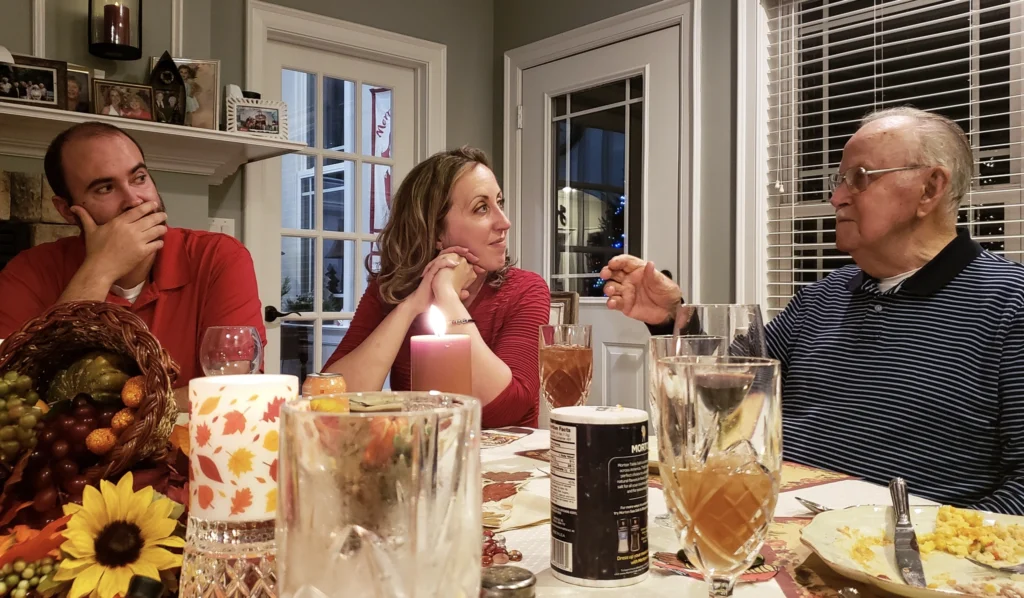
The research backs this up. Emory University found that simply meeting grandparents wasn’t enough to improve children’s well-being. It was knowing their stories — their history, their struggles, their lives — that made the difference.
My family’s journey to feeling closer
My family is spread across three continents, and for years we did what most families do: catch-up calls, photos, the occasional message. It kept us in touch. But it never quite made me feel properly close to the people I was talking to. I missed them — not because we weren’t communicating, but because we weren’t really sharing anything that prompted a deeper connection. It was about exchanging information, not feelings, thoughts and aspirations.
What we needed was something that would prompt us into deeper conversations — the kind that rarely come up in daily catch-ups. Not just what’s happening now, but exploring people’s pasts, their lessons in life, their views on things that matter. And something that could capture those stories properly, so our children — and generations after them — could feel genuinely connected to family members they’ll never have the chance to meet.
Not finding anything that did what we needed, we built Simirity — a private family journal designed to help families share and preserve the stories that matter most.

You can explore a demo account to see how your family might use Simirity.
Summary of Statistics About Family Relationships
Let’s revisit the chart that opened this article, as it shows something quietly urgent: every family relationship you have is changing right now, whether you notice it or not.
- Time with children peaks and then falls
- Siblings settle into distance or closeness depending on effort made during the busiest years
- Grandparent bonds — some of the most protective relationships a child can have — are easy to let drift and hard to rebuild
What the statistics about family relationships points to, is that the families who feel genuinely close are the ones who go beyond staying in touch. They share stories. They ask better questions. They make the invisible visible — the history, the struggles, the life lived before you knew each other.
That’s worth starting today.
This article is part of our family statistics collection — if you’d like to explore the broader picture, our roundup of statistics about family brings together the most interesting findings in one place.
FAQs About Family Relationships
What do statistics about family relationships reveal about how they change over life?
They’re never fixed. Time with children peaks in the early forties then falls to almost nothing by sixty. Time with a partner dips during the child-rearing years and recovers later, while time spent alone rises steadily from forty onward — passing 400 minutes a day by our eighties.
Why is the grandparent–grandchild relationship so important?
Why is the grandparent–grandchild relationship so important?
Because it shapes a child’s sense of identity. Emory University research found that children who know their grandparents’ stories score higher on resilience, self-esteem and wellbeing — the single strongest predictor they tested. Yet many families let this bond develop by chance rather than nurturing it deliberately.
Which family relationship lasts the longest?
For most people, it’s the sibling bond. It usually begins before our friendships and outlasts our relationships with parents and often partners. Yet research shows sibling closeness tends to dip during the busy child-rearing years — the siblings who stay close are those who keep making the effort.
When do parents spend the most time with their children?
Time with children climbs through your twenties and thirties and peaks in the early forties, before dropping sharply. If you’re in the thick of raising young children now, the data carries a simple message: this is the peak, so make the most of it.
What makes some families feel close across a lifetime?
Deliberate effort, not proximity. The families who stay close go beyond simply staying in touch — they share real stories, ask better questions, and keep investing in their relationships during the busiest years, rather than assuming closeness will look after itself.
Share
