


Childhood Development Triangle: Understanding Your Child

I first heard about the Childhood Development Triangle on a Diary of a CEO podcast, where Steven Bartlett interviewed Chase Hughes, a behavioural expert. Hughes used the triangle to explain adult behaviour, saying that the coping strategies we develop as children, like feeling safe, making friends, and earning recognition, don’t just disappear as we get older. Instead, they stay with us and influence how we act in relationships, at work, and in our families, often without us noticing.
My first reaction was to think about my own triangle. What patterns did I develop? Where did they start? Are they still affecting me today?
But then another, more important question came to mind: what does this mean for my children, while their own triangles are still forming? If these patterns can affect adults for years, what can I do as a parent to help my kids build healthier ones from the beginning? That’s the question I want to explore in this post.
Jump to section:
What Is the Childhood Development Triangle?
The term Childhood Development Triangle was introduced by Chase Hughes, a behaviour analyst and author, during his interview on The Diary of a CEO with Steven Bartlett. Hughes has written extensively on human behaviour and how our earliest experiences shape the way we operate as adults.
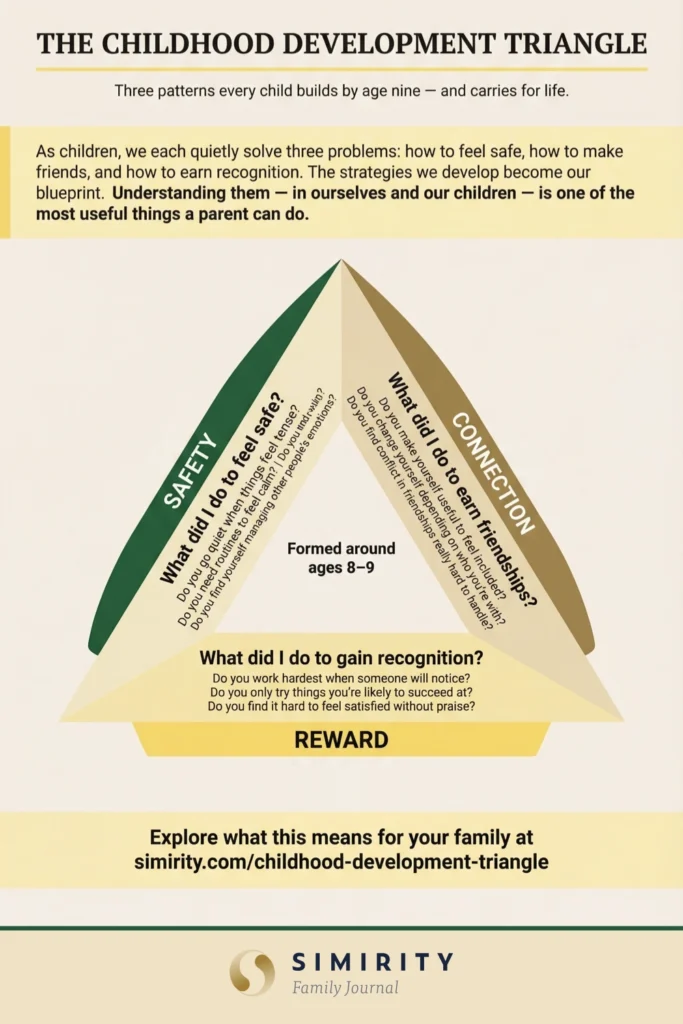
He explains that as children, we’re not only playing and learning — we’re also figuring out how to handle problems. The world can seem unpredictable, confusing, or even unsafe. So we come up with strategies, often quietly and without realising it. These strategies tend to fall into three main areas:
- Safety — What did I do to feel safe?
- Connection — What did I do to earn friendships?
- Reward — What did I do to gain recognition or reward?
Together, these three form what Hughes calls the Childhood Development Triangle.
The strategies children develop in each area aren’t random. They’re ways of adapting to their environment. These strategies worked, or at least seemed to work, when the child was growing up. The challenge is that these patterns often stick around into adulthood, even when the situation has changed.
The Science Behind the Three Dimensions
Hughes’s three-dimensional framework hasn’t been peer-reviewed. Still, what’s interesting is that the three dimensions he talks about are very similar to ideas found in well-known developmental psychology research. The science not only supports the triangle, but also helps explain why it makes sense.
Dimension 1 — Safety
Attachment theory, developed by John Bowlby and extended by Mary Ainsworth, proposes that children have a fundamental need for “felt security” — the sense that they are safe and that a trusted adult is available if needed.
It’s important to remember that feeling safe isn’t always the same as actually being safe. A child might live in a stable, loving home but still not feel secure if emotions are unpredictable, conflict happens often, or parents respond in different ways. When a child doesn’t feel safe, they come up with ways to cope. These coping methods make up the safety part of the triangle.
Dimension 2 — Connection
Developmental psychologist Robert Selman studied how children’s ideas about friendship change as they grow. Young children see friends as whoever is nearby, while older kids focus on group rules, and teenagers look for real emotional closeness. This research, shared in resources like Psychology Today, shows that children’s social needs are always changing and always influence how they act.
The strategies children use to meet those needs — to get in, stay in, and feel valued — are exactly what the connection dimension of the triangle describes.
Dimension 3 — Reward
The Harvard Center on the Developing Child has produced extensive research on children’s motivation and reward. Their work confirms that children’s brains are highly sensitive to feedback — praise, recognition, achievement — and that the patterns formed around reward in early life have lasting effects on motivation, self-esteem, and resilience.
Social media platforms are built to exploit this same reward system — it’s one of the central findings of The Social Dilemma documentary, which explains in detail how likes and notifications trigger the same brain chemistry as gambling.
In short, the Childhood Development Triangle brings together decades of research into a single, practical framework that parents can actually use.
Applying These Patterns to Children
This is where the Childhood Development Triangle really comes into its own. It’s one thing to understand these three areas in theory, but it’s another to spot them in your own child.
Here are some common ways each area can appear in children. These are just examples, not an exhaustive list.
Safety patterns
Below are six of the most common ways the safety dimension shows up in children. You may recognise more than one.
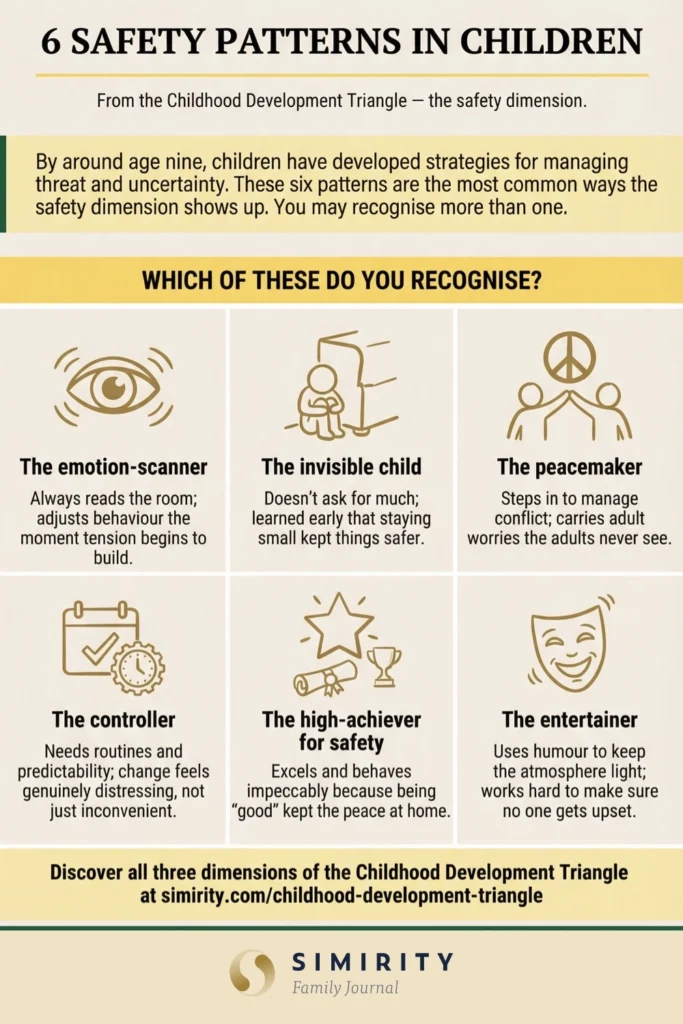
1. The emotion-scanner
This child is always paying attention to the mood in the room. They notice when a parent’s tone changes or when tension is building. They adjust their own behaviour in advance — getting quieter, being extra helpful, or going to their room. What seems like sensitivity is often their way of spotting problems early.
2. The invisible child
They don’t ask for much. They don’t take up space. They find it genuinely hard to make requests or draw attention to their own needs. They learned, somewhere along the way, that visibility could bring unwanted consequences.
3. The peacemaker
This child steps in to defuse family conflict, often taking on emotional responsibilities that belong to adults. They feel responsible for keeping things calm. The weight of that is rarely obvious to parents, because the child usually carries it quietly.
4. The controller
Routines are very important to this child. When plans change, it feels truly upsetting, not just inconvenient. They’re not trying to be difficult — they’re just handling unpredictability in the way that works for them.
5. The high-achiever for safety
This child does well at school, behaves very well, and wants everything to go smoothly. But it’s not about ambition — it’s about feeling that being “good” helps keep things calm and safe.
6. The entertainer
This child uses humour and energy to keep things light. They’re fun to be around, but underneath, they’re often trying hard to make sure no one gets upset.
Connection patterns
Here are six common ways the connection dimension appears. Children rarely show just one — most blend several of these together.
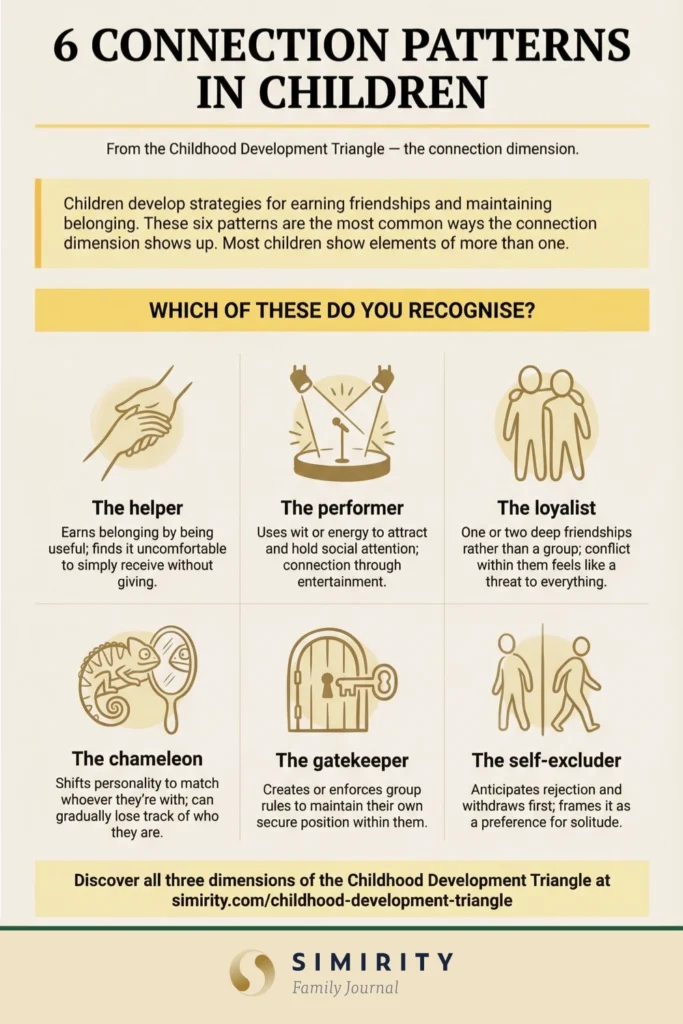
1. The helper
This child earns belonging by making themselves useful. They’re the ones who offer to clear up without being asked, who notice when a friend needs support, who always put others first. Receiving without giving feels uncomfortable to them.
2. The performer
This child uses wit, energy, or humour to get and keep others’ attention. They like having an audience — not because they’re shallow, but because entertaining others is how they connect.
3. The loyalist
One or two deep friendships, rather than a wide group. They invest everything in those relationships. Conflict within a close friendship is genuinely destabilising — it feels like a threat to their whole social world.
4. The chameleon
This child changes their personality, interests, and opinions to fit in with whoever they’re with. It’s not about being dishonest — it’s their way of belonging. The challenge is that they might lose sight of who they really are.
5. The gatekeeper
They create or enforce the rules of a friendship group — who’s in, who’s out, what the terms of inclusion are. It’s a strategy to ensure they always maintain a secure position within the social structure.
6. The self-excluder
This child expects to be left out, so they pull away first. They might say they just like being alone, and sometimes that’s true. But often, leaving before they can be excluded is a way to protect themselves when they’re not sure they belong.
Reward patterns
Finally, here are six common ways the reward dimension shows up.
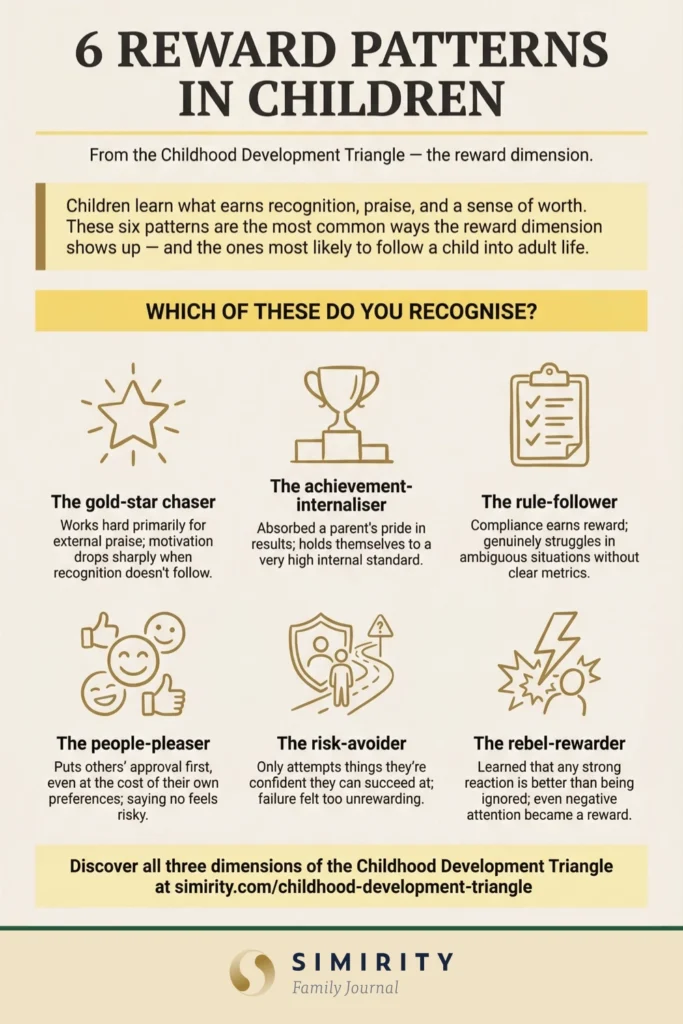
1. The gold-star chaser
This child works hard, but mostly because they want praise or recognition. If they don’t get it, their motivation can drop quickly. They’ve learned that effort brings approval, and that’s what they’re really seeking.
2. The achievement-internaliser
They’ve absorbed a parent’s visible pride in results and now carry that lens themselves. They don’t need you to cheer — they’ve built the cheering into their own internal voice. The standard they hold themselves to can be very high.
3. The rule-follower
Compliance earns reward in this child’s experience, so ambiguous situations are genuinely difficult. If there’s no clear measure of success, they’re not sure how to try. They do best when they know exactly what’s expected.
4. The people-pleaser
This child has learned that making others happy gets the best response. So they put others’ approval first, even if it means ignoring what they want. Saying no feels truly risky to them.
5. The risk-avoider
This child only tries things they’re fairly confident they can do well. When they tried something new and failed before, it didn’t feel good — or it felt even worse. So now, they stick to what they know they can succeed at.
6. The rebel-rewarder
In places where positive feedback was rare or only given sometimes, some children learned that getting any strong reaction was better than being ignored. Even a negative reaction became a kind of reward.
These Patterns Don’t Stay in Childhood
These strategies don’t just disappear as we grow up. They start in early childhood, become habits through repetition, and follow us into adulthood — affecting our relationships, our work, and our parenting.
- The emotion-scanning child becomes the adult who can never fully relax in a room full of people.
- The gold-star chaser becomes the professional who struggles to feel satisfied unless someone tells them they’ve done well.
- The self-excluder becomes the person who pulls back from friendships the moment they sense things might get complicated.
This doesn’t have to happen, but it’s very common. That’s one reason this framework connects so well with adults who are open to looking at their own patterns.
Research in attachment theory consistently shows that the strategies we develop in childhood to manage safety, connection, and reward become templates for adult relationships and behaviour. — University of Illinois PRISM Lab

A Moment to Look at Yourself
Before we move on to the practical part, talking with your children, it’s worth asking which of those patterns you recognise in yourself.
Are you the emotion-scanner in your own home? The one who still works hardest for external praise? The one who pulls back from relationships when they start to feel complicated?
It didn’t take long for me to spot my own patterns. These strategies got me here — but the real question is whether they’re still helping, or whether I’m just repeating them out of habit. I can see how some of mine have become an anchor I carry needlessly.
This kind of self-reflection won’t change your past, but it can change how you act today — and what you pass on to your children and beyond.
Exploring the Childhood Development Triangle With Your Children
This is where things get really interesting, and where the framework becomes more than just an idea — it starts to change how you talk with your family.
The printable conversation sheet below is a good place to start — especially with younger children.
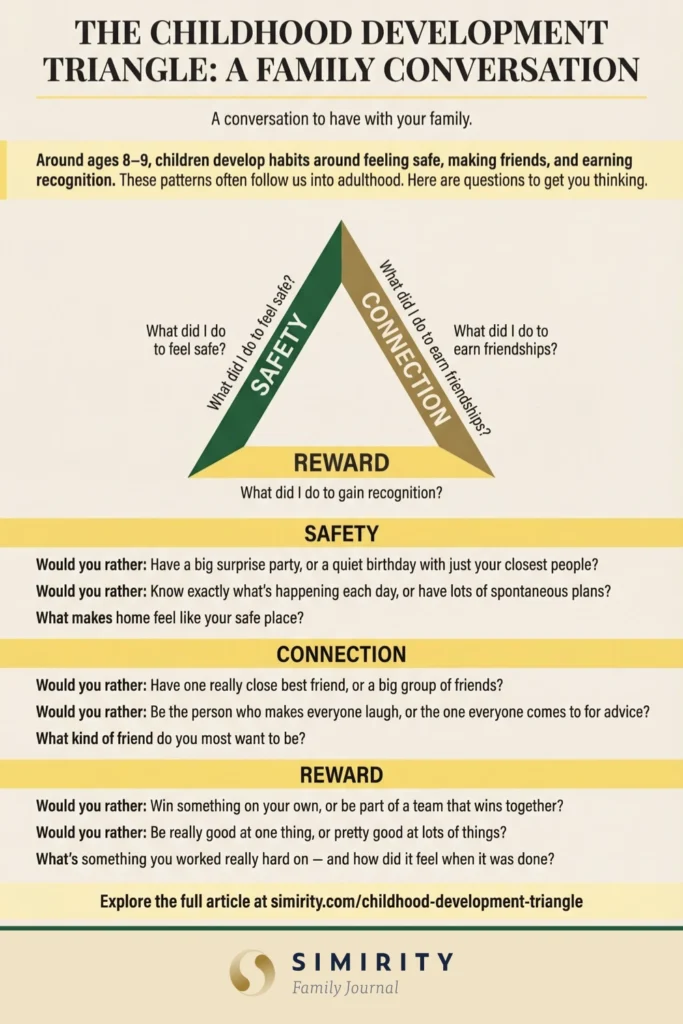
I recently tried this with my own teenage boys. I explained the triangle to them, the three dimensions and the main questions, and then honestly shared some of my own patterns. I talked about what I’ve noticed in myself and where I think those patterns started.
I wasn’t sure how they’d take it — but the silence quickly gave way to a lively conversation where they shared their own patterns and where they thought those came from.
I learned a lot about them. I’m curious to see how this framework weaves itself into our daily lives.
For younger children (around ages 7 to 12), direct questions about psychology don’t work as well. You need a softer way in. The printable conversation sheet above is made for this — it uses would-you-rather questions and simple scenarios to help children talk about their patterns without feeling like it’s a big deal.
Safety questions
- “Would you rather have a big surprise party or a quiet birthday with just your closest people?”
- “If something went wrong at school, who’s the first person you’d want to tell?”
- “What makes home feel like your safe place?”
Connection questions
- “Would you rather have one really close best friend, or a big group of friends?”
- “Would you rather be the person who makes everyone laugh, or the one everyone comes to for advice?”
- “What kind of friend do you most want to be?”
Reward questions
- “Would you rather win something on your own, or be part of a team that wins together?”
- “Would you rather be really good at one thing, or pretty good at a lot of things?”
- “What’s something you worked really hard on — and how did it feel when it was done?”
With teenagers, you don’t need games. You can just talk, as long as you’re willing to lead by example. Share your own pattern and be honest about where you think it came from. Then ask how they think the framework relates to them. You might be surprised how readily they engage.
The goal isn’t to label your child or try to change who they are. It’s to start a conversation that most families never have — one where your child can begin to understand their own actions and feel understood, not just managed.
What Can You Actually Do With The Childhood Development Triangle?
When I first learned about the Childhood Development Triangle, my biggest question was: what do I do next? Understanding a pattern doesn’t automatically change it. But here’s what I think awareness does give you.
- It changes how you see behaviour: A child who melts down when plans change isn’t being difficult; they’re struggling with unpredictability. That shift in perspective changes how you respond.
- It helps you create better conditions: You can’t change the past, but you can change what happens now. More emotional consistency builds real safety. Unconditional connection means your child doesn’t have to earn their place. Praising effort over results builds internal motivation.
- It gives your child language for their own behaviour: When a child can say “I do this because it felt safer,” that’s genuine self-awareness. That’s not a small thing.
- It prepares them for when old patterns stop working: What helped a child feel safe at home can become a problem in adult relationships or at work. A child who already understands their patterns will find it much easier to recognise when something needs to change.
The earlier your children understand their own patterns, the better placed they’ll be for everything that follows.

There’s no one idea that makes parenting easy. But some things are worth knowing, and the Childhood Development Triangle is one of them.
What I value most isn’t just understanding my children’s behaviour better. It’s being able to talk about it with them directly. We’ve had some great family conversations about these ideas.
My kids got involved right away, saw themselves in the patterns, and started asking their own questions about why they do certain things — and realised they don’t have to keep doing them if those patterns aren’t helping.
That kind of self-awareness at a young age is really valuable. I’m proud to give my children tools like the Development Triangle, as it helps them better understand themselves and their value system, and feel more in control of their choices. The sooner they have that, the better.

Your family’s past, present & future—woven together in Simirity.
