


Social Dilemma Documentary: A Family Discussion Guide

The Social Dilemma documentary is one of those rare Netflix movies that not only makes you think, but leaves you feeling like, as a parent, you have no choice but to act.
I had been frustrated with social media for years. When my wife and I started building Simirity, a platform for families to share stories privately, it was partly because we didn’t want our family memories spread across platforms that collect data and encourage endless scrolling for profit. So when The Social Dilemma documentary came along — a Netflix film made by insiders who actually built these platforms — we watched it together immediately and agreed: the kids need to see this! What struck us most was how clearly it explained everything, in a way that even younger teenagers could follow.
But we didn’t want to just watch it and move on. We wanted to use it as a starting point to hear what our kids actually thought, get them reflecting on their own habits, and have conversations we could return to as they grow up.
In this guide, we’ll briefly cover the main themes from the documentary and then provide 25 questions to help you have meaningful conversations with your children that promote healthy social media use.

Jump to section:
What The Social Dilemma Netflix Documentary Is About
If you haven’t seen it yet, The Social Dilemma is a Netflix documentary directed by Jeff Orlowski and released in 2020. What makes it unusual is who’s talking: former engineers, designers, and executives from Google, Facebook, Twitter, Instagram, and Pinterest — people who helped build these platforms and are now genuinely worried about what they created.
The documentary isn’t just a lecture about screen time. It clearly explains how these platforms work, why they’re so hard to stop using, and what the consequences are, especially for young people. If you’ve ever wondered why parenting in the digital age feels so challenging, this film gives you one very clear answer.
Our sons were 12 and 14 when we watched it with them. It held their attention completely. If your kids are already using social media, they’re ready to watch this too.
46% of teens say they’re online almost constantly.
— Pew Research Center, 2024
8 Things The Social Dilemma Documentary Explains (That Every Teen Should Understand)
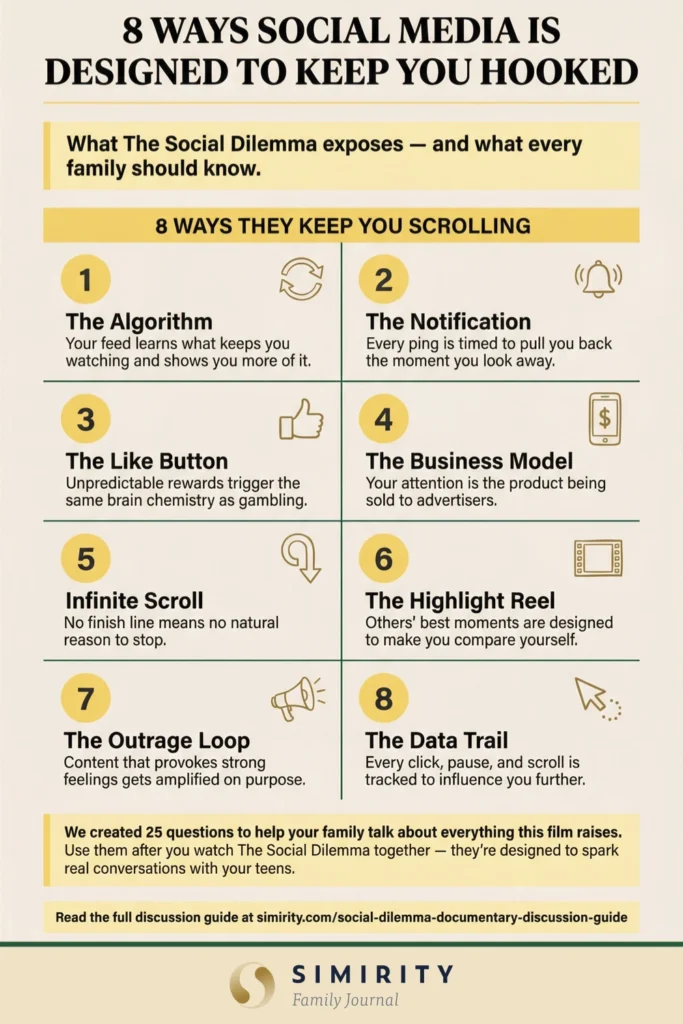
- Your feed is not random. Algorithms learn what keeps you scrolling and show you more of it.
- Notifications are timed to hook you. Every ping is designed to pull you back as soon as you look away.
- Likes work like a slot machine. The unpredictable rewards trigger the same brain chemistry as gambling.
- You are the product. Your attention and data are collected and sold to advertisers.
- Infinite scroll has no finish line. There is no natural stopping point because the platforms want you to keep going.
- Comparison drives engagement. Highlight reels of other people’s lives are designed to keep you coming back and comparing yourself.
- Outrage is amplified on purpose. Content that stirs up strong feelings gets more clicks, so the algorithm shows you more of it.
- Everything you do is tracked. Every click, pause, and scroll helps the algorithm learn how to influence you more effectively.
These eight points are the core of the film and are why it’s worth watching together as a family instead of alone. The facts about modern families and the connection gap show that this is not just a small issue — it’s changing how families interact every day.
25 Questions to Have After You Watch
The goal of these questions isn’t to test your kids or make the film feel like a classroom lesson.
It’s to hear what they really think and to help them reflect on their own habits in their own words.
Some questions will work better than others depending on your child, and that’s okay. Choose the ones that feel natural and let the conversation flow. If your teen usually shuts down during talks like this, consider reading our guide on making tough conversations with kids more engaging before you begin.
Section 1: Personal Recognition
Start here. These questions are the easiest to answer and help get the conversation started.

“46% of teens say they’re online almost constantly — and nearly half say they spend more time on social media than they intend to.”
— Pew Research Center, 2024
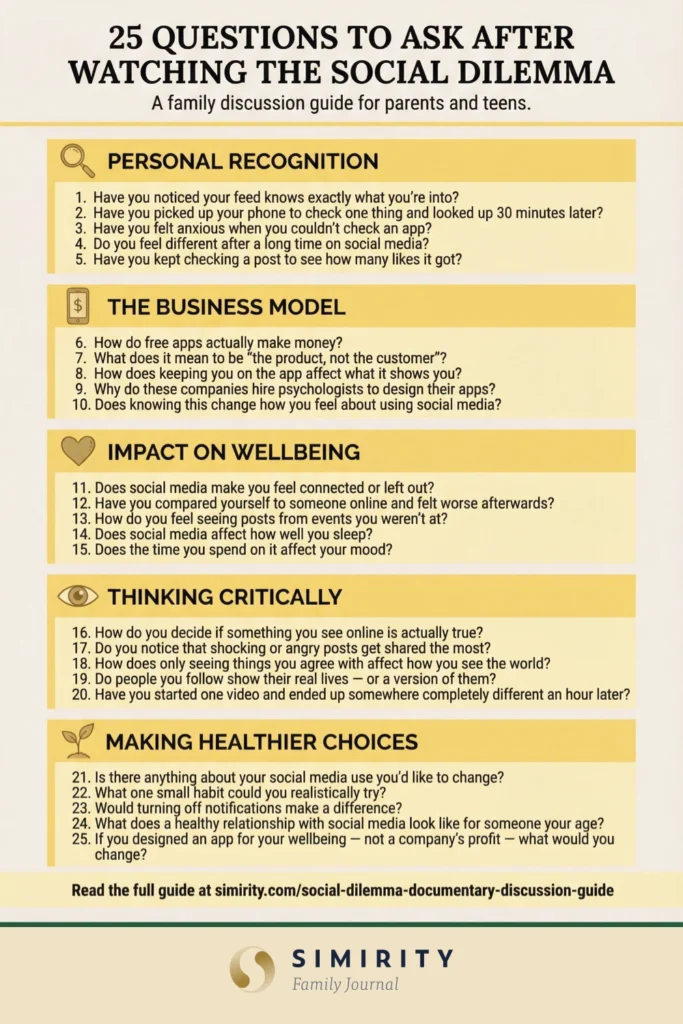
- Have you ever noticed that the videos or posts you see seem to know exactly what you’re into?
- Have you ever picked up your phone just to check one thing and then looked up 30 minutes later?
- Have you ever felt anxious when you couldn’t check an app for a while?
- Do you notice that you feel different after spending a long time on social media — maybe better, worse, or just a bit empty?
- Have you ever posted something and then kept checking to see how many likes or comments it got?
Section 2: Understanding the Business Model
This is the main idea that The Social Dilemma documentary explains.

“64% of people who joined extremist groups on Facebook did so because the algorithm steered them there.”
— The Social Dilemma
“If you’re not paying for the product, you are the product.”
— Tristan Harris, former Google Design Ethicist
- Most social media platforms are free to use — so how do you think they actually make their money?
- The film talks about users being “the product” rather than the customer. What do you think that means?
- If a company’s main goal is to keep you on their app as long as possible, how do you think that affects what they show you?
- Why do you think these companies hire psychologists to help design their apps?
- Does knowing that the app is deliberately designed to keep you scrolling change how you feel about using it?
Section 3: Impact on Wellbeing
These questions might lead to more honest answers than you expect.

Teens who spend more than 3 hours daily on social media have double the risk of anxiety and depression.
— U.S. Surgeon General Advisory, 2023
“Using social media activates the same parts of the brain as gambling, drugs and alcohol.”
— ReachMD research review, 2025
The share of teens who say social media makes them feel supported has dropped from 67% to 52% in just two years.
— Pew Research Center, 2025
- Do you think social media makes you feel more connected to your friends, or does it sometimes make you feel left out?
- Have you ever compared yourself to someone you follow online and felt worse about yourself afterwards?
- How do you feel when you see someone posting about a party or event you weren’t at?
- Do you think social media affects how well you sleep?
- Do you think the amount of time you spend on social media affects your mood?
Section 4: Thinking Critically About What You See
These questions help build habits that last long after this conversation.

“False news spreads 6 times faster than true news on social media.”
— MIT Media Lab
Upward social comparisons — measuring yourself against people who seem to be doing better — consistently result in lowered self-esteem and worsened mood.
— Nature Communications Psychology, 2023
- How do you decide whether something you see online is actually true?
- Have you noticed that the things that make you feel most angry or shocked online tend to get shared the most?
- If the algorithm mainly shows you things you already agree with, how does that affect how you see the world?
- Do you think the people you follow online show their real lives — or a version they want others to see?
- Have you ever started with one video and ended up somewhere completely different an hour later?
Section 5: Making Healthier Choices
Finish with action steps. Keep it realistic and focus on awareness, not just rules.
48% of teens now say social media has a mostly negative effect on people their age — up from just 32% in 2022.
— Pew Research Center, 2025
- After watching the film, is there anything about the way you use social media you’d like to change?
- What would feel realistic? Not a total ban, but maybe one small habit you could try changing?
- Do you think turning off notifications for certain apps would make a difference? Would you try it?
- What do you think a genuinely healthy relationship with social media looks like for someone your age?
- If you could design a social media app with your wellbeing in mind — rather than a company’s profit — what would you change?
Here’s a quick recap of all the questions, with a link to download a printable PDF:
If you want more conversation starters beyond the film, our collection of questions that strengthen family relationships is a good next step.
Making These Conversations Stick
One thing we learned is that the conversation after the film is even more important than the film itself.
Our kids already knew a lot of what the documentary talked about. They had heard about algorithms and knew they were being tracked. What they didn’t have was the language for it — a shared way to talk about these ideas. The film gave us that.
They didn’t change their behaviour overnight. The change was more subtle: they started noticing things and talking about them. They would point out when YouTube suggested something that seemed too perfect, or recognise when a notification was pulling their attention even though they didn’t need to check it.
That was our real goal: not control, but awareness. The questions above are meant to help build that awareness.
A few practical suggestions:
- Watch together, not separately. The conversation can start during the film, not just after. Pause it and react to it as a family.
- Don’t treat this as a one-time conversation. Return to the questions over time. As your kids grow, their answers will change.
- Go first. One of the best ways to open up the conversation is to answer some of these questions yourself. It changes the dynamic completely.
- There’s no right answer. These questions aren’t a test. If your child pushes back or disagrees, that’s actually a good sign — it means they’re thinking.
If The Social Dilemma documentary has made you want to explore apps that are actually designed around family connection rather than engagement metrics, our guide to the best family bonding apps is a good place to start.
Our Family’s Outcome
The goal was never to make our kids avoid social media. It was to help them understand what they’re dealing with so they can make better choices than they might have otherwise.
These questions helped us do that. I hope they do the same for your family.
If you’ve watched The Social Dilemma documentary and started wondering if there’s a better way to stay connected with family than using mainstream social platforms, that’s the question that inspired us to build the Simirity family journal.

FAQ About The Social Dilemma Documentary
What age is The Social Dilemma suitable for?
There isn’t a strict rule; it depends on your child’s maturity. Our son was 12 when we watched it together and had no trouble understanding it. If your kids are already using social media apps, they’re old enough to understand what the film is about.
What are the main messages of The Social Dilemma?
The film argues that social media platforms are deliberately designed to keep you on them as long as possible. They use algorithms, notifications, and psychological tricks that take advantage of how our brains work. It’s not an accident — it’s the business model.
How do I start a conversation with my teen about social media?
Watch the film together first. Then use the questions in this guide to start the conversation. The key is to ask, not lecture. You might be surprised by how much your kids already know.
Is The Social Dilemma still relevant in 2025?
More than ever. The platforms have changed, but the main idea — capturing your attention and selling it to advertisers — has stayed the same. If anything, the tools have become even more advanced.
What’s the best way to watch The Social Dilemma with kids?
Watch it together, not separately. Pause it when something lands and react to it in the moment. The conversation during the film is just as valuable as the one afterwards.
What should we do after watching it as a family?
Use the 25 questions in this guide. Don’t try to cover all of them at once — pick the ones that feel natural. Return to them over time. Our conversation starters are also a good way to keep the dialogue going.

Your family’s past, present & future—woven together in Simirity.
