


Traditional Family Values: 6 Timeless Principles

“Traditional family values” — a phrase that somehow manages to mean everything and nothing at the same time. It makes me cringe a little when I hear it. It’s been politicised, turned into a dividing line, and used in culture wars. But beneath all the noise, there’s a lot we can learn from traditional family values.
“Traditional” just means something that’s handed down. Every family, in every culture and generation, passes things along. The real question isn’t if you have traditional values, but which ones you’ve chosen and whether you’re passing them on purposefully.
In this article, we present six traditional family values that recur across cultures, faiths, and family types. It’s not about being conservative or liberal, old-fashioned or modern. They matter because they offer something valuable to families like yours.

Jump to section:
What “Traditional” Actually Means
Before we dive into the principles, it’s worth taking a moment to look at the word “traditional” because it carries a lot of meaning. “Traditional” comes from the Latin “traditio”, meaning “to hand over” or “to pass on.” That’s it. No political charge, just the idea of deliberately giving something to the next generation.
When you look at it this way, every family is traditional. Every family passes something down, whether they realise it or not. The real question is what those things are.
The principles families pass down through cultures and centuries aren’t random. They exist because they meet real human needs: belonging, trust, knowing your roots, and feeling that your life matters.
Research shows that children with strong family identity, clear values, and connections across generations are more resilient, have better mental health, and a steadier sense of self.
What’s striking is that these principles appear everywhere:
- In Asian cultures, respect for elders is key
- In Irish families, storytelling brings people together
- Many African American families focus on community service and shared responsibility
- In immigrant families worldwide, sacrifice is the story that ties everything together
The expressions differ, but the underlying need is the same: something worth passing on. That’s what traditional family values really are. They’re not a political platform or a set of strict rules. They’re a conscious choice about what your family stands for.
6 Timeless Traditional Family Values
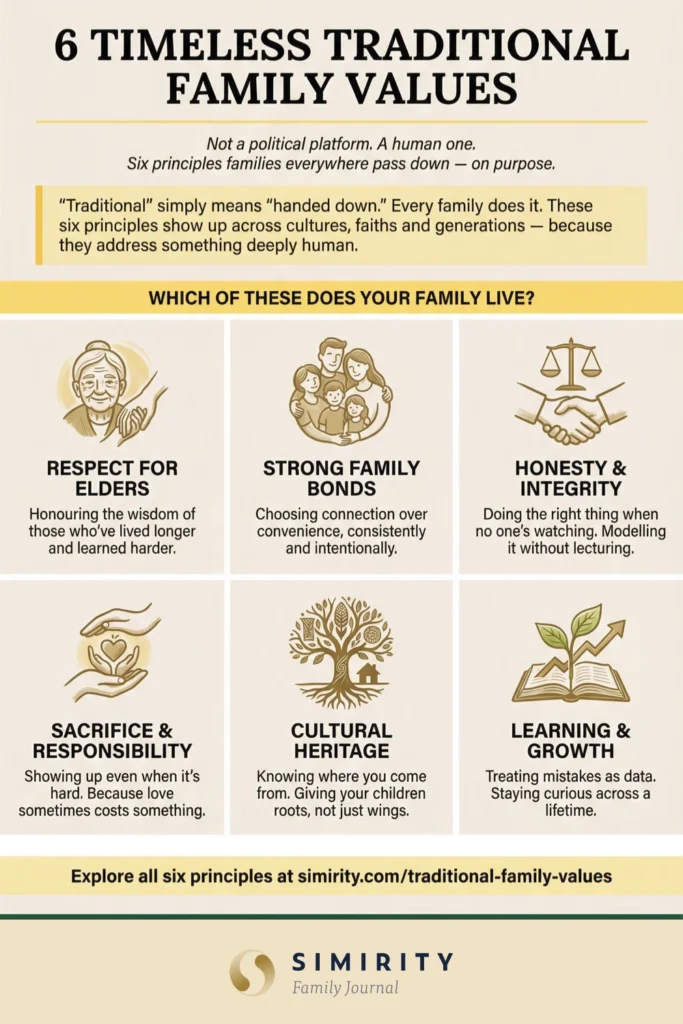
Family Value 1: Respect for Elders and Ancestors
At its core, respecting elders isn’t about always doing what they say. It’s not blind obedience, and it’s not pretending older generations were always right.
It’s about recognising that people who have lived longer have survived things and had a wealth of experiences that you haven’t. They hold knowledge you can’t find in books or online.
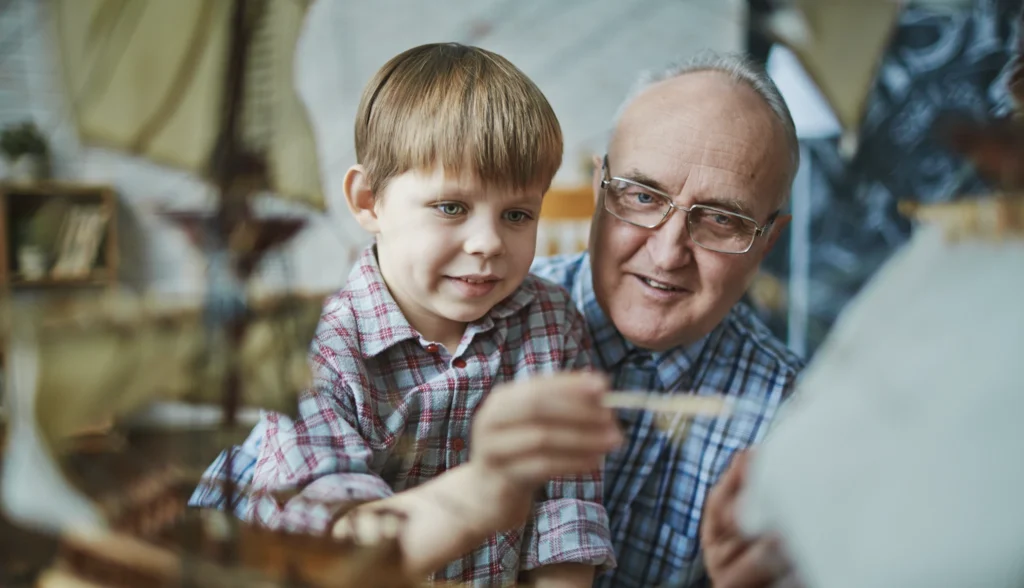
Your family’s elders have experienced things you can’t imagine. Respecting that doesn’t mean copying them; it means learning from them. I think of it as a shortcut to a better life.
It appears more in small moments than in big gestures. Asking a grandparent for advice. Letting them teach you something — cooking a dish, handling a tough situation. Calling just to check in, not because you need anything, but because the relationship matters. It also shows in how you speak about your elders in front of your children. Kids notice everything.
In our family, we ensure our children see old photos of family members living elsewhere and ancestors dating back centuries. We weave their stories into our daily lives. Quite often, our kids refer back to these people in seemingly unrelated conversations, showing how present these people and their stories are in our children’s minds.
And respecting elders is a habit you’ll be glad gets passed on. Your kids need to see you genuinely respect your own parents, as one day, they’ll decide how to treat you based on what they’ve seen.
Family Value 2: Strong Family Bonds Over Individual Pursuits
This principle is often misunderstood. It doesn’t mean self-sacrifice or putting family above your own safety, mental health, or personal goals.
It means that when you make decisions, you consider your family — not just as an afterthought. The group’s well-being matters as much as your own.
Neuroscience shows us that humans are wired for belonging — research from UCLA found that social connection is as fundamental to us as food and shelter.. Secure family attachment is one of the strongest predictors of wellbeing across the lifespan. Families that maintain strong bonds tend to have lower rates of depression, anxiety, and loneliness in all their members, children and adults alike.
It appears in the routines you build and protect:
- Sunday dinners together
- Regular calls
- Showing up when someone needs you
It also shows in what you choose not to do:
- Scrolling through your phone at family meals
- Working every weekend
- Letting months go by without real contact
Coming from a family living in different time zones, I’m acutely aware of the challenge to feel bonded to them despite living separately. The desire to go beyond sharing photos and weekly catch-up calls, and talk about deeper and more meaningful topics, is partly why we created the Simirity family journal. By sharing stories in a more complete and authentic way, we feel closer than ever.
Everyone is busy and stressed. In a world that pulls family members in different directions, families who choose to stay connected are doing something rare and even countercultural. Kids raised with this principle have a sense of belonging that’s becoming harder to find. That’s not old-fashioned — it’s a real advantage in an increasingly lonely world.

Feel together, even when you can’t be together with Simirity.
Family Value 3: Honesty and Integrity
Integrity in a family context means your private and public selves are the same. You do the right thing even when no one is watching. You keep promises, admit mistakes, and don’t take shortcuts just because you can.

Families with strong integrity still mess up, they just don’t hide it. They don’t shame each other for mistakes, but they do take them seriously. And crucially, the adults model this for the children, because research is clear that integrity is learned through watching, not through lectures.
You can tell your kids to be honest a thousand times. What they’ll actually remember is what they saw you do when honesty was inconvenient.
It appears in small moments that stick in children’s memories. Returning the extra money you were given by mistake. Telling your kids when you made a mistake. Keeping a promise even when a better option comes up.
I’m the first to admit a mistake in my family, and as a result, our boys don’t seem to feel awkward admitting theirs. It’s a seemingly little thing, but I don’t doubt it will benefit them greatly over the course of a lifetime.
Family Value 4: Sacrifice and Responsibility
Sacrifice feels like an old-fashioned concept. Self-care and saying “yes” to every opportunity is almost a religious belief these days. But sacrifice is not a bad thing. It’s a deliberate choice — to do something that’s hard, to show up when you don’t want to, to accept responsibility even when it limits you.
Sacrifice isn’t about being a martyr. It’s about accepting responsibility for things that matter, even when it would be simpler to ignore it. It appears in the everyday, unglamorous things. Working at a job you don’t love because it helps your family. Being there at 3am when your child is sick.
I’ve been lucky to have a dad who made sacrifice look easy. From big things like the 4-hour work commute because it was best for his family, to little things like giving us the creamy “top of the milk” with our breakfast cereal. Children raised with a sense of responsibility and a readiness to make sacrifices for the greater good will cope better with the challenges that life throws at them.
Family Value 5: Cultural Heritage and Identity
Your family has roots. It has a history, a story, and traditions shaped by geography, religion, migration, survival, and everything your ancestors went through to get you here. Honouring that isn’t about being stuck in the past, it’s about knowing who you are.
Children who know their family story, their cultural roots, and their heritage have a stronger sense of identity. Research from Emory University found that children who knew more about their family history showed higher levels of emotional wellbeing and stronger identity — and proved more resilient when faced with adversity. Kids who know where they come from are less adrift, less susceptible to the search for identity that can lead young people into some very dark places.
It appears in the choices you make to keep your family’s story alive:
- Speaking the language of your ancestors
- Cooking traditional foods together
- Sharing stories about where your family came from and what they went through
For families living in different countries or continents, it can take real effort to preserve cultural heritage and identity. It happens because someone, often a parent, decides it’s important enough to make it happen.
My family’s a real mix of cultures and lifestyles, and it really feels like a super-strength that connects us. We have an interesting blend of British, Hungarian and Thai cultures — showing up in the words we use, shared beliefs, the food we eat and of course, the holiday destinations!
Family Value 6: Learning, Growth, and Wisdom
Families that value learning aren’t always the ones where everyone goes to top universities. They’re families where curiosity is encouraged, mistakes are seen as learning opportunities, and changing your mind when you learn something new is a strength.
Growth mindset, the idea that intelligence and character develop through effort, isn’t just an education theory. It’s a family culture. Research shows that children raised in families that value learning and growth are more resilient in school, adapt better, and have stronger mental health.
It appears in how your family deals with failure. Do you ask “what did we learn?” or “who’s to blame?” It also shows whether adults admit when they don’t know something and then go find out.
It took me a while, coming from a typically British ‘keep calm and carry on’ background, to see failure as something worth celebrating rather than quietly moving past. I’m glad I now see growth opportunities in setbacks, and I’m pleased to be able to celebrate failures with my kids, helping them grow from moments of disappointment. The world is changing faster than ever — families who raise curious, growth-minded children give them a practical gift: the ability to keep learning and reinventing themselves.
How These Traditional Family Values Work Together
These values are not just a list, they work as a system:
- Respect for elders gives you access to wisdom you can’t find anywhere else.
- Family bonds create a safe space for honesty.
- Sacrifice shows your children what real love looks like in action.
- Heritage gives them roots and a sense of identity.
- Growth makes sure everything evolves, so you’re not just keeping the past for its own sake, but choosing what’s worth holding onto.
Think of a family you know that seems to have life completely figured out:
- They probably gather often, that’s family bonds
- Grandparents are involved, that’s respect for elders
- They have their own food, language, and stories: that’s cultural heritage
- When something goes wrong, they talk about it rather than hide it: that’s honesty and integrity
- And they are endlessly curious and keep learning regardless of age, enjoying the challenge and the feeling of progress

The point isn’t that you need all six principles or that they must be equally strong. It’s that these principles support each other.
And, of course, there are hundreds of additional family values that supplement these traditional values.
Which of These Traditional Family Values Resonates With Your Family?
These six values are not a checklist. You don’t need to rate yourself or feel bad if one of them isn’t strong right now. This is an invitation to reflect. Most families already live out some version of these principles — they just haven’t named them.
A few questions worth sitting with:
- Which of these family values do you already live — even imperfectly?
- Which ones do you wish were stronger in your family?
- Which ones feel less relevant to you — and why?
- What traditions from your own upbringing are you choosing to keep?
- What new values matter to your family that aren’t on this list?
You get to define what ‘traditional’ means for your family. Not because some authority said so, but because you get to select the ones you want to pass on.
Preserving What Matters
Once you know what your family values, the next challenge is keeping those values alive, not just now, but for future generations too.
This is where most families struggle, not because they don’t care, but because life moves quickly and urgent things often push out what matters most. Stories go untold, wisdom isn’t recorded, and the principles that shaped your family stay in people’s minds instead of being passed down in a way future generations can access.
The families who get this right aren’t necessarily the ones with the most time or resources. They’re the ones who’ve made a deliberate decision to capture their family story — not perfectly, not all at once, but consistently. These moments are how values are truly passed on, not through lectures or rules, but through stories.
If you’re wondering how to start, our guide to preserving family stories is a practical place to begin. And if you want questions to spark those conversations, our collection of questions to ask your mom is a good next step.
My family built the Simirity family journal as a private place for family storytelling. Stories from ancestors sit alongside your own childhood stories, and those of your children. It’s home to precious memories and characters, with stories brought to life with photos, videos, voice recordings and more.

If you would like to see it in action, view our demo family account.
Frequently Asked Questions
What are traditional family values, exactly?
Traditional family values are the principles and beliefs that families deliberately pass down from one generation to the next — such as respect for elders, honesty, strong family bonds, and cultural heritage. The term has been politicised, but at its core, it simply describes the values a family consciously chooses to preserve and transmit.
Are traditional family values the same across all cultures?
The specific practices differ enormously, but the underlying principles are remarkably consistent. Respect for elders, strong family bonds, honesty, and the importance of knowing where you come from show up across Asian, African, European, Middle Eastern, Indigenous, and immigrant family traditions. The expression varies; the human need it addresses doesn’t.
Do traditional family values conflict with modern life?
Not necessarily. The six principles outlined in this post are entirely compatible with modern family structures, including single-parent families, blended families, same-sex parent families, and geographically dispersed families. The question isn’t whether your family fits a traditional mould — it’s which values you’re choosing to pass on.
How do I teach family values to my children without it feeling forced or preachy?
The research is clear: values are caught, not taught. Children learn from watching what you do, not from listening to what you say. The most effective approach is to model the values you want to pass on — and to tell stories about them. Real stories, with real texture, about what those values have meant in your family’s actual life.
What if my family doesn’t have strong cultural traditions to pass on?
Every family has something worth passing on — even if it’s not tied to a specific cultural heritage. Your family’s values, the lessons you’ve learned, the way you handle hardship or celebrate success — these are traditions in the making. You don’t inherit them; you create them.
How do I start preserving my family’s values and stories?
Start small. Ask your parents or grandparents a question you’ve never asked before. Write down something your child said that captured what your family stands for. Have a deliberate conversation about what matters most to you. The act of capturing these things — in whatever form works for your family — is itself an act of tradition-making.

Your family’s past, present & future—woven together in Simirity.
