


10 Good Family Values for Raising Modern Children

Parenting has always been tough, but today’s parents face a different set of challenges.
In the past, parents didn’t have to think about smartphones at dinner, explain deepfakes, or watch their teens’ mood shift with every social media like. These are new challenges our parents didn’t have.
That’s why this list isn’t just more advice to “be kind” or “work hard.” These ten good family values were chosen because they address the real challenges that kids and parents are up against today.
You don’t have to leverage all ten values. Treat them as a starting point to help you decide what matters most to your family.

Jump to section:
10 Good Family Values for the Modern Age
1. Presence
Being present is a real strength, especially now when so many things compete for our attention.
The American Academy of Paediatrics says kids now spend 5 to 7 hours a day on screens, and parents check their phones more than 96 times daily. Each time you look at your phone, it sends your child the message that the device matters more. Kids need more than food and shelter — they need your attention. Even a few moments of real focus show them they matter.
Picture your child talking to you from the back seat while you’re distracted by your phone. If you notice, put your phone down and ask them to start again. That small change is what being present looks like. It doesn’t have to be perfect; just being aware is enough.
2. Emotional Literacy
Kids can’t deal with feelings they don’t have words for.
The CDC and NIMH report that 32% of teens feel depressed and 42% feel anxious. A big reason is that many kids don’t know how to describe their feelings. When emotions aren’t named, they don’t disappear — they show up as anger, pulling away, or risky choices.
If a child can say, “I feel embarrassed, not just bad,” they’re already learning to handle that feeling. Start early and keep it simple by saying your own feelings out loud. For example, say, “I’m feeling frustrated right now.” If you do this often, your child will pick it up too.

3. Resilience
Letting your child solve their own problems is a real gift.
Research from the American Psychological Association found that overparenting leads to more anxiety and depression in young adults. If kids never face failure, setbacks can feel much harder than they should. You can read more about what this looks like in practice in our post on snowplow parenting.
Resilience isn’t just about being tough — it’s knowing you can handle hard things. Let your child forget their PE kit and don’t fix it for them. Let them feel disappointed by a bad grade and decide what to do next. When you stay calm while they work through problems, you teach them something important.
4. Critical Thinking
With so much information everywhere, good judgment matters more than just knowing facts.
Research consistently shows that misinformation is one of the most common things young people encounter online, and most of them struggle to identify it. Deepfakes now look real, and AI can create convincing text in seconds. In this world, asking “how do I know this is true?” is more important than memorising facts.
You don’t need formal media literacy lessons for this. It’s about building a habit. When something surprising comes up online, try asking out loud: “Who made this? What are they trying to say? Is there another side?” If you ask these questions often at home, they’ll become second nature.
5. Authenticity
Kids are exhausted from performing to meet the expectations of their peers. Authenticity is the antidote.
Pew Research found that 65% of teenagers feel pressure to look perfect online. That’s a lot of energy spent on an image. Over time, the gap between who they are and who they pretend to be stops feeling like normal teenage stuff — it starts to feel like shame.
Families that talk openly about failure, embarrassment, and the ordinary stuff give their kids something social media never will — permission to be imperfect. Share your own “this went badly” stories. Laugh at yourself. Your kids need to hear, more than once, that they don’t have to be impressive to be loved.

6. Empathy
Empathy means treating people like people — not just profiles.
Online, it’s easy to only talk to people who agree with you and ignore others. The Greater Good Science Center at Berkeley found that empathy helps young people understand different points of view. Without empathy, polarisation isn’t just political — it shapes how your kids treat classmates, coworkers, and even future family.
You don’t have to weigh in on every difficult topic to teach this. Just ask, “Why do you think they see it that way?” — after a disagreement, a news story, or a falling-out with a friend. That one question, asked often enough, goes a long way.
7. Curiosity
Curiosity is a skill that will always matter, no matter how the job market changes.
The World Economic Forum’s Future of Jobs Report says curiosity will be the most important skill for workers after 2030. That makes sense. AI can do tasks, but it can’t replace the urge to explore, ask questions, and create. Curious kids adapt, while those who only follow rules may struggle when things change.
Curiosity can fade fast, but it’s easy to keep alive. The biggest risk is answering too quickly. Next time a child asks something you could look up, try saying, “I don’t know. What do you think?” first. Wondering together matters more than the answer.
8. Healthy Boundaries
Sometimes, saying ‘no’ is the best way to show you care.
Group chats don’t stop. Notifications don’t stop. And kids are watching to see how the adults around them handle it. The APA found that setting boundaries leads to better mental health and more genuine relationships — but kids won’t learn that from a lesson. They’ll learn it from watching you.

If they never hear you say, “I’m not taking my phone to dinner,” or see you turn down plans when you’re stretched thin, they’ll assume saying yes to everything is just what you do. Protecting your time isn’t selfish. It’s one of the more useful things they’ll see you model.
9. Gratitude
Gratitude is one of the easiest ways to calm an anxious mind.
Research by Robert Emmons at the Greater Good Science Center found that regular gratitude leads to 25% higher life satisfaction and 30% less anxiety. These numbers matter. In a world of instant delivery and endless scrolling, noticing and appreciating what you have really stands out.
You don’t need a gratitude journal, though it can help. It can be as simple as asking at dinner, “What’s one thing that went well today?” Noticing small moments out loud makes a difference over time.
10. Connection
Real belonging matters more than having thousands of followers.
Pew Research says 56% of teens often feel lonely, even though they’re the most digitally connected generation ever. Following influencers can fill time, but it doesn’t meet the deeper need to be truly known and accepted. Real-world connections are linked to 40% higher life satisfaction.
If you want to learn more about how families pass down values, stories, and a sense of belonging, our post on family values examples is worth bookmarking.

Good Family Values: Bringing Them All Together
You don’t need a perfect family, a large enough income, or a big lifestyle change to use these ten values. They aren’t the only good family values — they’re just a direction to move toward. For a more complete list, visit 100+ family values examples.
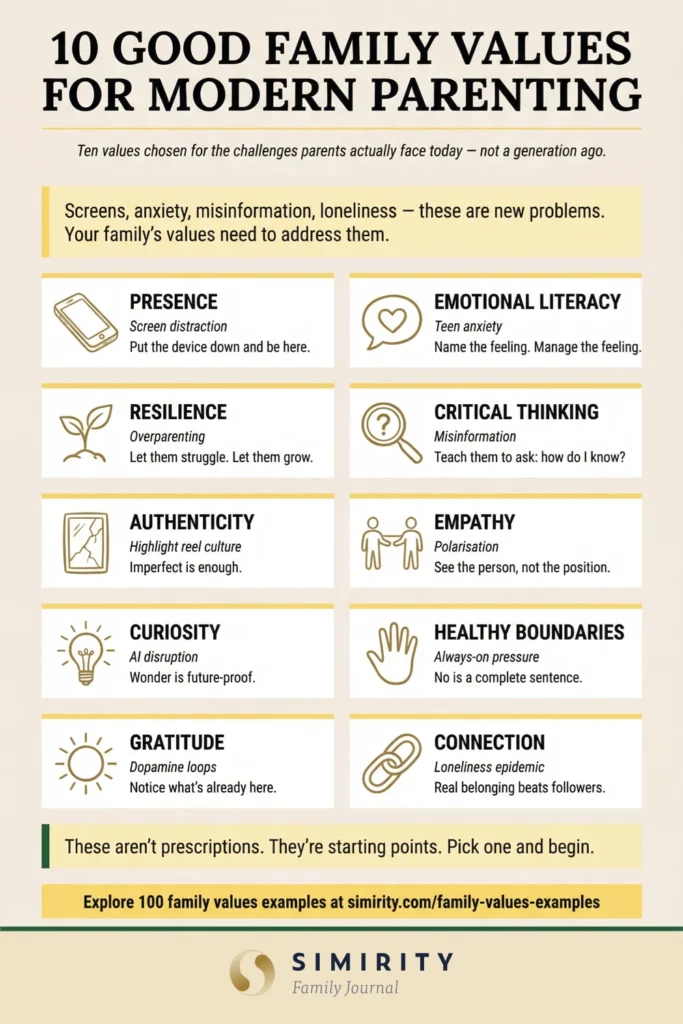
What these values have in common is that they push back against things in modern life that can quietly harm your child’s well-being. Screens, anxiety, misinformation, performance culture, and loneliness aren’t problems you solve once — they’re part of daily life. Good family values help your kids deal with these challenges effectively, not succumb to them.
Start with one or two values that feel important for your family right now. Talk about them as real conversations, not lectures. Values don’t stick just because you say them — they take hold through repetition, example, and the stories you share about why they matter.
How Storytelling Supports Good Family Values
One of the most effective ways to embed any of these values isn’t to talk about them — it’s to build small practices that quietly reinforce them over time.
One of the most powerful, and one we’re genuinely passionate about, is families getting better at sharing stories with each other.
Family storytelling isn’t a new idea. But most families do it far less intentionally than they could. And when you look at these ten values against what storytelling actually does, the overlap is striking:
- Emotional literacy — When children hear the full stories of parents, grandparents, and extended family, including the hard and vulnerable parts, they gain a vocabulary for emotions they might not yet have words for. Those stories open conversations that polished, surface-level updates never would.
- Resilience — Family history is full of difficulty. A grandparent who struggled after redundancy. A parent who failed an exam and found a different path. Stories like these do something a pep talk can’t: they show children that hard things are survivable, because people they love have survived them.
- Critical thinking — Honest family stories include failure, misjudgment, and decisions that went wrong. When families talk openly about these things and ask, “What would you have done?” children learn that it’s not only acceptable to question and reflect, but also what thoughtful people do.
- Authenticity — Private family storytelling is the opposite of social media performance. Nobody is curating for an audience. Families can talk about embarrassment, failure, and ordinary moments without any pressure to look impressive. That honesty is exactly the environment where authenticity takes root.
- Empathy — Listening to someone else’s story, really listening, and then asking questions about how they felt and why they made the choices they did, is one of the most direct routes to genuine empathy. Extended family stories give children a wealth of different lives and perspectives to explore.
- Curiosity — Wondering about a grandparent’s life, or a great-grandparent’s experience of a world event, is a completely natural form of curiosity. Stories from previous generations open questions children would never think to ask, and answers they won’t find anywhere else.
- Gratitude — Capturing moments from children’s own lives in a journal they can look back on, is one of the most effective gratitude practices available. Revisiting a happy ordinary Tuesday from two years ago, documented in detail, produces a sense of richness that no highlight reel can match.
- Connection — When children have access to authentic, private stories from across their extended family, they feel genuinely part of something larger than their immediate household. That belonging, knowing real people and their real lives, is what builds the kind of connection that lasts.
This is partly why we built the Simirity family journal. We wanted a private, purposeful space for our own family to share stories across generations — not a social network, not a photo dump, but something designed specifically for the kind of storytelling that actually matters.

You can see it in action in our demo account — no sign-up needed.
FAQs About Good Family Values
What are good family values to teach children?
Good family values are the principles that guide how your family treats each other and interacts with the world. For today’s kids, the most important values help them handle things like screen time, social media pressure, building resilience, and making real connections. The ten values in this article — presence, emotional literacy, resilience, critical thinking, authenticity, empathy, curiosity, healthy boundaries, gratitude, and connection — were chosen because each one addresses a modern challenge.
How do you actually teach good family values?
Most of the time, kids learn values through consistency and example, not just by being told. Values aren’t learned in one talk — they’re picked up through hundreds of small moments: how you react when things go wrong, what you celebrate, and what you say when you think no one is listening. The practical examples in each section of this article give you real starting points, not just abstract advice. Beyond that, the single most useful habit we’ve come across is family storytelling — it reinforces emotional literacy, resilience, empathy, curiosity and more without feeling like a lesson.
Are these values contradictory? Can you have healthy boundaries and connection at the same time?
These values work together rather than clash. Clear boundaries actually make real connection possible. When kids know they can say no, they can say yes more honestly too. The same is true for resilience and emotional literacy: naming emotions clearly helps kids work through tough feelings instead of being overwhelmed.
How do I know which values to prioritise?
Notice what your child is struggling with right now. If they’re anxious or facing peer pressure, start with presence and healthy boundaries. If misinformation is a problem at school, focus on critical thinking first. These are just starting points for your family’s conversation, not rules from someone else.
Are these values just for young children?
Not at all. Some values — like curiosity, critical thinking, and authenticity — become even more important as kids become teens and face social media, career choices, and complex relationships. The examples may change by age, but the core values matter from childhood through adulthood.

Your family’s past, present & future—woven together in Simirity.
