


Defining Family Values: A Simple 3-Step Process That Actually Works

Here’s an uncomfortable question: if someone asked your kids what your family stands for, what would they say?
Defining family values isn’t about putting inspiring words on the fridge. It’s about taking an honest look at your beliefs and aspirations. What do you truly care about? What guides your decisions? What do you hope your children take with them when they grow up?
This guide walks you through a simple process to help you define your family values.

Jump to section:
The Values Conversation
Most families don’t talk much about their values. It’s not that they don’t have any; it’s just that values often seem obvious, like something everyone already knows.
The problem is that when values feel obvious, they stay vague. Vague values can’t help you make decisions, solve conflicts, or show your kids what your family really stands for.
There’s often an odd silence about values. You might assume your partner shares them, or that your kids are learning them. But when did you last talk about it together?
You can’t wish or buy into a set of values—they come from what you actually do, the choices you make, what you protect, and the moments you show up. So it’s not about creating your family values from scratch, rather it’s about recognising and naming what’s already there.
What Are Family Values?
Before you start defining family values, it helps to be clear about what a value really is, since it’s easy to mix it up with something else.
Here’s a quick breakdown:
- A goal is “We want to spend more time together.” A value is togetherness.
- A rule is “No screens at the dinner table.” A value is presence.
- A virtue is a universal ideal, like kindness. A value is what your family means by kindness — and how you live it.
Values are the principles behind your decisions and they tend to fall into a few natural groups — a distinction supported by developmental psychology research:
- Relationship values — loyalty, forgiveness, connection
- Character values — integrity, courage, resilience
- Achievement values — learning, contribution, excellence
- Meaning values — faith, legacy, creativity, service
- Lifestyle values — adventure, stability, health, simplicity
- Heritage values — traditions, roots, language, story
You don’t need just one value. You need a mix—the unique combination that makes your family who they are.
True values show up in your choices, not just your intentions. If you say family comes first but often miss dinner for work, that tells you something about how you prioritise different values.
Defining Family Values: The 3-Step Process
The process has three steps: Reflect, Share, and Refine. Each builds on the last.
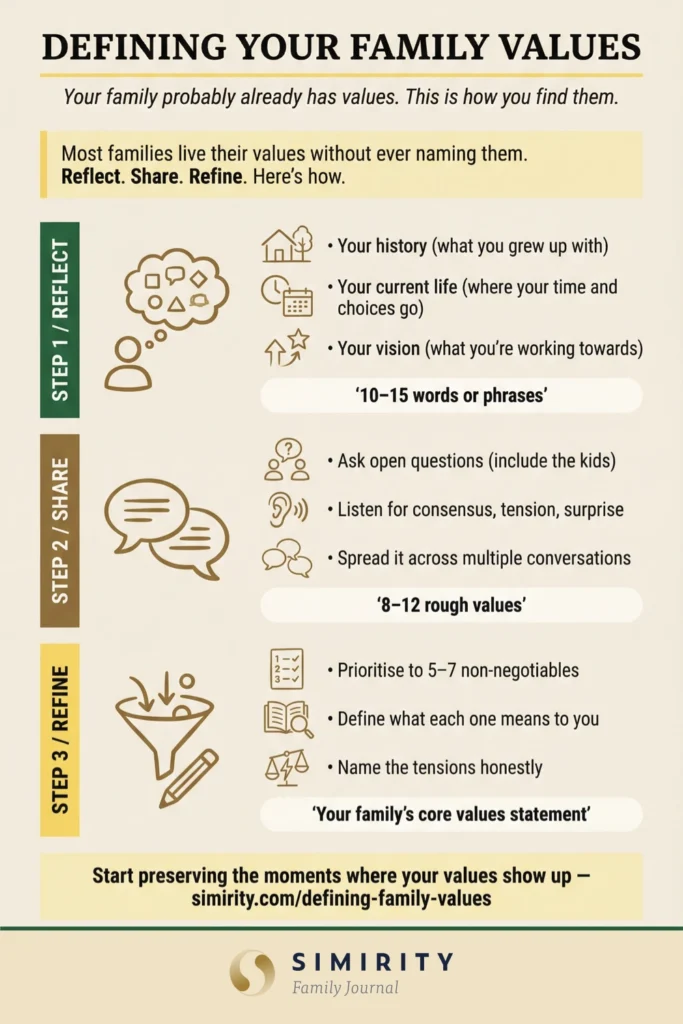
Step 1: Reflect (on your own)
Before you gather everyone, everyone should take some quiet time to reflect individually. This matters because if you skip it, the loudest voice in your family may drown out the opinions of others.
Look back at your history
- What did your childhood family value, whether they said it out loud or not?
- Which values did you keep? Which did you consciously walk away from?
- Are there values your parents modelled silently that you find yourself living now?
Look at your current life
- Where do you actually spend your time and energy?
- When you face a hard decision, what principles guide you?
- What makes you genuinely proud of your family?
- What frustrates you when it goes wrong? (Frustration often points to a violated value.)
Look ahead to the future
- If your family were fully living according to what matters most, what would that look like?
- What would be different? What would stay the same?
- What would your kids understand about themselves and your family?
Write down 10 to 15 words or phrases without overthinking it. Your first thoughts are better than overanalysing at this stage.
When I did this, I found it very satisfying. It felt as if I was discovering some previously hidden formulae that had been silently guiding my decisions through life.
Step 2: Share
Now everyone brings their notes into the room.
Each person shares what came up for them — the words, phrases, and values they wrote down. This is where you can really learn something about each other. You start to see what everyone noticed, what overlaps, and where your instincts differ.
If needed, here are some questions that can help people open up:
- What do you think our family cares about most?
- If someone asked what the [your surname] family stands for, what would you say?
- What’s something you’re proud of about our family?
- Are there things we say we value but don’t actually live? Be honest.
- What matters to you? Is that the same as what matters to me?
It can be really valuable to include the kids in this process. Our children certainly had some interesting perspectives to share—it was a fun discussion, with some serious takeaways.
During your discussion, listen for:
- Consensus — things that come up again and again from everyone
- Tension — one person says adventure, another says safety (both are real)
- Surprise — something you didn’t know mattered to someone you live with
- Authenticity — values that feel lived-in, not borrowed
You’re aiming for a rough list of 8–12 things. Some will overlap. Some will conflict. That’s all useful.

Step 3: Refine
This is where you move from a list to something tangible you can apply to daily life.
Prioritise ruthlessly
Take your list of 8 to 12 words. If you could only keep five, which would you choose? If you have too many core values, you risk diluting the meaning behind them all.
Define what the values actually mean
For each value, write one or two sentences. It might seem unnecessary, but once you do it, you’ll see that “honesty” can mean something different to each person.
A few examples:
- Honesty: being truthful, but also being willing to be vulnerable. It’s not just facts — it’s feelings
- Adventure: saying yes to new things and staying open. Calculated risk, not recklessness
- Family first: when it actually matters, we prioritise being together. But we also value independence
Identify when personal values differ from family values
You might find that some of your personal values are in conflict with family values, like togetherness versus independence or adventure versus stability. It’s good to recognise this tension between values with an honest conversation. Name the tension and talk about how you’ll handle it.
The result? A short list of 5–7 core family values, each with a working definition, and an honest note about where they might be in conflict with someone’s personal values.
From Definition to Applying Them
Naming the values is a great first step, but now comes the harder part: using them.
A few things that help:
- Make them visible by writing them down and putting them somewhere you’ll see them. Not as a poster, but as a reminder.
- Refer to them when making real decisions. Ask, “Does this fit with what we’ve said matters?”
- Notice when someone lives them — saying it out loud reinforces it more than anything else.
- Be honest when you fall short. Families who live their values aren’t perfect; they’re just willing to notice when they get off track.
- Revisit your values regularly, since they can change. Check in once a year and update the definitions as your family grows.
Applying family values to daily life is an ongoing process.
Referring back to your values should become a habit, and one that family members of all ages can use when making decisions together. Research in family psychology shows that families who regularly reference their shared values demonstrate stronger decision-making capacity and improved family cohesion.
As a parent, I’ve been influenced by my kids more than once when they reminded me of our values, and how my original decision was in conflict. I think it’s great how values can be used to start healthy discussions like this.
6 Common Mistakes When Defining Family Values
A few things to be aware of so you can get the most out of your family values:
1. Choosing values you think you should have, not ones you actually live: Your choices reveal more about you than your intentions ever will. If a value isn’t showing up in how you actually live, it’s an aspiration — and that’s okay. Just be honest with yourself about the difference.
2. Having too many: If you have 15 core values, you really have none. Narrow your list down to 5 to 7. You can’t live out all of them at once.
3. Treating it as a one-time exercise: Values evolve. Your family in five years may emphasise different things. Revisit annually and update the definitions.
4. Skipping the tensions: Pretending adventure and stability don’t conflict doesn’t make them stop conflicting. Name it and decide how you’ll handle it.
5. Not involving everyone: Children see more than we give them credit for. They notice what we do, not just what we say. When a child answers “what does our family stand for?”, their answer is often the most unfiltered, honest one in the room.
6. Defining them and then forgetting them: Written values that you never use are just words on a page — and your family deserves more than that. The real work is bringing them into the room when it actually matters. When you’re deciding whether to take that job. When a teenager pushes back on a rule and wants to know why it exists. When something goes wrong and you’re trying to figure out how to respond together. That’s when your values either mean something or they don’t. Refer back to them. Say them out loud. Let them be part of the conversation, not just something framed on the wall.
From Definition to Preservation
Once you’ve done the work of defining family values, something else becomes possible: you start noticing when they show up.
When your daughter stands up for someone at school, that’s courage. When nobody wants to skip the Sunday family walk, that’s togetherness. When you choose a more difficult path because it feels more honest, that’s integrity.
These moments are worth capturing—not as proof that you chose the right values, but as real stories that show what your family stands for. Stories pass values between generations, not wall prints or formal statements, but through moments people remember.
My route to preserving family stories
A few years ago, both of my parents fell seriously ill at the same time.
For the first time, I understood something pretty scary: so many of our family stories, about their lives, our ancestors and even my own childhood, were saved only in their minds. If they were gone, so were the stories. As the next link in the family chain, I felt a huge responsibility to try to preserve these stories.
I started looking for somewhere to put them — somewhere private, organised, combining text with media, actually built with family needs in mind. But the best we could find was a shared document in the cloud, which wasn’t an exciting prospect. So we built an app designed specifically for family storytelling.
Simirity family journal is the result. If you want to see what it looks like in practice, explore our demo app.

Overview of Defining Family Values
Your family’s values aren’t waiting to be invented. They’re already embedded in how you spend a Saturday, what you apologise for, what you refuse to compromise on, and what you quietly hope your kids carry with them when they leave home.
This process is really just about paying attention to that, and finding the words for it together.
If you’re looking for inspiration or want to check whether you’ve missed anything, check out our comprehensive list of family values examples. Sometimes seeing a value named helps you recognise it’s already there, or sparks the realisation that it’s one you’d like to build.
Frequently Asked Questions About Defining Family Values
How many family values should we have?
Most families do best with 5 to 7 core values. Fewer than that and you might miss something important; more than that and they stop being useful. If you’re having trouble narrowing the list, ask yourself: if you could only keep five, which would you choose?
What if my partner and I disagree on values?
It’s important to notice differences in values rather than avoid them. Often, the best conversations happen when you realise you mean different things by the same value. Start by defining what each of you means, instead of assuming you’re talking about the same thing.
At what age should you involve children in defining family values?
Earlier than you’d think. Children as young as 5 or 6 can answer “what matters to our family?” in ways that are surprisingly honest. Research in child development shows their perspective often reveals values that adults have stopped noticing because they’ve become invisible habits.
Do family values need to be written down?
Writing your values down, even briefly, makes a real difference. Vague values stay vague. A written definition gives you something to look back on, especially during decisions or conflicts. It doesn’t have to be formal; a page in a notebook is enough.
How often should we revisit our family values?
Checking your values once a year is a good habit. You don’t need to overhaul them, just see if your definitions still fit. Families change as kids grow up and life shifts, so values that felt central before may need to be updated.
What if our family already has values from religion or culture?
This process isn’t about replacing those foundations. It’s about being clear about what they mean to you and how you want to live them day to day.
What’s the difference between family values and family rules?
Rules guide behaviour, like “no phones at the table.” Values explain why the rule exists, such as “because we value presence and connection.” Rules may change as kids grow, but values usually stay the same. Defining the value behind the rule makes it last longer.

Your family’s past, present & future—woven together in Simirity.
