


Family Morals and Beliefs in Action: 6 Real Parenting Moments

Here’s an uncomfortable question: if someone asked your kids what your family stands for, what would they say?
Listing family morals and beliefs like honesty, kindness, and responsibility is simple. The real challenge comes when life gets messy, like when your child pushes back or your teenager makes a choice that tests everything you believe.
This post looks at how family morals and beliefs play out during tough times, not just when things go smoothly. Here are six real scenarios that show how parents can deal with a real clash between their beliefs and what’s happening right then.

Jump to section:
How Family Morals and Beliefs Show Up in Real Life
Most parents aren’t short on good intentions. What’s harder to find is a clear way of thinking when two things you believe equally are pulling against each other.
Before we dive into the scenarios, keep in mind that morals are different from rules.
- Rules tell you what to do
- Morals and beliefs help you figure things out when the answer isn’t obvious.
Sometimes two values pull in opposite directions, like honesty and kindness. The goal isn’t to pick one and drop the other. It’s to make a considered choice and be able to explain it.
Each scenario below names the values involved, the tension between them, and how you might respond.
Six Scenarios Where Family Morals and Beliefs Get Tested
Scenario 1: When your child lies about homework
Your child says they’ve done their homework, but their teacher says otherwise.
The instinct is to punish. But the real issue is whether your child feels safe enough to be honest with you next time.
Instead of asking “why did you lie?”, try asking “what made the truth feel harder?” If they were afraid of your reaction, that’s worth knowing. Accountability matters, but so does making honesty feel safe.
This shows your child that mistakes can be fixed, but broken trust is much harder to repair.
Scenario 2: When your teenager faces peer pressure
Your teenager wants to go to a party where alcohol will be available. Everyone else is going.

Here, independence and protection are at odds. If you just say no without explaining, you’re only enforcing a rule. But if you share your reasoning honestly, not as a lecture, you’re doing something more valuable. You’re showing how to balance competing values.
The conversation matters as much as the decision. Teenagers can tell when their independence is genuine and when it’s conditional.
This shows your teen that adults also stick to their principles, even when there’s social pressure.
Scenario 3: When your teenager stops wanting family time
Your teenager used to enjoy Sunday dinners. Now they eat fast and disappear.
Forcing everyone to spend time together can cause resentment. But letting your teen pull away completely doesn’t show that family connection matters, either.
Ask them away from the table what would actually work for them. Maybe it’s cooking together, going for a walk, or watching something. Connection doesn’t have to look the same as it used to. It just has to be real.
What you show here is that family bonds are worth caring for, and that you’re willing to adapt to keep them strong.
Scenario 4: When your child refuses to take responsibility
Your child fails a test. They firmly believe that it’s the teacher’s fault, their classmate’s fault or your fault for not reminding them. Anyone’s fault but their own.

Accountability is the main value here, but how you teach it matters too. Shaming doesn’t help, and ignoring every outside factor your child mentions doesn’t work either.
Go through what happened together. Asking “What was your part in this?” works better than “stop making excuses.” When they figure it out themselves, it sticks.
This shows your child that failure is just information, not a label for who they are.
Scenario 5: When your child witnesses bullying and says nothing
Your child watched a classmate get bullied. They didn’t say anything. They didn’t want to get involved.
Start with empathy. Ask how they felt, not just what they did wrong. Fear is real, and talking about it honestly leads somewhere better than guilt.
Ask what feels possible for them. Speaking up in the moment isn’t the only option. Reaching out afterwards matters too.
This shows your child that doing the right thing doesn’t mean you’re never afraid. It means you act even when you are.
Scenario 6: When your child wants to skip a family tradition
The family gathering is coming up. Your child wants to skip it and spend the time with friends instead.
Forcing attendance without explanation makes the tradition feel like a punishment. But letting them skip without a conversation misses something too.
Tell your child honestly what the occasion means to you. Then look for a compromise. Maybe they come for part of it, or you frame it as a choice rather than a requirement.
This shows your child that it’s important to explain the reasons behind traditions, not just enforce them.
What to Do With Conflicting Family Morals and Beliefs
Parents who handle these moments well do the following:
- Pause to recognise the conflict in values
- Name the values involved
- Spot the tension in your values that causing the conflict
- Involve their child in the process with an open and honest discussion
- Model their behaviour to be consistent with family values
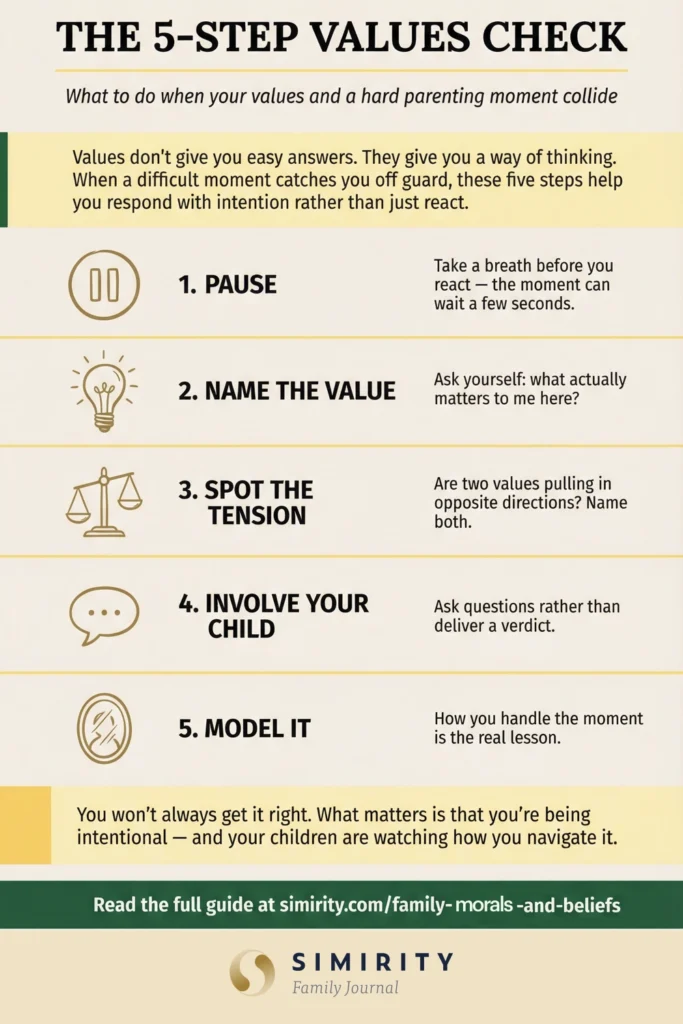
The real moral lesson isn’t in the decision itself, but in how you make that decision as a family.
How Stories Pass on Family Morals and Beliefs

- Conversations are where family morals and beliefs get explored
- Stories are where they get remembered
There’s a difference between telling your child honesty matters and telling them about a time you weren’t honest, and what it cost you. Stories make values stick.
Think beyond your own stories
You’re not the only source of moral education in your child’s life. Grandparents, aunts and uncles, older siblings all carry stories that bring your family’s values to life in ways your own experience can’t.
Simirity is a private family journal where families capture and share real stories across every generation. The happy ones, the ordinary ones, and the ones that show your family’s morals and beliefs in action. It’s a family business, built in the hope that many other families like ours can create the ultimate family resource that tells the story of who you are, where you came from, and what you stand for.

View our demo app so you can see family storytelling in action.
Summary of Family Morals and Beliefs
Family morals and beliefs don’t get passed down in a single conversation. They accumulate through hundreds of small moments, difficult decisions, and honest exchanges over the years.
Three things worth remembering:
- Your morals and beliefs matter most when they’re inconvenient: that’s when your children are watching most closely
- When two values pull against each other, naming the tension out loud is more valuable than ignoring it or pretending there’s an easy answer
- The stories your family share across all generations are what make morals and beliefs real and memorable
Of course, morals and beliefs don’t exist in isolation; they’re shaped by the broader values your family holds.
If you’re wondering which values are already guiding your family’s moral framework, or which ones you’d like to strengthen, our guide to family values examples covers 100+ values organised by category. It’s a practical starting point for seeing what’s already there.
FAQs about Family Morals and Beliefs
What are family morals and beliefs?
They’re the values and principles that guide how your family makes decisions, treats each other, and interacts with the world. Honesty, loyalty, courage, and kindness are common examples, but every family has its own mix.
How do you teach children about family morals?
Mostly through real-life moments, not formal lessons. When your child faces a tough choice, helping them see which values are involved, and why, teaches more than any rule.
What if family morals and beliefs clash?
That’s totally normal. Point out the conflict instead of ignoring it. Decide which value matters most in that moment, and explain your thinking. That process is the real lesson.
How do you keep family morals alive as your kids grow up?
Honest, ongoing conversations work better than just enforcing rules. Teenagers especially need to know why your family values matter, not just what they are.
Why do family morals and beliefs matter in parenting?
They guide you when decisions get tough. Without them, it’s easy to react out of habit or emotion. A clear set of values helps you respond thoughtfully and shows your children how to do the same.
How are family morals different from family rules?
Rules guide behaviour, like ‘no phones at the table.’ Values explain why the rule exists, such as ‘because we value presence and connection.’ Rules may change as kids grow, but values usually stay the same. Defining the value behind the rule makes it last longer.

Your family’s past, present & future—woven together in Simirity.
