


Family Size Statistics: The Incredible Shrinking Family

Family size statistics tell a story most parents feel but rarely see in numbers — we’re having smaller families than we’d like, and the data shows exactly why.
In the US and UK, the average number of children per family has almost halved over the past sixty years. The fertility rate fell to a record low of 1.6 in 2024. Yet when Gallup asks Americans about their ideal family size, the answer is 2.7, which is nearly one more child than most families have. The difference between the families people hope for and the ones they have is not random. Modern challenges like housing costs, delayed careers, and difficult timing are quietly making it harder for people to have the families they want.
We collected the most relevant family size statistics from trusted sources and shaped it into a story that families will recognise from their own lives, rather than just listing facts.

Jump to section:
The Big Family Era We Left Behind
Not long ago, having a large family was the norm, not the exception.
At its height in the late 1950s, the Baby Boom saw American families average 3.6 children — the highest on record. Even as late as 1976, nearly two-thirds of American mothers in their early forties (65%) had three or more children, and more than a third had four or more.
This trend was not limited to America. Family life everywhere was shaped by culture, religion, and the shared belief that having many children was normal.

When four children was the most common family
In 1980, four or more children was the most common family size for American women in their early forties.
According to the National Center for Family and Marriage Research at Bowling Green State University, 33% of women in that age group had reached that milestone. Back then, this was considered a typical family, not a large one.
The UK’s family size statistics show a similar story. Large households were common, and extended families with grandparents, aunts, and uncles nearby gave children a sense of belonging beyond their immediate home.
In some communities and countries, that way of life still exists.
The Incredible Shrinking Household
The US total fertility rate — the average number of children a woman has in her lifetime — dropped to a record low of 1.6 in 2024, according to the CDC. In the early 1960s, it was about 3.5. The UK shows a similar trend, with the ONS reporting an average household size of just 2.35 people in 2024, down from over 3 in earlier decades.
US household data reflects the same pattern. The average household size fell from 3.33 people in 1960 to about 2.5 by 2024, according to the Census Bureau and Pew Research. At the same time, the average American home grew 20% larger, so there are bigger houses but fewer people living in them.
The collapse of the large family
In 1980, 33% of women aged 40 to 44 had four or more children, making it the most common family size. By 2022, only 11% did.
In just one generation, large families went from being the most common to the least common.
Now, two children is the standard across almost all racial groups and education levels.
The share of women completing their childbearing years with only one child doubled — from 11% in 1976 to 22% in 2015, according to Pew Research. Meanwhile, the share with four or more children collapsed from 40% to 14% over the same period.
This shift — where one-child families doubled and four-child families dropped by more than half — happened within a single generation: your parents’ generation and your own.
The one-child family is no longer unusual
For much of the 20th century, having only one child was often seen as unusual. Today, it is the fastest-growing family type in the Western world.

In the UK, there are now an estimated 3.7 million one-child families — more than the 3.4 million two-child families, according to the Office for National Statistics. The one-child family is no longer a minority. In much of the UK, it has become the plurality.

Preserve their childhood memories in media-rich stories.
Starting Later — and Sometimes Not at All
Another key factor in shrinking families is that people are becoming parents later, and more people are not having children at all.
The average age of first-time mothers in the US rose from 21.4 years in 1970 to 27.5 years in 2023, according to CDC data. In cities, the average is even higher at 28.5. First births to women aged 35 and over increased by 25% between 2016 and 2023.

This is not just about women choosing careers over children. In fact, childlessness among women in their late forties dropped from 16.7% in 2014 to 14.9% in 2024, according to the US Census Bureau.
More women are having children in their forties than ten years ago. The main change is about timing, not whether to have children. The window for having children is simply opening and closing later.
Childlessness is rising — but the picture is nuanced
- About 1 in 6 women in their early forties in the US has never given birth, compared to 1 in 10 in the mid-1970s
- Among women aged 25 to 29, childlessness rose from about 50% in 2014 to 63% in 2024. For women aged 30 to 34, it increased from 29% to 40%
These numbers may seem dramatic, but many of these women could still have children in the future. The bigger picture is about delay, not giving up on parenthood. A generation is waiting longer, even though the time they have to start a family is shorter than they might realise.
The Gap Between What We Want and What We Have
Here’s a surprising fact: most families are smaller than people wanted.
Life simply got in the way.
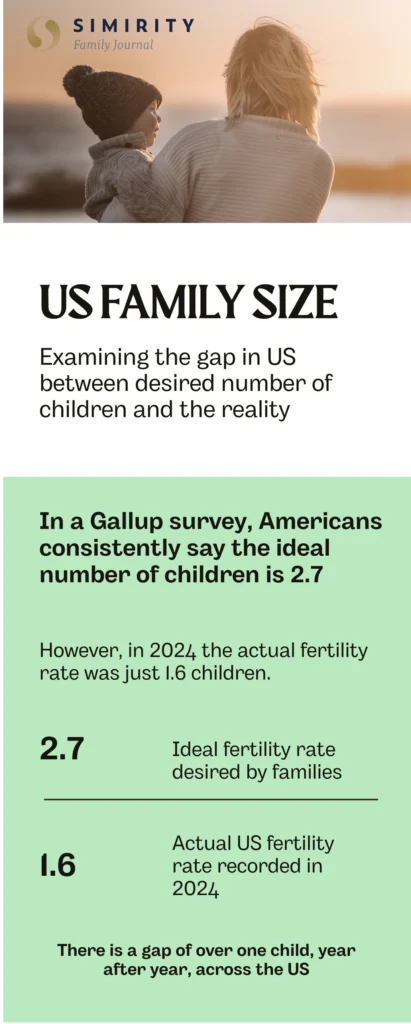
For almost ninety years, Gallup has asked Americans about their ideal family size. The answer has stayed almost the same over time. In 2025, the average American says the ideal number of children is 2.7.
The US fertility rate in 2024 was 1.6.
That means there is a gap of more than one child, year after year, in households across the country.
The gap is widening, not closing
In 2023, 45% of Americans said that three or more children was the ideal family size — the highest percentage since 1971, according to Gallup. Yet the fertility rate has kept falling. The gap between what people want and what they have has not closed over time. It has grown.
A 2024 survey by Population Connection found that 39% of parents across all ages have fewer children than they wanted. Among women under fifty, that figure rises to 45%. Among men under fifty, 53%.
These are not people who changed their minds about having children. They wanted more, but ended up with fewer children than they hoped.
The two-child family: default, not dream
Two children is now the most commonly cited ideal, chosen by 40% of Americans.
But the actual two-child family is also under pressure. In 2016, 62% of US mothers aged 40–44 had given birth to one or two children — roughly the inverse of 1976, when 65% of mothers the same age had three or more.
The two-child family has become the norm not because it was the dream, but because it was what was achievable.
Why Life Keeps Getting in the Way
The data shows that people are not choosing smaller families because they want to. So what is stopping them?
When Gallup asked Americans why families are smaller than people would like, the picture was consistent:
- High costs for housing, childcare, healthcare and education
- Delayed marriage
- Delayed parenthood
The numbers support this. Raising a child in the US from birth to age 17 now costs about $322,000, based on USDA data adjusted for inflation by the Bureau of Labor Statistics as of 2025. That’s around $23,000 per year for each child. For families thinking about two or three children, these costs add up quickly.

Housing, childcare, timing
Housing is the biggest expense in raising a child, making up 29% of total costs according to the USDA.
Childcare comes next and has become a major burden.
A 2025 Care.com survey found that parents spent an average of 22% of their household income on childcare in 2024. On average, parents said they used 29% of their savings to pay for it.
The data shows that the problem is not a lack of desire. According to Gallup, the risk of the US population shrinking due to a lower birth rate is mostly because young adults are waiting much longer to have children than previous generations, not because they want fewer children.
People want families, but it has become harder to build them.
An interesting footnote: bigger families cost less per child
One surprising finding from the USDA data is that having more children is not proportionally more expensive. In fact, it is actually cheaper per child.
- Families with one child spend 27% more per child than families with two
- Families with three or more children spend 24% less per child than two-child families. This is because children share rooms, hand down clothes, and older siblings often help with younger ones
A family that seems too expensive at first can actually become more affordable as it grows. For many people, having that first or second child feels like the biggest hurdle.
What Smaller Families Mean for Family Stories
Family stories matter more when there are fewer people to remember and share them.
Stories for smaller families offer depth rather than breadth. While the living network might be smaller, the generations behind it remain vast. A child who truly knows and understands these stories carries something bigger than just their immediate family, something that connects them to a larger world.
A generation ago, family stories were shared among siblings, cousins at the table, and parents with four or five children who would pass them on. There were many people to remember, retell, and keep these stories alive.
Today, family networks are smaller.
There are fewer siblings, fewer cousins, and sometimes only one child to carry the family’s history.

That makes the stories we capture — the ones we take time to write down or record instead of just remembering — more important than ever. A smaller family is not a lesser one, but what gets preserved or forgotten matters more now.
At Simirity, we created a private family storytelling platform because we felt this gap in our own lives. We noticed that important stories were slipping away from our families, even though we shared messages, photos, and had regular calls.

If family size statistics show us anything, it is that future families will be smaller and more spread out — and the stories that hold them together will matter more than ever. The question is simply whether we capture them while we still can.
This article is part of our family statistics collection — if you’d like to explore the broader picture, our roundup of statistics about family brings together the most interesting findings in one place.

Connect every generation through the power of storytelling.
Recommended

Statistics About Family: 10 Insights on Modern Family Life
Read more: Statistics About Family: 10 Insights on Modern Family LifeStatistics About Family Relationships: The Shape of Love Across a Lifetime
Read more: Statistics About Family Relationships: The Shape of Love Across a LifetimeFamily Size Statistics: The Incredible Shrinking Family
Read more: Family Size Statistics: The Incredible Shrinking Family