


How to Write Life Lessons: An 8-Step Guide to Preserving Family Wisdom

Much of life is trial and error. We think we know the right way, and discover our failings. A lot can be said of learning things the hard way like this, but as a parent, I’m keen to share my hard-earned mistakes with my children. Repeating my mistakes seems unnecessary—they can learn from my life lessons and venture into new areas to make their own mistakes!
Sharing stories about our hard-won life lessons can really help your family. But it can be challenging, especially if the topic is sensitive or you still feel embarrassed about your past actions. That’s why I want to show you how to write life lessons as short nuggets of wisdom within stories that give the full context.
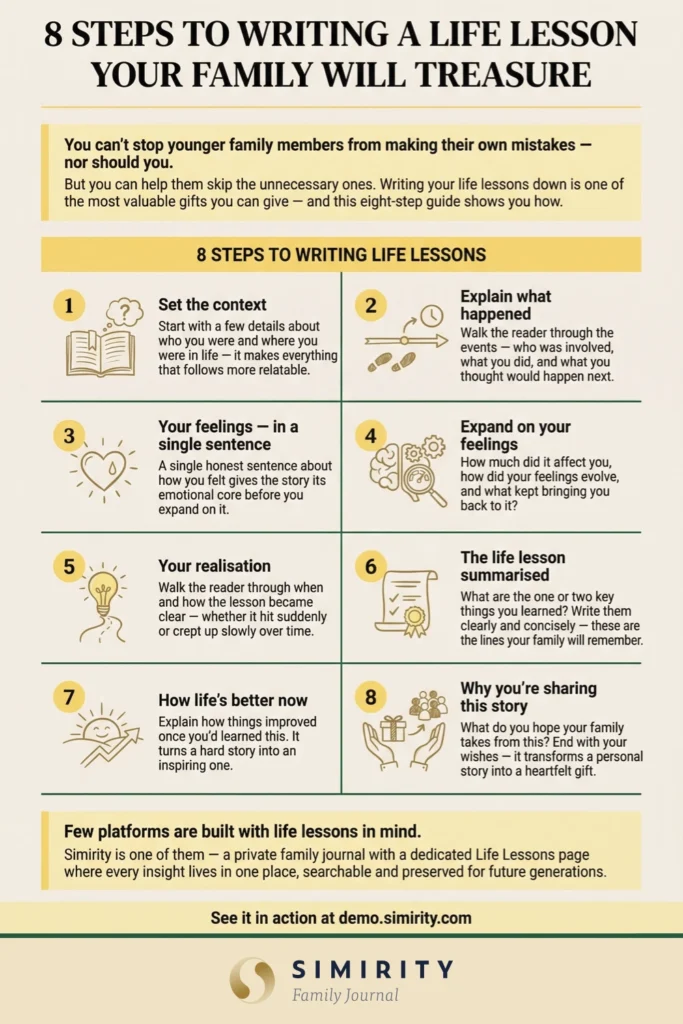
Learn how to write life lessons with ease using the following 8-step story template.
By three methods we may learn wisdom: First, by reflection, which is noblest; Second, by imitation, which is easiest; and third by experience, which is the bitterest.
Confucius
I love how this ancient quote captures exactly why family storytelling matters. When you share your experiences, you’re giving others the chance to learn through reflection—the “noblest” path to wisdom. Why let your children and grandchildren learn life’s hardest lessons the “bitter” way when your stories could guide them?
Let’s get started, and see how you can use your experiences to help your family.
Jump to section:
What Experience Can You Share as a Life Lesson?
If you could share some wisdom with your younger self, what would you share?
It’s too late for you, but what you’ve learned can help your children, nieces, nephews, and grandchildren. So many hard-earned lessons from life are not taught in schools, so the younger generation predominantly relies on family for advice on topics like:
- Mental health.
- Physical health.
- Relationship struggles.
- Self-identity challenges.
- Addiction and recovery.
- Poor professional choices.
- Poor financial choices.
- Poor values or beliefs that influenced your behaviour.
- Personal growth challenges.
There are so many pitfalls in life like those above. I’ve been fortunate to have great parents who helped me navigate challenges by sharing stories from their lives. I learned a great deal from their experiences. I don’t feel I ‘missed out’ on making mistakes firsthand—I got to bypass these mistakes and make my own as I ventured further down the road.
If you would like to see some examples of what a life lesson looks like, check out James Clears’ Life Lessons or use our list of 110 life lesson questions to help you identify your own.

Use life lessons to help family in times of need.
The Life Lessons Game
If you would enjoy a fun way to discover life lessons while engaging your whole family in conversation, try our Life Lessons Game.
It is a free game with 100+ life lesson prompts, designed for 2 to 8 players across all generations. Children, parents, and grandparents each receive questions tailored to their stage of life, so the game works just as well with a seven-year-old at the table as with a seventy-year-old.
How to Write Life Lessons: The 8-Step Guide
Sometimes it’s hard to find the right words. What should be said and in what order to create a story that others find interesting and helpful? Story templates help by breaking your story down into carefully chosen steps that ensure your story grabs readers’ attention.
Now all you have to do is fill in each section, and hey presto, you’ll have a great story that family can learn from.
Copy the steps in your writing editor, and replace each section with your story.

1. Set the context
Start by setting the stage for your story. This makes your story more relatable and sticky.
- How old were you?
- Where were you living at the time?
- What events led up to the coming lesson?
- What were you like back then?
2. Explain what happened
This is the ‘backstory’ to your lesson. Here you add details to give the reader a complete picture of how it all came about.
- Who is a part of this story?
- What roles did they have?
- What happened?
- What did you do?
- What did you expect to be the result of your action?
- What actually happened?
3. Your feelings — in a single sentence
Your feelings give meaning to the story.
Give a single sentence that explains succinctly how you felt as a result of what happened. You will elaborate on this next.
4. Expand on your feelings
Now take that opening sentence and expand on it, so the reader feels what you felt.
- How big a deal was this for you back then?
- How much did it impact other areas of your life?
- How did your feelings evolve over time?
- Did your interpretation of the event change over time?
- What triggered you to think about what happened?
Sharing feelings is an authentic way of passing on values without preaching.
5. Your realisation
Now your story has turned the corner, transitioning from the backstory to what you learned from your experience.
- When did you start to realise there was a lesson to be learned here?
- Were others helping you make this realisation?
- What was your realisation? Be as detailed as needed.
- How did you feel having made this realisation?
6. The life lesson summarised
What are the one or two key lessons from your story? What do you hope others will learn from it?
- Capture each learning in a single sentence.
- Remove all unnecessary words.
- Ensure it visually stands out on the page.
7. How life’s better now
Explain the consequence of learning this lesson. This is your happy ending, showing that hard times were faced and overcome.
- How important is this lesson for you?
- How regularly do you refer back to this lesson?
- How has it helped you in your life?
8. Why you’re sharing this story
Add context to the story by sharing your reasons for writing it.
- What are your hopes for those who read it?
- What is the final message or moral you wish the reader to the left with?
How Simirity App Helps Families Share Their Life Lessons
Simirity is a family business, and like you, we want to share what we have learned with our younger family members.

We created the Simirity journal so families can privately share stories about their lives, including stories about challenges faced and lessons learned. Over time, your entire family can build an archive of digital stories, filled with memorable photos, videos and audio, that share your experiences with young generations.
Sharing wisdom is a core part of the Simirity app. It’s unmatched in its ability to help others navigate life.
When you create stories, you can add a ‘Life Lesson’ block. This is a punchy statement of up to 300 characters, a bit like a quote, that summarises your overall life lesson (step 6 from the template). It stands out visually in your story, catching people’s attention, as illustrated below.
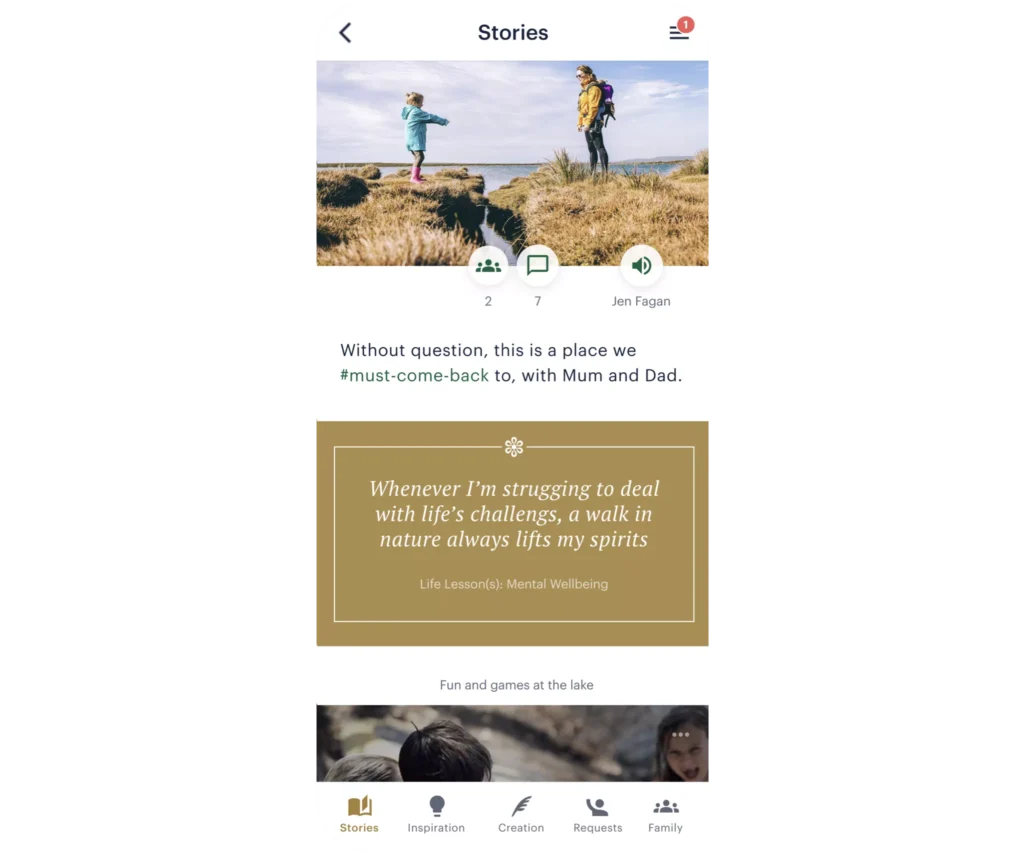
But more importantly, all the Life Lessons from all family stories can be viewed on one page!
This page, your family’s Life Lessons page, is:
- The single source for all your family wisdom
- A priceless resource for family seeking help
- A legacy that will be passed onto future family
Family members can scroll down the list and see what catches their eye, then click to discover the backstory that led to this insight. Or if they have a specific issue they would like help with, they can filter using 10 Life Lesson categories such as ‘relationships’, ‘parenting’ or ‘mental wellbeing’.
A US survey revealed that children aged 8-12 spend an average of 4.6 hours daily online, while teenagers (13-18) spend a staggering 6.67 hours online for non-school purposes. This digital immersion means young people are increasingly influenced by strangers—turning to Google, YouTubers, and TikTokers for guidance rather than family.
By sharing authentic family stories with valuable life lessons embedded within them, younger generations are being given a clear path to seek family help before turning to strangers online.

Of course, you don’t need Simirity to write and share your lessons! An email, document, or even a letter works perfectly well. The real challenge is that families need to be prompted to share their hard-earned insights—everyone’s so busy that important things like this get overlooked.
That’s where Simirity really helps, by making family storytelling a regular activity and offering an easy, gentle way to share lessons from life.
- There is no better way to support family facing tough times.
- There is no better way to strengthen family bonds than sharing real-life stories.
- There is no better legacy to leave for generations to come.
Explore our demo account and see how preserving life lessons within stories, and preserving family memories in general, can help both today’s and tomorrow’s family.
FAQs About Writing Life Lessons
How do you write life lessons?
Start with the moment something changed for you, then walk through what happened, how you felt and what you realised. The 8-step template above turns that into a short, readable story. Most people finish a first draft in under twenty minutes.
What makes a good life lesson to share with family?
The best ones come from a genuine mistake, struggle or turning point, not a tidy success. Honesty is what makes a lesson land. If it taught you something you’d want your children to know, it’s worth writing down.
Do I need to be a good writer to write life lessons?
No. Writing life lessons is about being truthful, not polished. Short, plain sentences in your own voice will always connect more than clever prose.
How long should a written life lesson be?
Around 300 words is plenty. Long enough to set the scene and share the realisation, short enough that your family will actually read it. The template keeps you focused.
What if my life lesson involves a painful memory?
Write only what you’re comfortable sharing, and remember that writing is often easier than saying it aloud. You can keep a story private until you’re ready, or share it with just one person.
