


350+ Questions to Ask Your Mom Plus a List-Building Tool

How well do you really know your mom?
I thought I knew everything about the woman who raised me—key moments from her life, her favourite sayings, quirks and passions. But when I finally asked the right questions, I discovered a whole world of untold stories and life lessons that shaped not just her life, but mine too.
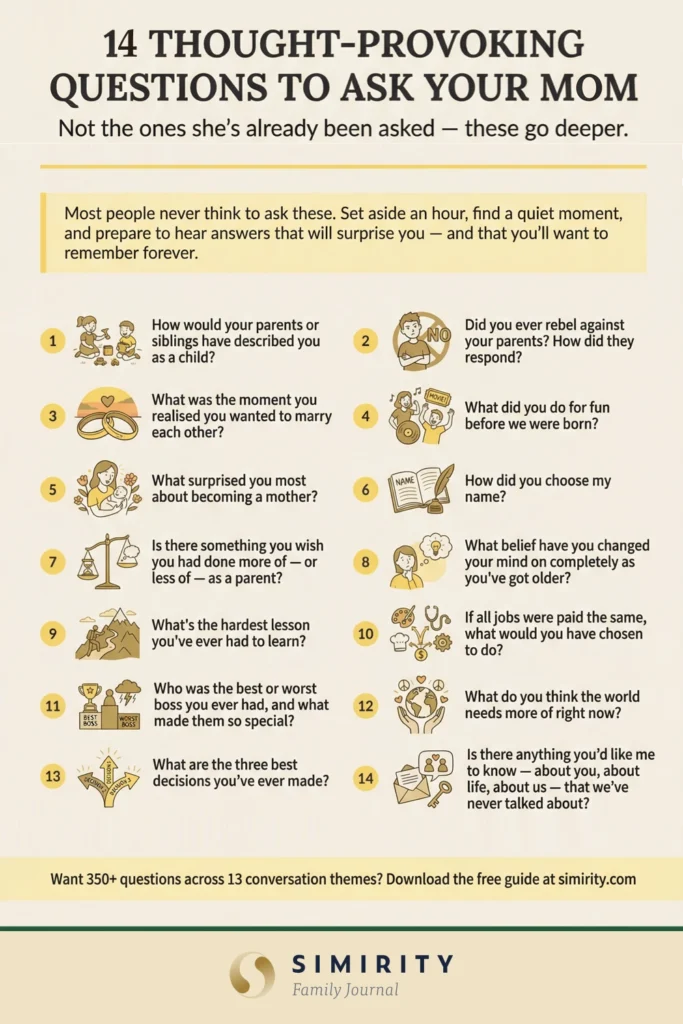
This page gives you everything you need to start those conversations. Browse five of our 13 themed conversations below and use the list-building tool to bookmark the questions you want to ask. When you’re ready to go further, download our free guides — including printable memory books your mom can fill in herself, and the complete 350+ question conversation guide across all 13 themes.
Jump to section:
Your First 5 Conversations With Mom
Work through the conversation themes below and save the questions you want to ask. Your list builds as you go.
Found a question worth asking? Tap it to save it to your list. Work through as many sections as you like — then copy everything in one click and bring your list to your next conversation with Mom.
Don’t let her stories stay in your head
The conversations you have with your mom deserve more than a notes app. Simirity is a private family journal where you can record her stories with photos, voice recordings, and video — and share them with future generations.
See how it looks in the demo →Share this questions tool
Help a friend start a meaningful conversation with their mom today.
For a similar experience with other members of your family, try these questions to ask your dad and these questions to ask your kids.
Memory Book for Mom vs Guided Conversations
A memory book is a guided journal — a curated set of questions covering all phases of life that she completes in her own time, at her own pace. No conversation required, no scheduling, no pressure.
Our Essential and Complete editions are both free to download, and many families find it’s the easiest way to start capturing the foundations: where she grew up, her education, her career, the key moments of her life.
But they have a blind spot.
Predictable questions lead to predictable answers—and the stories that actually reveal who she is rarely make it into the book.
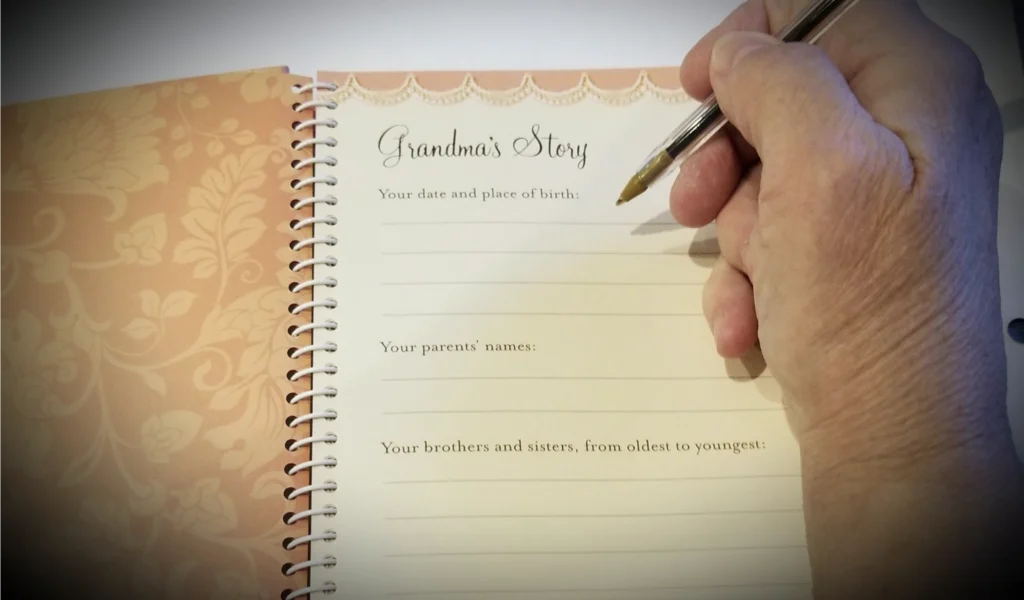
A memory book will tell you where your mom was born and what job she had. It won’t tell you why she chose that path, what kept her up at night, or how it felt to become a mother.
That’s where guided conversations go so much further. When I searched for conversation guides to use with my own mother, I found nothing worth using — hundreds of disconnected questions with no structure or flow. So I created my own conversation guides — thirteen themed conversations, each designed to explore one chapter of her life at a time.

I’ve tested these guides with my own mother, and those conversations were without doubt the most precious we’ve ever had—exploring parts of her life and personality I’m ashamed to have overlooked for so long.
The best approach? Both. Start with the memory book to capture the foundations. Use the conversation guide to explore the stories behind them. The four free guides below give you everything you need for either approach.
Going Beyond The First 5 Conversations
The list builder above covered 5 of our 13 conversation themes. When you’re ready to go further, the free Conversation Guide below includes all 13 — from her career and travels to her reflections on life and what she hopes for the future. Each theme is designed to fill an hour or two, so there’s no need to rush. Pick one, find a quiet moment, and let the conversation lead where it will.
- Childhood and Family History
- Family and Friends
- Early Relationship Years
- Her Parenthood Journey
- Your Childhood years
- Life-long Learning (only in PDF)
- Career (only in PDF)
- Hobbies and Interests (only in PDF)
- Travel and Places (only in PDF)
- Challenges and Milestones (only in PDF)
- Witnessing Historical Changes (only in PDF)
- Reflections on Life (only in PDF)
- Retirement and the Future (only in PDF)
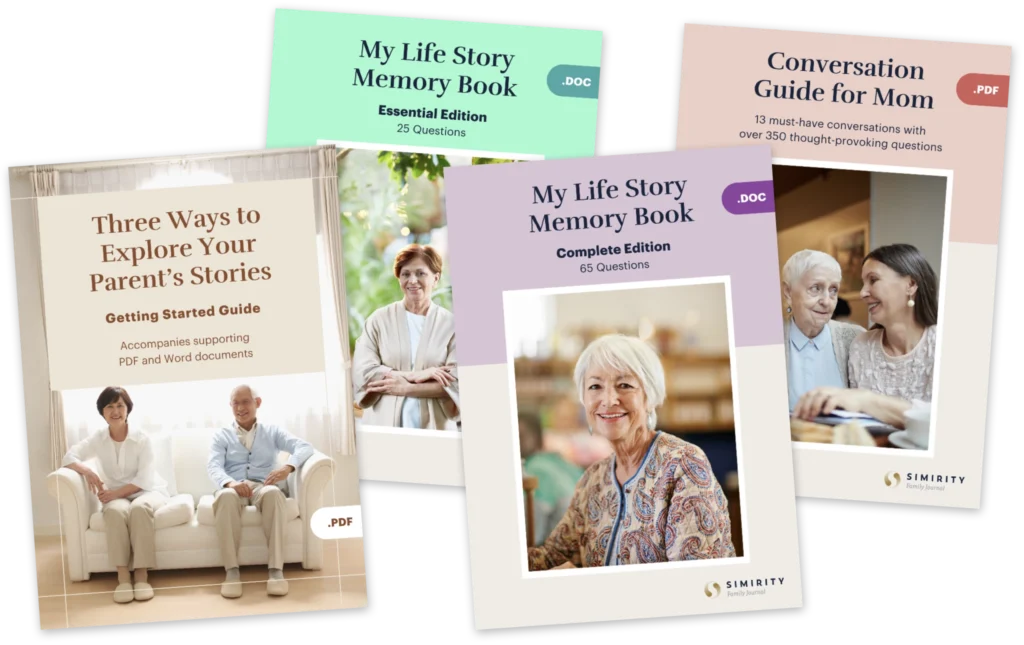
Everything you need to start the conversation and preserve what you hear
What you’ll get:
- Getting Started Guide – Not sure which approach is right for your family? This short guide helps you choose the right approach to storytelling in your family.
- Memory Book Templates – Two Word documents your mom can complete in her own time, at her own pace. The Essential edition covers the foundations (25 questions). The Complete edition goes deeper (65 questions). Give her one and let her fill it in — no conversation required.
- Conversation Guide PDF – All 350+ questions organised into 13 themed conversations. The list builder above covers the first five themes. This PDF gives you all thirteen — including Life-Long Learning, Career, Hobbies, Travel, Challenges, Historical Changes, Reflections on Life, and Retirement.
Must-Ask Follow-up Questions
Follow-up questions are the key to unlocking deeper, more meaningful conversations with your mom.
The best conversations don’t follow a script. Once your mom starts talking, these follow-up questions help you go deeper — past the facts and into the feelings, the context, and the stories she wouldn’t have thought to share unprompted.
Emotional responses
- How did you feel about that?
- What emotions did that bring up for you?
- Did that make you happy, or was it difficult for you?
- What was the most exciting part of that experience?
- How did you handle that situation emotionally?
- Looking back, do you think you’d feel the same way now?
Personal reflections
- Did you enjoy that? Why or why not?
- Looking back, would you have done anything differently?
- What do you think you learned from that experience?
- How did that experience shape who you are today?
- Do you ever think about that moment now?
- What advice would you give to someone facing a similar situation?
Deeper insights
- Why do you think that happened the way it did?
- What was the hardest part of going through that?
- Did anyone help you during that time?
- How did you make that decision?
- Was there anything you wished you’d known back then?
Connections and relationships
- How did that affect your relationship with [specific person]?
- Did you talk about this with anyone at the time?
- What do you think your parents (or siblings) felt about that?
- Was that something your friends or family also experienced?
Hindsight and perspective
- Any regrets about how things turned out?
- What would you tell someone going through the same thing now?
- Was there anything you overlooked or didn’t realize at the time?
- Do you think you’d handle that situation differently today?
- Did that experience teach you any life lessons?
Fun and nostalgic prompts
- What’s the funniest thing that happened during that time?
- Did you have a favourite memory from that experience?
- Were there any inside jokes or stories tied to that?
- What do you miss most about that time in your life?
The Conversations That Are Easy to Put Off
Some questions aren’t about nostalgia. They’re about preparation.
While you’re having meaningful conversations with your mom, use this opportunity to discuss practical matters that affect your health and future planning. I found these topics initially awkward to discuss. But it was a great relief to finally address them.
You’re not being morbid or intrusive, just thoughtful and prepared.
Health & medical history
- What health conditions run in our family?
- How did your parents and grandparents pass away?
- What medical challenges have you faced personally?
- Were there health issues that surprised you as you aged?
- Looking back, what health decisions do you wish you’d made differently?
- Has our family dealt with any hereditary conditions I should know about?
- Are there any health risks you’d want us to monitor as we age?
Legal/Financial
- Do you have a will? When was it last updated?
- Who has power of attorney for healthcare decisions?
- Who should we contact about financial matters if needed?
- Where do you keep important documents (birth certificates, insurance policies, property deeds)?
Personal Wishes
- What brings you comfort when you’re unwell or stressed?
- How would you want to be cared for if you became unable to live independently?
- Are there specific people you’d want notified about major life events?
- What matters most to you about maintaining dignity and independence?
Practical Details
- Who is your primary doctor, and how can we reach them?
- What medications do you take regularly?
- Do you have any advance directives or living wills?
- What’s the password/location for your important online accounts?
Legacy Wishes
- Is there anything special you’d want done with particular possessions?
- Are there any messages or wisdom you’d want passed to future generations?
- What would you want your obituary to emphasise?
Tips for Better Conversations With Your Mom
Here are seven tips to help you use these conversation starters with your mom in the most effective way.
1. Print out and highlight your must-ask questions
Not all questions will feel right for you or your mom — be selective. Use the list builder above to save your must-ask questions before the conversation, so you have a focused list rather than hundreds to scroll through.
In preparation for your interview, we recommend printing the PDF with the list of questions and highlighting the essential questions to ask your mom. These ‘must-ask’ questions can help keep your discussion on track if it gets sidetracked (and it will!).
2. Choose the right time and place
Setting the stage for your discussion can make a world of difference.
Here are some key points to consider:
- Pick a moment when your mom is relaxed
- Allow sufficient time to not feel rushed
- Ensure the environment is free from distractions
I found that my mom appreciated being told ahead of time about my plan to ask her questions about her past. I didn’t share all the questions ahead of time to avoid her preparing answers that felt staged (more on that later).
3. Start with easy, fun questions
Begin the session with fun and simple questions that put your mom at ease.
We’ve tried to organise the question list with this in mind, but adjust according to your mom. You’re looking to get your mom into her comfort zone, where she can enjoy herself in a relaxed atmosphere.
It’s a great way to set the tone for deeper discussions later.
4. Be patient and open to tangents and small talk
Some of the best stories emerge when you let the discussion flow naturally.
Your mom might veer off-topic or share something unexpected—embrace these moments. They often reveal insights and memories you wouldn’t think to ask about.
I recorded the audio of all our conversations, and listening back to them reminds me how precious small talk can be. These authentic interactions capture what she’s really like in day-to-day life, which is how I want to remember her.
5. Actively listen and ask follow-up questions only when they’ve finished
“The art of conversation lies in listening.”
— Malcolm Forbes
We recommend asking follow-up questions only when the line of conversation seems to be exhausted. Give her the time she needs — often the best answers don’t come immediately to mind.
TIP – When you sense the topic has reached an end, try waiting a little longer before asking something new. Doing so creates a little tension, and if they were holding back, they might decide to share it after all.
6. Make it a flow — it shouldn’t feel like an interview!
Think of your list of questions as a rough guide designed to spark insightful discussions. Pick and choose what works for you, and be open to exploring the topics that arise even if they weren’t planned.
Here is an ideal conversation flow:
- Ask your question and see where it takes you.
- Give your mom time, and a little extra, to tease out stories.
- Prompt her with ideas if she is struggling.
- Pose the next question when your topic has reached a natural end.
7. Ensure your mom’s stories are preserved for your children
These conversations will produce real stories — about real people who shaped your family’s life. Don’t let them live only in your memory. Record the audio, and find somewhere to keep it that the whole family can access.
We built Simirity specifically for this: a private family journal where voice recordings, photos, videos, and written stories live together in one place, privately shared with everyone who matters. The conversations you have with your mom deserve more than a folder on Google Drive.
Browse our demo account to see families preserving stories from parents and everyone in their family. See how Simirity compares to other family journaling apps.
Why You Should Have These Conversations Soon
1. You’ll discover who she really is, beyond her role
When we surveyed parents, 60% said their regular family conversations followed similar patterns and themes. Comfortable, yes, but rarely revealing. Thoughtful questions take you somewhere different. Past the routines and the parental role, into the person she was before you knew her — her ambitions, her fears, the experiences that shaped her values.
My only regret is not asking these questions earlier.
2. You’ll understand yourself differently
Knowing your family’s story is key to understanding your own.
— Unknown
Her story is part of your story.
The expectations her parents had of her, the environment she grew up in, the difficult times she faced — these shaped your family in ways that are still playing out today. Many of which you’re probably passing on to your own children without realising it.
Knowing your family’s history is one of the most clarifying things you can do for your own sense of identity.
3. Time matters more than you think
The conversations you have now become the stories your family tells forever. Once they’re gone, they’re gone — not just for you, but for your children and grandchildren who will never have the chance to ask.
Preserving these stories gave me an unparalleled sense of purpose. They are nothing short of our most precious family legacy.
Don’t wait until it’s too late.
— Andrew Ronald (Simirity Founder)
Other Ways to Bond With Your Mom
Here are some other ways to connect with your mom and the rest of your family.
- Use family journal ideas to uncover even more discussion topics.
- Play the how well do you know your family game, to test your knowledge of your mom, and bookmark the unknowns to prompt a follow-up conversation with her. Works for other family members too.
- For moms who don’t like to be in the spotlight, try the Family Story Game. Your mom and up to 7 others take turns drawing life-related question cards. Questions are tailored to your stage of life, so everyone from grandchildren to grandparents gets questions relevant to them.
- Discover the stories behind your family’s heirlooms.
- Start a new hobby that you can enjoy together—here are 25 fulfilling activities that are suitable for grandparents.
Bonding Conversations for the Whole Family
Mom’s not the only one with stories worth capturing. The deck below covers story prompts for everyone — grandparents, kids, partners, siblings. 14 categories, 100 ideas, so many conversations worth having.
FAQs About Asking Mom Meaningful Questions
Still not sure how to go about interviewing your mom? Review these frequently asked questions to fill in the gaps.
Should I consider sharing questions with her before our conversation?
There are some good reasons to share, but it can come at a cost.
Advantages
- She can find supporting photos, heirlooms or documents that accompany her answers.
- Some questions are a bit tricky or may require time to reflect. Questions like “is there anything in life you regret?” may benefit from being shared ahead of time.
Disadvantages
- If you share questions, her answers might feel staged and less authentic.
- Some moms might feel stressed ahead of the conversation.
What is a good way to start?
Before the conversation, it can help to explain why you want to talk to her.
When you start, icebreakers may help ensure that she feels relaxed and open to sharing. Try leading by example — talk openly and in the manner you wish them to reply.
Should I take notes during our conversation?
It’s good to note down any follow-up questions you would like to ask as the conversation evolves, but we would not recommend trying to write down all her answers, as you cannot be fully present in the moment. Instead, try recording your conversation so no detail gets forgotten.
How can I record our conversation?
I strongly recommend recording your conversation in some way—you’ll be grateful you did. Video recordings are especially valuable because they preserve not only words, but also the emotions behind them. Seeing your mom’s smile as she recalls a happy memory, or watching her gesture as she tells a story, will be wonderful to look back on.
Video recording tips:
- Your smartphone is perfect – no fancy equipment needed.
- Position it slightly off to the side (more natural than center).
- Ensure good lighting (face a window if possible).
- Check audio in the actual room first – soft furnishings improve sound.
- Start recording before the conversation begins to capture natural moments.
Video feels too much? Audio still captures far more than written notes. Use iPhone Voice Memos or an app like this one for Android. The key is preserving her actual voice and the way she tells stories.
How much time will these conversations take?
A good conversation is like a miniskirt: short enough to retain interest, but long enough to cover the subject.
— Celeste Headlee
Spending time talking about things that really matter shouldn’t be rushed. In our experience, you will want at least one to two hours to address each of the 13 conversation themes. If they drag on too long, you’ll run out of momentum, so take breaks as needed.
How can I ask my mom a hard question?
There may be challenging aspects from your mom’s past that you would like to learn more about and gain her perspective on. You may think that asking your mom a hard question like ‘why did you separate from my dad?’ is not possible, but I challenge you to reconsider, as the potential upside if she does answer could be significant.
It’s very important to never start out with a tough question — warm her up with fun questions so she feels comfortable first.
Tough though they may be, the hard questions are often the most rewarding, giving you a deeper level of understanding that strengthens your bonds.
What should I do if she is reluctant to answer?
Firstly, be aware that our minds have a habit of playing tricks on us—building an imaginary narrative of how others might react. The only way to really know is to ask, and you can do so without offence with the following tips:
1. Respect their boundaries. Acknowledge her feelings and let her know it’s okay if she’s not ready to share. Example: “I understand if this is hard to talk about. We can move on if you’d prefer.”
2. Approach gently. Introduce sensitive topics indirectly or in a lighter way to ease into the conversation. Example: “I was wondering about what life was like for you growing up, but only if you’re comfortable sharing.”
3. Show empathy. Let her know why her stories matter to you and that you’re coming from a place of care and curiosity. Example: “I’d really love to understand your experiences more—it helps me feel better understand your train of thought.”
4. Reframe the topic. If she resists a certain topic, try approaching it from a different angle. Example: Instead of asking directly about a painful time, ask, “How did you find strength during that period?”
5. Share your own experiences. Share something personal first to encourage reciprocity. Example: “I sometimes feel overwhelmed with [specific challenge]. Did you ever feel like that?”
6. Focus on positives. Frame questions in a way that emphasises resilience or growth. Example: “What did you learn from that experience?” or “Was there anything good that came out of that difficult time?”
7. Offer an alternative format. Suggest discussing difficult topics in a less direct way—could she write them down and share them that way?
8. Give her time. Let her process her thoughts. If she’s not ready now, ask if you could revisit the topic later. Example: “No pressure to talk about this now—we can come back to it anytime you feel comfortable.”
Are these interview questions good for my grandmother too?
Yes, they are great for grandmothers.
They’ll need to be done differently in places — for example the questions about your childhood should be reframed towards your parents’ childhood. Their memories of your childhood would be a bonus question!
