


Statistics About Family: 10 Insights on Modern Family Life

Statistics about family highlight something many of us feel but rarely pause to consider: family life is under more pressure than ever before, and most families are dealing with it on their own.
Families today are smaller than most people would like. Parents are more involved than ever, but also more exhausted. Even with more ways to stay in touch, loneliness is widespread. The difference between the family life people want and what they experience has never been greater.
But the statistics also show something else. What makes families genuinely close — what builds resilience in children, keeps relationships strong across distance and holds families together through difficult times — is often simpler than people expect. The research is quietly encouraging, if you know where to look.
We spent months creating a series of in-depth articles on all major aspects of modern family life, using the most trusted sources available. Each article explores its topic in detail.
This article brings together the ten most important findings from all that research. Think of it as a starting point, and follow the links to the topics that matter most to you.

Jump to section:
INSIGHT 1: Family Structure Has Changed Beyond Recognition
How families used to be
Sixty years ago, the shape of family life was largely predictable. Most adults married in their early twenties, had two or three children and stayed together. Mum was typically at home. Dad went out to work. Grandparents, aunts and uncles often lived close by.
It wasn’t perfect, but it was consistent. Most families looked much like the family next door.
That world is now a statistical minority.
What today’s family actually looks like
Only 14% of US households fit the traditional family model today (Pew Research Center). In 1970, married couples made up 71% of all households. That figure has since dropped to just 47% (US Census Bureau).
The US has more children living with a single parent than any other country in the world. Nearly one in four American children lives in a single-parent home, compared to a global average of 7% (Pew Research Center).
At the same time, multigenerational living has made a quiet comeback. The number of Americans living in multigenerational households has quadrupled since 1971, driven by housing costs, student debt and an ageing population (Pew Research Center).
Today, only 14% of US households fit the traditional family model. Sixty years ago, that number was closer to three quarters.
This does not mean families are worse off. It means family life has become much more varied than it was a generation ago.
INSIGHT 2: Families Are Getting Smaller — But Not by Choice
The numbers behind the shrinking family
The US fertility rate dropped to a record low of 1.6 children per woman in 2024 (CDC). In 1960, it was 3.5. This is not a slow change, but a sharp drop in family size within one lifetime.
What makes this even more striking is what people actually want. The average American still sees 2.7 children as the ideal family size (Gallup). Gallup has asked this for nearly ninety years, and the answer has hardly changed. The gap between what families want and what they have is now more than one child per family.
Americans say their ideal family size is 2.7 children, but the actual fertility rate is 1.6 — a gap that has grown for decades and shows no sign of closing.
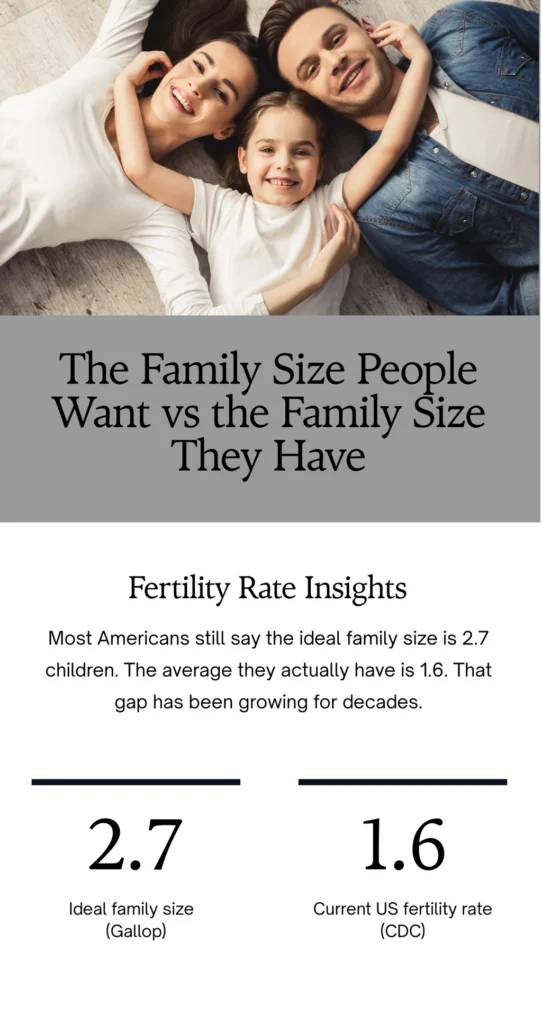
The families having fewer children are not simply changing their minds. More than half of men and nearly half of women under fifty have fewer children than they wanted (Population Connection). This is not about shifting values, but about changing economics.
The financial barriers to building a family have grown significantly:
- Raising a child to age 17 now costs around $322,000 (USDA / BLS)
- Childcare for two children now exceeds annual mortgage payments in 45 states (Child Care Aware of America)
- The average age of first-time mothers has risen by six years since 1970 (CDC)
- The share of women having only one child has doubled in less than forty years (Pew Research Center)
One-child families are now the fastest-growing family type in the Western world. People want bigger families, but life keeps making it harder to have them.
INSIGHT 3: Parenting in the Modern Day Feels Harder Than Ever
What the stress statistics actually say
One surprising finding in modern family research is that parents today spend much more time with their children than any previous generation. Yet many still feel more overwhelmed, guilty, and stretched than ever.
Fathers now spend nearly four times as much time with their children as fathers did in 1965 (University of California, Irvine). Mothers have nearly doubled their daily childcare time over the same period. By almost every measure, today’s parents are doing more.
But the data on stress tells a different story:
- Nearly half of all parents say their daily stress feels completely overwhelming — almost double the rate among non-parents (American Psychological Association)
- Over half of parents report outright burnout (Ohio State University)
- Most parents say parenting has been harder than they expected (Pew Research Center)
In 2024, the US Surgeon General issued the first formal advisory on parental mental health after finding that nearly half of all parents say their daily stress feels completely overwhelming.
Why the system is not helping
The systems in place are making things harder, not easier.
The US is the only OECD country without a national paid parental leave policy (Pew Research Center). Only 27% of private-sector workers have access to any paid family leave at all.
Screens are adding pressure from both sides. Teenagers now average nearly nine hours of daily entertainment screen time (Common Sense Media). Nearly half say their parent is distracted by their phone when they try to talk to them (Pew Research Center).

Many parents in their forties are also caught in what researchers call the sandwich generation. More than half of Americans in their forties are simultaneously caring for children and ageing parents (Pew Research Center).
INSIGHT 4: Families Are More Spread Out Than Ever
The reality behind the distance statistics
Most people assume American families are geographically spread out. The overall picture is more nuanced. More than half of US adults live within an hour’s drive of extended family (Pew Research Center). Nearly 60% of 26-year-olds live within 10 miles of where they grew up.
But those averages hide a real divide. College-educated adults are far less likely to live near extended family than those without a degree. Economic opportunity pulls people away from their roots. And even when individual members are close by, only about one in five three-generation families has everyone living nearby (Pew Research Center).
For millions of families, the distance is not a town or two away. It spans continents. The number of people living outside their country of birth has nearly doubled since 1990, reaching 304 million worldwide (United Nations).
Why distance hits hardest between grandparents and grandchildren
There are now 63 million family caregivers in the US, a 45% increase over the past decade (AARP). More than 6.9 million of those are supporting a relative who lives over an hour away.
But perhaps the most important distance statistic concerns grandparents and grandchildren.
Distance is the strongest factor in how close grandparents and grandchildren feel. Eighty percent of children feel closest to the grandparent who lives nearest to them.

This finding should prompt a question for any family where grandparents live far away. What replaces the proximity? Occasional visits are not enough on their own. The relationships that stay close across distance are the ones actively maintained through calls, shared experiences, and the deliberate sharing of stories.
INSIGHT 5: The Connection Gap: Connected but Not Feeling Close Enough
The ‘alone-together’ problem
We have more ways to stay in touch with family than ever before — video calls, messaging apps, photo sharing, and social media. Still, something is missing.
The US Surgeon General declared loneliness a national epidemic in 2023, warning that lacking social connection carries health risks equivalent to smoking 15 cigarettes a day (US Surgeon General). Around half of American adults reported measurable loneliness even before the pandemic.
What stands out is that loneliness is not just a problem for people who are physically alone. You can be with your family and still feel lonely.
Researchers found that from 2000 to 2015, families spent more time at home together, but much of it was ‘alone-together’ time — in the same room but on separate devices, not really interacting. This kind of time increased by 43% during that period (University of Oxford / University of Warwick).
59% of adults say that communicating online instead of in person makes them feel lonelier, not closer. We have more ways to connect than ever, but many families are losing real closeness.
When asked what they believed caused loneliness:
- 73% of adults blamed technology (Harvard Making Caring Common)
- 66% said families were not spending enough meaningful time together

The problem is not the tools we use, but how we use them.
INSIGHT 6: Family Dinners Are Fading — and the Cost Is High
What happens when families eat together regularly
Only about 30% of families eat dinner together regularly (Harvard Graduate School of Education). This number has dropped by more than 30% in the past thirty years. Still, research on the benefits of family dinners for children is some of the most consistent in family science.
Teenagers who eat with their family five or more times a week are four times less likely to use tobacco and more than twice as likely to avoid alcohol and marijuana (CASA Columbia).
Girls who eat seven or more family meals a week are half as likely to have attempted suicide. These are not small differences. Long-term studies confirm that it is the dinner itself that has the protective effect, not just that happier families eat together more often.
The benefits go beyond behaviour:
- Children aged three to five hear around 1,000 rare words during a typical family dinner — compared to around 140 during a read-aloud session (Harvard Graduate School of Education)
- Regular family mealtimes are a stronger predictor of academic achievement than time spent in school, doing homework or playing sport (Harvard Graduate School of Education)
- 91% of parents say their family feels less stressed on days they eat together (American Heart Association)
Why one more dinner a week matters
Nearly half of all families say eating together regularly is genuinely difficult. Schedules, screen time and competing demands all get in the way. But the research offers an encouraging finding.
Each extra shared dinner per week leads to measurable improvements in children’s mental health, including lower anxiety, less depression, and greater life satisfaction (Canadian Family Physician, study of 26,069 adolescents). The goal is not seven dinners a week, but just one more than you have now.
80% of teenagers say dinner is the time of day they are most likely to open up to their parents (Anne Fishel, Harvard Medical School). For parents of teenagers, that is worth sitting with.
INSIGHT 7: Single Parents Are Working Harder With Less Support
The support gap that makes the hardest job even harder
One in four children in the US now lives in a single-parent household — a figure that has nearly tripled since 1960 (US Census Bureau). The US also sits at a striking position globally. Not only does it have more single-parent families than almost any other country, it also provides less of the support that makes a real difference.
Only 8% of children in US single-parent households live with extended family, compared to 38% worldwide (Pew Research Center).
A common stereotype is that single parents do not work, but the data shows otherwise. 75% of single mothers are employed, which is a higher rate than married mothers. The issue is not effort, but that one income now covers what two incomes used to share.
The financial gap is significant:
- The average single mother earns around $41,000 a year, compared to around $133,000 for married-couple families (US Census Bureau)
- 31% of single-mother families live below the poverty line — nearly six times the rate for married-couple families
- 77% of single parents describe themselves as lonely (Cigna)
The hidden weight of doing it alone
Beyond finances, there is the mental load. A 2025 study of 3,000 US parents found that mothers in two-parent households handle 71% of all household mental load tasks (Journal of Marriage and Family). For single parents, there is no one to share even the remaining 29%.
43% of single-parent women get fewer than seven hours of sleep per night, compared to 31% in two-parent families (CDC). Nearly one in three single mothers experiences moderate or severe psychological distress (Brookings Institution).
Research consistently shows that the challenges single parents face are rarely about family structure. They are about resources, support, and connection — things that can change.
INSIGHT 8: The Hidden Scale of Family Conflict and Estrangement
The statistics about family nobody talks about
27% of Americans — around 67 million people — are living with active family estrangement (Cornell University / Karl Pillemer). A more recent YouGov poll puts that figure even higher, finding that 38% of American adults are currently estranged from at least one family member.
Conflict that does not lead to estrangement is also common. Research from the Institute for Family Studies found that the most frequent sources of tension in relationships are chores, money, and disagreements about children. Importantly, 69% of relationship conflicts never fully resolve (John Gottman, University of Washington). Couples who do well are not those without conflict, but those who keep about five positive interactions for every negative one.
67 million Americans are living with an active family estrangement. Most estrangements are not permanent — research shows that around 80% of adult children who become estranged from a parent eventually reconcile.
Why political divisions are making this worse
In recent years, political identity has added a new layer of strain to family relationships.
32% of adults say the political climate has caused friction with family members (American Psychological Association). 38% avoided relatives they disagreed with during the 2024 holidays.
- 21% of Americans have become estranged from a family member over a controversial topic (American Psychiatric Association)
- 22% have blocked a family member on social media
- 69% of adults said the 2024 US election was a significant source of stress — up from 52% in 2016
Not all family statistics point in the same direction. The American National Election Study found that 85% of Americans say politics has not significantly hurt their family relationships. The tension is real, but it is often felt most at the dinner table or on social media, not throughout all of family life.
INSIGHT 9: How Family Relationships Evolve Across a Lifetime
What time-use data tells us about life’s key relationships
A decade of American time-use surveys offers some of the most revealing data in family research. When charted, it shows something clear but unsettling: every family relationship is changing right now, whether you notice it or not.
Time spent with children peaks in the early forties and then drops quickly, reaching almost zero by age sixty (Our World in Data, American Time Use Survey). If you are in your thirties or forties, this is the peak. The window is shorter than it seems.
For most people, the sibling relationship is the longest one they will have. It usually begins before most friendships and lasts longer than relationships with parents or partners. Yet research shows that sibling closeness often dips during the busiest years of raising children (Journal of Marriage and Family). Siblings who stay close are usually those who keep making the effort during those years.
The relationships that need the most intention
Around 27% of Americans are estranged from a sibling — making it one of the most commonly cited forms of family estrangement (Cornell University).
The grandparent-grandchild relationship is perhaps the most underinvested of all.
Research found that knowing grandparents’ stories is the strongest predictor of children’s psychological wellbeing — stronger than any other factor tested. Yet most families let this relationship develop by chance instead of planning for it.
There is also a line on the time-use chart that rises steadily from about age forty onward: time spent alone. By their eighties, people spend more than 400 minutes alone each day. The US Surgeon General called loneliness a public health crisis in 2023. The statistics suggest that for many, the groundwork for loneliness in later life is laid quietly, long before it becomes obvious.
Families who feel close in later life are not those who assumed closeness would happen on its own. They are the ones who made it a priority during the busy years.
INSIGHT 10: The Quiet Loss of Family Stories — and Why It Matters
What the research says about children who know their family stories
Every day, about 10,000 Baby Boomers in the US turn 65 (Pew Research Center). This will continue through 2029. When older generations pass away, decades of experience, survival stories, family traditions, and hard-won wisdom disappear for good.
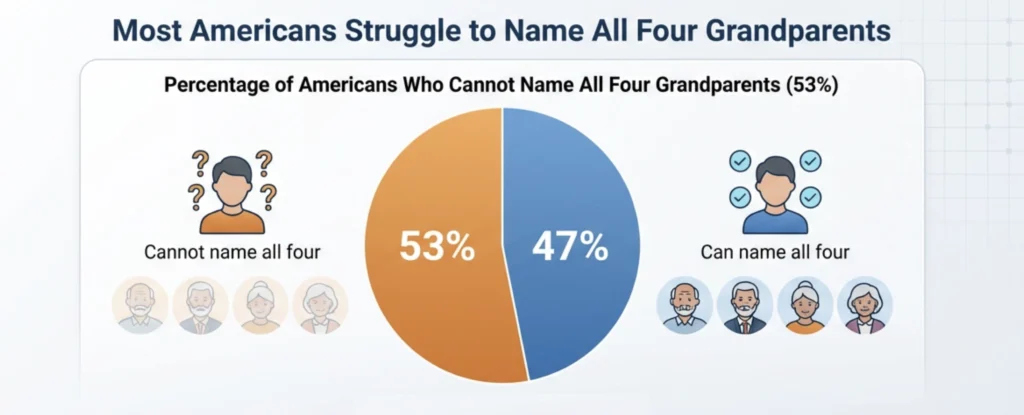
We are already losing touch with the generations above us. 53% of Americans cannot name all four of their grandparents (Ancestry.com). Only 4% can name all eight great-grandparents.
This is important for more than just nostalgia.
Researchers at Emory University found that children who knew more of their family’s stories scored higher on every positive psychological measure tested — self-esteem, resilience, sense of identity, lower anxiety, fewer behavioural problems (Emory University / Marshall Duke and Robyn Fivush).
Family story knowledge was the only variable that correlated with every positive psychological outcome measured. It turned out to be the single strongest predictor of children’s psychological wellbeing — above all other factors tested.
It is not just the happy stories that matter. Families who shared stories about both hard times and recoveries raised the most resilient children — not just those who talked about successes.
Saving family stories became my personal mission
These statistics about family stories resonate with me deeply.
When both my parents were hospitalised at the same time, I became acutely aware of how many stories existed only in their memories — not just their own lives, but those of generations above them. They were the gatekeepers of our wider family history. The health scares, the hardships they had overcome, the stories behind things we had inherited, the things nobody had ever thought to write down.
That fear of losing it all is what led me to build Simirity family journal: a place where families can privately capture and share the full picture of their lives — not just the highlights, but the struggles, the wisdom, and the stories that deserve to outlast the people who lived them.
5 Takeaways From Statistics About Family
Here are five key takeaways from all these statistics about family in the modern world:
- The pressure most families feel is real — and it comes from outside. Housing, childcare, distance, and lack of parental leave are not signs of failure. They are the conditions millions of families are navigating right now, often alone.
- Connection does not require a perfect setup. One more dinner together a week, a regular call with a grandparent, a question that goes deeper than “how was your day?” — these things move the needle more than most families expect.
- The grandparent relationship is one of the most underinvested in family life. When it is actively maintained, children feel the difference for decades. Proximity helps — but intention matters more.
- Children who know their family stories are measurably more resilient. Not just the happy stories — the whole picture. Families who talk honestly about what they have faced, and how they came through it, raise children better prepared for life.
- Every generation holds stories the next one needs. Hard-won lessons, health histories, the meaning behind things passed down — these live in people’s memories and nowhere else. Sharing them across generations is not a nice-to-have. For many families, it is a gap that quietly grows until it is too late to close.
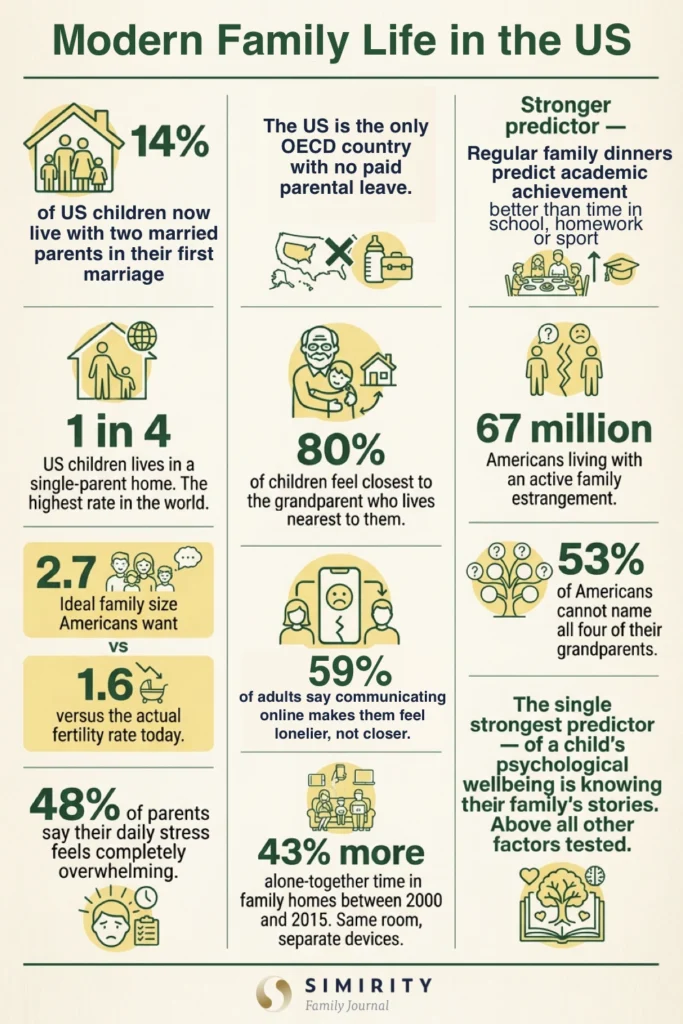
Here is a quick summary of key statistics about family:
Explore the full articles in our statistics about family series
Each of these topics deserves more than a summary. The full articles are below — explore the ones that matter most to you.
- Facts About the Modern Family
- Statistics About Families in the US
- Family Size Statistics
- Statistics About Single-Parent Families
- Statistics About Family Relationships
- Statistics About Family Dinners
- Facts About Family Problems
- The Importance of Family Storytelling

Connect every generation through the power of storytelling.
Recommended

Statistics About Family: 10 Insights on Modern Family Life
Read more: Statistics About Family: 10 Insights on Modern Family LifeStatistics About Family Relationships: The Shape of Love Across a Lifetime
Read more: Statistics About Family Relationships: The Shape of Love Across a LifetimeFamily Size Statistics: The Incredible Shrinking Family
Read more: Family Size Statistics: The Incredible Shrinking Family