


Statistics About Family Dinners: Why Eating Together Matters

The statistics about family dinners are among the most consistent in family research — and if you have ever felt that sitting down together matters, the evidence is firmly on your side.
Researchers have been studying shared family meals for decades, across more than 80 countries and hundreds of thousands of families. What they have found covers children’s wellbeing, academic performance, and the role a regular evening meal plays in protecting teenagers through some of their most difficult years. Yet for all that, only around 30% of families manage shared dinners on a regular basis.
We set out to create the best resource for statistics about family dinners, gathering the most compelling data from trusted sources and presenting them a story you can relate to.

Jump to section:
How Often Do Families Actually Eat Together?
According to a Gallup poll, 53% of American families with children under 18, eat dinner together six or seven nights a week.
That sounds positive. However, closer inspection shows that the number of families eating together less than four times a week has actually risen: it was 16% in 1997, and now it’s 22%.
How family dinner habits have changed
Analysis of over 40 years of survey data by the American Enterprise Institute shows how family dinners have changed over time.
- In the mid-1970s, approximately 80% of Americans reported that their whole family “usually eats dinner together” (American Enterprise Institute, analysis of survey data)
- By the early 1990s, this figure had dropped to around 70%, coinciding with the rise of two-income households
- During the Covid-19 lockdowns of 2020, family dinners increased significantly, with daily shared meals reported by 54% of families, compared to the pre-pandemic range of 43–48%

So the family dinner isn’t gone, but for many families, it is under pressure.
My childhood dinners
Growing up, family dinner was non-negotiable — a daily ritual that happened without question.
I’ll admit, I wasn’t always enthusiastic (what teenager is?), but looking back, I see how important it was. It was the one time each day when we all truly connected, away from outside distractions. Dinners were unhurried, with my mum putting in the effort to make at least two courses. They were a world away from the rushed, ten-minute meals I sometimes throw together for my own kids these days.
Families still aspire to eat together
Maybe the most interesting thing isn’t how often families eat together, but how much we want to.
84% of Americans wish they could share meals more often with the people they love, and 62% of parents with children under 18 say they would specifically like family dinners to happen “much more often” or “somewhat more often.”
Parents clearly know that shared mealtimes matter, but find it hard to make them happen.
Not All Dinners Are Equal
Many parents believe family dinners are valuable simply because they bring everyone together. And it’s true — any shared meal offers something positive. But some family dinners do much more than provide food or company; they can have a powerful impact that goes far beyond just eating together.
When researchers from Harvard’s Home-School Study of Language and Literacy Development analysed what children were exposed to at the dinner table, they found something that I still struggle to comprehend:
Children aged three to five hear around 1,000 rare words during a typical family dinner.
During a read-aloud session with a picture book, they hear around 140. Dinner conversation exposes children to roughly seven times more sophisticated vocabulary than reading aloud does.
And those rare words matter. Research from Cambridge University found that children exposed to sophisticated language during mealtimes as preschoolers had measurably better vocabulary at age five — and that benefit was still detectable through sixth grade. Harvard researchers also found that regular mealtime is a more powerful predictor of high academic achievement in school-age children than time spent in school, doing homework, playing sports, or doing art.
The reason is storytelling.
Dinnertime stories
Dinner is where families share stories about the day, the past, and people or places the children have never met. Children who can understand and create narratives as preschoolers become stronger readers at ten and beyond.
The dinner table is where children learn how stories work. Stories are the building blocks of literacy.
It is also the place where teenagers are most likely to open up. According to Anne Fishel, co-founder of The Family Dinner Project and Associate Clinical Professor at Harvard Medical School:
80% of teenagers say that dinner is the time of day when they are most likely to talk to their parents.

This connection to storytelling is something we think about a lot at Simirity. We built our private family journal partly because the stories that matter most — the ones that go deeper than today’s news or weekend plans — can be hard to start.
Sometimes sharing a story from Simirity at the table is a good way to begin: a grandparent’s memory, a childhood photo with a note attached, or a question that no one has thought to ask before. And when a conversation at the table sparks something worth keeping, Simirity is a quiet place to capture it.

Go beyond “How are you?”—truly connect with family.
The Science Behind What You’re Protecting
The evidence on family dinner outcomes is remarkably consistent across countries, income levels, and decades of research.
A systematic review of 14 studies, published in the Canadian Family Physician, found:
- Frequent family meals are linked to lower rates of disordered eating, alcohol and drug use, violent behaviour, depression, and suicidal thoughts in young people
- Regular family meals are associated with higher self-esteem and better school performance
- The protective effects are especially strong for girls
Perhaps the most striking single statistic in the entire body of research comes from CASA Columbia, which conducted annual surveys on teenage substance use for nearly a decade.
Their conclusion: compared to teenagers who eat dinner with their families five or more nights a week, those who share fewer than three dinners a week are almost four times more likely to use tobacco, more than twice as likely to use alcohol, and two and a half times more likely to use marijuana.
A separate study of nearly 5,000 adolescents, published in JAMA Pediatrics, found that girls who ate seven or more family meals a week were half as likely to have attempted suicide.
These are not marginal differences. And they cannot be explained away by the idea that “happier families just eat together more.” Longitudinal studies that tracked the same children over years — controlling for family income, family structure, and baseline wellbeing — have consistently found that it is the dinner itself, and especially how often it happens, that carries the protective effect.
The OECD’s PISA 2022 study of over two million students across 80 countries confirms the pattern holds globally: students who regularly share a main meal with their family are significantly more likely to report higher academic performance, a stronger sense of belonging at school, and greater life satisfaction.
And the benefits reach further than most parents expect. A meta-analysis of 17 studies covering 182,836 children, published in the American Academy of Paediatrics’ journal, found that children eating five or more shared meals a week are roughly 25% less likely to face nutritional health problems, 12% less likely to be overweight, and 35% less likely to develop disordered eating.
“It’s 25 years of dozens and dozens of studies that show when families have dinner together, it’s great for the body, the brain, and the mental health of kids and adolescents. And it also turns out that family meal time is also good for the mental health and nutrition of adults.”
—Anne Fishel, Harvard Medical School / The Family Dinner Project
It Matters Even More as Children Get Older
As children enter their teenage years, family dinner frequency drops sharply.
For 14–15-year-olds, research tracking thousands of adolescents over more than a decade found a consistent, steady decline — from around five shared dinners a week in the mid-1990s to fewer than four-and-a-half by the late 2000s. Among families with children aged 11 to 18, roughly a third eat together only once or twice a week. Only about a quarter manage seven or more meals together weekly.
We often assume this is fine. Teenagers want independence. They’re busy. The dinner table seems less important at fifteen than it did at seven.
But research suggests that you should reconsider.
A daily diary study published by the American Psychological Association, which tracked 396 adolescents across 14 consecutive days, found that on the days teens shared a meal with their families, they felt measurably happier and less distressed.
More importantly, family meals buffered the emotional fallout of family conflict — on days when there was friction at home, having a shared meal neutralised much of its impact on a teenager’s mood. And the researchers found this buffering effect was stronger among older adolescents, not younger ones.
CASA Columbia’s surveys add another perspective. Teenagers who eat fewer than three family dinners a week are five times more likely to say their parents know “very little or nothing” about what is really going on in their lives.
For teenagers, the family meal can be the last remaining open door for real conversation and connection.
It’s not too late to make a change
There is something hopeful in the CASA data too.
Among teenagers who don’t currently eat with their families regularly, 60% say they would like to.
Teenagers do want the connection, but life gets in the way for them just as much as it does for their parents.

Why It’s So Hard, and Why That’s Not a Failure
Nearly half of all families — 46% — say that eating together regularly is genuinely difficult to do.
The average dinner now lasts around 12 minutes, compared with an estimated 90 minutes sixty years ago.
The barriers are real. In YouGov surveys:
- 65% of families point to members being on different schedules
- 36% say they are simply too busy
- 57% of parents acknowledge that even when they do eat together, someone at the table is distracted by a device
- Only around one in four families reports meals that are consistently free of phones and screens
Research by the Survey Center on American Life showed that there is also a class dimension to the data:
- Only 38% of Gen Z adults without a college degree grew up with regular family meals, compared to 61% of those with postgraduate education (Survey Center on American Life)
- Lower-income families face real structural barriers—such as shift work, unpredictable schedules, and reduced access to affordable food—that make shared meals much harder to achieve
Small improvements count
Thankfully, research shows that you don’t need to do this seven nights a week for it to make a difference.
A large Canadian study of 26,069 adolescents found that each additional shared dinner per week — not a target of five or seven, just one more than you’re currently managing — was associated with measurably better mental health outcomes across every dimension measured: lower anxiety, lower depression, greater life satisfaction, and more prosocial behaviour.
Longer meals matter more than perfect meals
Nutrition researchers found that the duration of meals had a high impact on the positive impact of meals.
So learn to take your time, eat more slowly, and try to avoid family members running off before everyone’s finished.
Your new mealtime mantra
It doesn’t need to be a huge change. The evidence points to something simple:
- +1 family dinner each week
- A bit longer than usual
- With fewer distractions at the table
A Summary on Statistics About Family Dinners
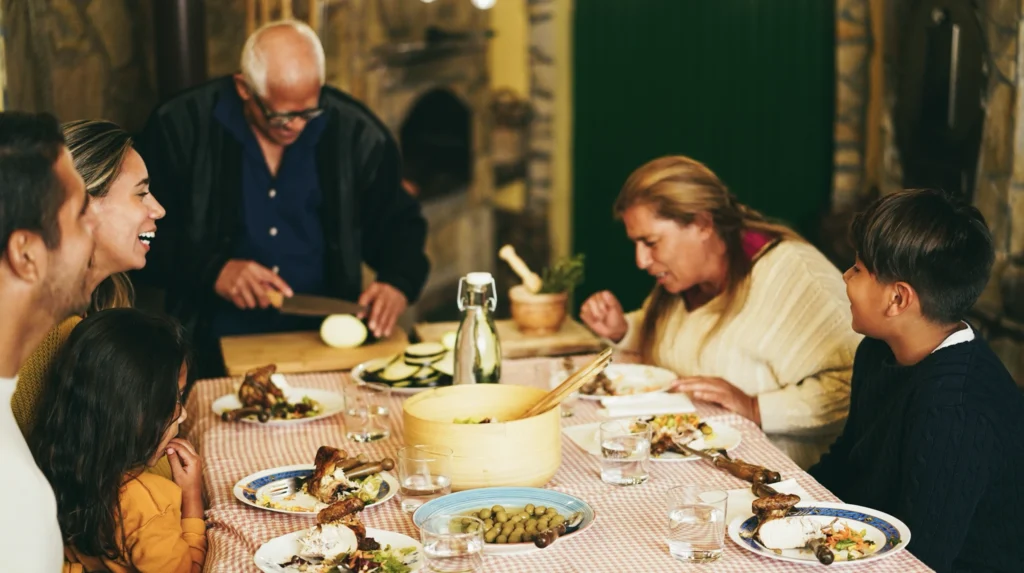
No matter how you look at them, the statistics about family dinners send a clear message: what happens around the table really matters for our kids, and for us as parents too.
The family table is more than just a place to eat. It’s where our children’s vocabulary grows, where teenagers stay connected, and where the tough moments of adolescence can feel a little less overwhelming. It’s where we share family stories and laughter — sometimes even the kind that gets passed down through generations. And according to 91% of parents in an American Heart Association survey, eating together is the single activity most likely to help families feel less stressed.
Deep down, most of us already knew this.
We know the value of family dinners, even if we can’t always put it into words or fit it into our schedules as often as we’d like. The research simply gives us the extra reassurance — and maybe a bit of motivation — to keep trying, even when family life feels chaotic.
This article is part of our family statistics collection — if you’d like to explore the broader picture, our roundup of statistics about family brings together the most interesting findings in one place.

Go beyond small talk—explore authentic family stories in Simirity.
Recommended

Statistics About Family: 10 Insights on Modern Family Life
Read more: Statistics About Family: 10 Insights on Modern Family LifeStatistics About Family Relationships: The Shape of Love Across a Lifetime
Read more: Statistics About Family Relationships: The Shape of Love Across a LifetimeFamily Size Statistics: The Incredible Shrinking Family
Read more: Family Size Statistics: The Incredible Shrinking Family