


Teaching Family Values Without Lecturing

Teaching family values works best when it doesn’t feel like teaching at all.
This post is really about moving from teaching to creating the right environment where kids learn values naturally. It’s less about saying the perfect thing and more about the stories you tell, how you handle challenges, the rituals your family follows, and whether your kids see your values in what you do, not just what you say.
All five of these methods are backed by research and are things most families can fit into their regular routines.
Jump to section:
Why Lecturing Doesn’t Work
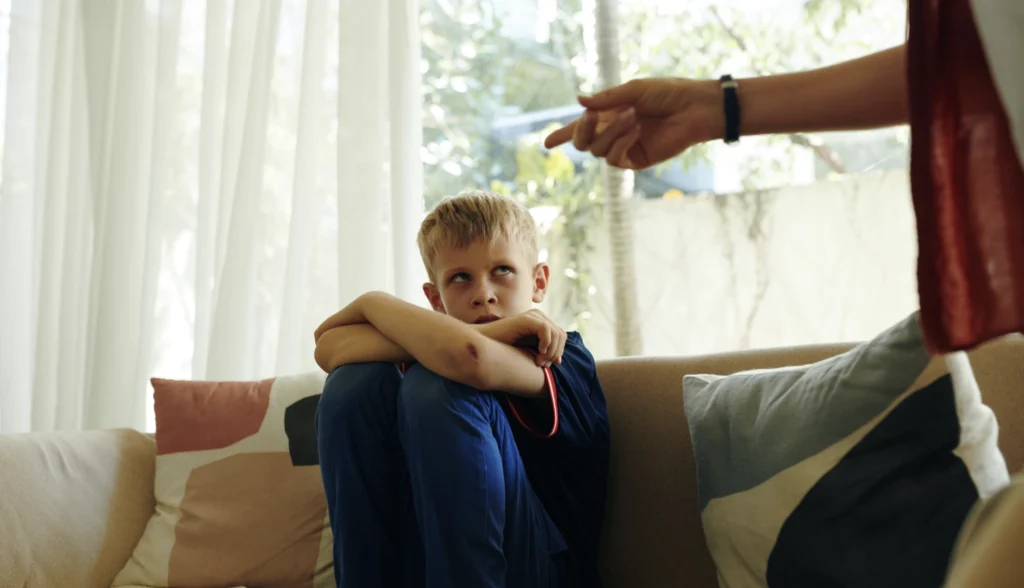
My default move, when something goes wrong, is still ‘the talk’. A lie surfaces, a sibling gets treated badly, responsibilities get forgotten without a second thought — and I pull my child aside. I explain, calmly and with real reasons, why honesty matters. Or kindness. Or accountability. I make good points and feel like I’ve handled it well.
And then nothing changes…
They still lie about homework, snap at their sibling and forget their chores. And I’m left wondering why a perfectly reasonable conversation didn’t seem to have any impact on them at all.
The problem isn’t with the message. It’s that the way it was delivered doesn’t match how kids really learn values.
Research shows that values don’t develop through rules or direct instruction. They become part of how a child thinks and behaves through stories, real-world experiences, and emotional connections. When you explain a value, you’re putting information into your child’s working memory. But when they experience it, see someone they love live it, or hear a story that makes them feel something, it reaches a deeper level.
That doesn’t mean you’ve failed as a parent. Wanting to explain is completely natural — it’s what we do when something is important to us. But values aren’t like facts. You can teach your child that Paris is the capital of France and expect them to remember. Teaching them that honesty matters doesn’t work the same way.
Kids need to experience values in action before they truly make them their own.
The good news is that most families are already creating the conditions for values to develop. They just don’t always recognise it. The story you tell at dinner. The moment you admit you got something wrong. The ritual your family has kept for years without thinking much about why. All of it is quietly doing the work that a lecture never could.
Here are five ways to help make this process more intentional, but still feel natural.
Method 1: Storytelling
Why it works
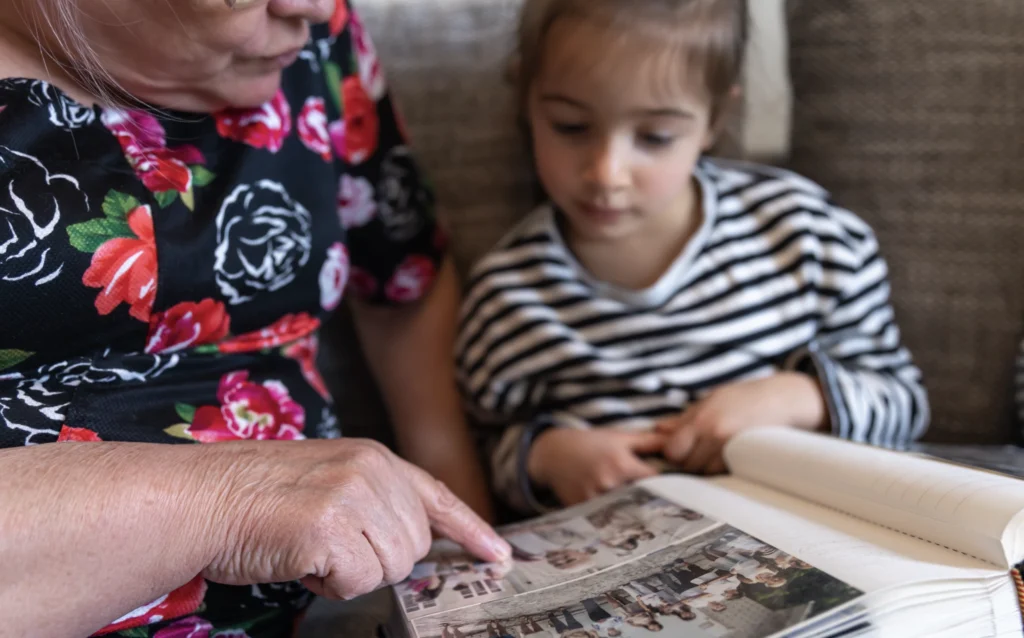
People have always used stories to pass down values from one generation to the next. Before anything was written, families would gather and share stories — not just for fun, but to show what was important.
Research shows that values become stable and connected to behaviour when they develop through stories and real-world examples, rather than through rules or instruction. The reason is simple: stories create emotional connection. When your child hears a story about a time someone in your family chose the harder right, they don’t just understand the concept. They feel why it matters. And feelings are what make things stick.
Rules are easy to forget, but stories stick with us.
How to use it
You don’t need a special reason to share a family story. The best ones often come up naturally — maybe in the car, at dinner, or before bed. The important thing is to tell them, instead of waiting for the perfect moment.
Start by thinking about moments in your family history where a value was clear. It doesn’t have to be a perfect lesson, just a real moment. Maybe something your parents did, something that happened to you, or a time someone in your family made a hard choice and what came after.
Here’s the difference between a story that has an impact on a child and one that doesn’t:
My grandmother was generous. She always helped people.
Compare that to this:
My grandmother never had much. But there was a period when my dad’s friend — a kid from a difficult home — would show up most afternoons, and she always fed him. She never mentioned it. My dad didn’t think much of it until he was an adult and asked her about it. She said she just didn’t want the boy to feel like a guest. That was it. No bigger reason. My dad told me that story once, offhand, and I’ve never forgotten it.
I don’t think about generosity as a concept. I think about that boy sitting at her table, not feeling like a guest.
The second story gives more detail. It shows real sacrifice and how values are handed down. It doesn’t sound preachy or tack on a lesson at the end. When a child hears it, they don’t just think, Mum wants me to be generous — they see what generosity really looks like.
After sharing the story, you can ask a simple question, like “What do you think about that?” or “What would you have done?” This keeps things light and encourages curiosity, instead of looking for the right answer.
I never heard my grandparents’ war stories directly. They were too modest for that — they’d lived through genuine hardship and somehow concluded it wasn’t worth mentioning. So it was my parents who told me, years later, what they’d pieced together.
Those stories did something no lecture about resilience or perspective ever could. They gave me a reference point. When things got hard, I didn’t think about the concept of resilience — I thought about my grandparents, and what they’d faced without making a fuss. That’s the thing about a good family story. It doesn’t tell you what to think. It just quietly changes what you compare things to.
When it works best
Younger children (ages 5–8) do best with short stories that have a clear cause-and-effect structure. They don’t need anything complicated — just something they can follow. As kids get older, they can handle more details and even like hearing about mistakes and what happened next. Stories about failure and what came after often work really well at this age.
Teenagers prefer stories that feel real and have something at stake. They can spot anything that feels fake or like it’s just there to teach a lesson. The more honest and open the story is, the more likely they are to listen.
A common mistake is adding a moral at the end. Just tell the story and let your kids come to their own conclusions. You’ll know this is working when your kids start bringing up the stories on their own — that’s when a story has really become part of your family.
Method 2: Modelling
Why it works
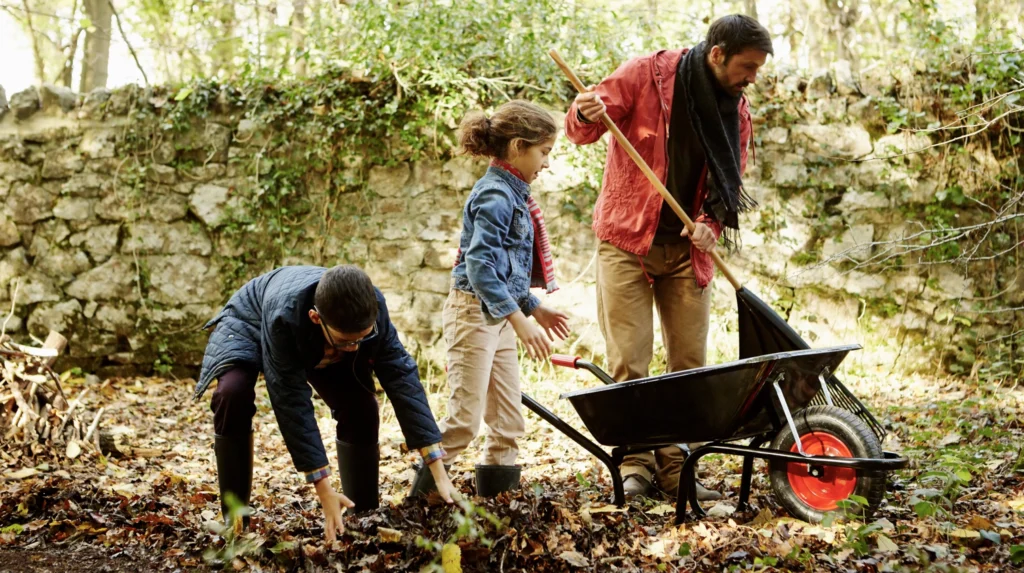
Kids are like little scientists. They watch what you do, test things out, and learn from what they see. What they pick up from your actions is much more powerful than anything you say.
Research on how families teach integrity shows that families remain the primary teachers of integrity — not through what they say, but through the behaviours children observe every day. When your child watches you return something that doesn’t belong to you, admit a mistake, or help someone when it’s inconvenient, they’re not having a teaching moment. They’re gathering data. Their brain is filing it away under: this is what honesty looks like. This is what kindness actually means in practice.
Lectures talk about values, but modelling shows them. Kids trust what they see you do.
How to use it
The most effective modelling is rarely dramatic. It’s the small, unannounced choices: returning the extra change, telling a friend something they don’t want to hear, sitting with discomfort instead of deflecting it.
Modelling is even stronger when you name what you’re doing, just in a quick sentence. For example, “I’m going to be honest here, even though it feels awkward,” or “I made a mistake, so I need to fix it.” This helps your child connect your actions to the reasons behind them.
The most powerful modelling can also be the hardest. It means letting your kids see you make mistakes and showing them how you make things right. Here’s a real example of how that can play out:
My child caught me exaggerating a story to some friends. I didn’t try to explain it away — I just said, yeah, you’re right, I made it sound bigger than it was. About three weeks later, they told their teacher they’d copied someone’s answers in a test. When I asked why they came clean, they said: you admitted you got it wrong and it was fine. So I thought maybe I could too.
That single moment of admitting a mistake did more than a year’s worth of honesty talks. The child learned that being honest doesn’t ruin relationships — it can actually make them stronger. That’s something a lecture can’t really teach.
When it works best
Consistency is more important than being perfect. Your kids aren’t looking for one big moment — they notice your patterns over time.
You’ll know it’s working when your children start calling you out. Hearing, “But you said…” is actually a good sign. It means they’re holding onto the value, even when you slip.
Method 3: Teachable Moments
Why it works
Developmental psychology shows that values stick best when kids learn them in real situations — when the value matters in the moment, not just as an idea.
When your child is making a real choice or dealing with a conflict, they’re much more engaged than in a made-up conversation. The feelings are real. If you respond with curiosity rather than judgment, you give them a chance to think things through on their own rather than just telling them what to do.
The key difference between a teachable moment and a lecture is who figures things out. In a lecture, you give them the answer. In a teachable moment, they come to it themselves — and that means it really sticks.
How to use it
This method is simple, but it takes practice. When something happens — a conflict, a choice, or a moment of kindness or meanness — pause before you react. Try not to jump in with an explanation or judgment right away.
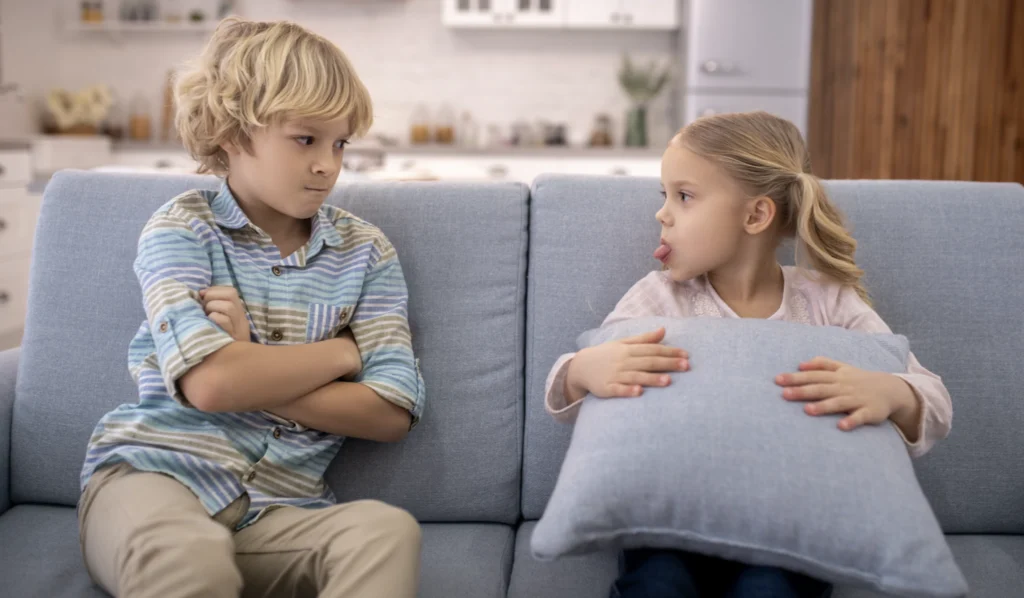
Then ask real questions: not ones that hint at the answer you want, but honest, open questions. Here’s what that looks like with something as ordinary as a sibling argument over a Lego set:
Your brother’s upset because you wouldn’t share. What do you think he’s feeling right now? … Have you ever felt left out like that? … What would have helped in that moment? … What does sharing actually mean to you — is it about giving things up, or something else?
Let your child think it through. Later on, not right away or as a lecture, you can reflect back on what you noticed:
You two figured out a way to both get a turn. That wasn’t obvious — you had to actually think about it. That’s what sharing usually looks like. Not giving something up. Working something out.
What happened? The child solved the problem, connected their feelings to someone else’s, and learned that generosity doesn’t mean giving up everything. Because they figured it out on their own, the lesson will stick much longer than if you had just told them.
When it works best
Trying to use a teachable moment in the middle of a conflict usually doesn’t work because everyone’s too emotional. The best time is a little later, when things have calmed down, but the experience is still fresh.
The key skill is to ask instead of tell. In a teachable moment, your job is to be a curious guide, not a judge. You’ll know this is working when your kids start pausing before they react, and you can see them thinking things through.
Method 4: Rituals and Traditions

Why it works
Research shows that regular family routines, whether weekly, monthly, or yearly, give kids a sense of stability. Doing things over and over helps values become part of daily life, without feeling forced. When something is done often enough, it stops feeling like a rule and becomes part of who your family is.
That’s the quiet power of rituals. They aren’t obvious lessons; they just happen. Over time, the value becomes as natural as the ritual itself.
How to use it
A ritual doesn’t have to be fancy or planned out. Some of the best ones start by accident and become meaningful over time. What matters is that they happen regularly, include everyone, and connect to something your family cares about.
At bedtime, we started asking our kids to name one thing someone did for them that day. It took about thirty seconds, and we didn’t think much of it.
Over time, though, they started noticing kindness during the day — almost like they were collecting it. They’d come home with things to say. The habit didn’t teach gratitude. It just trained their attention toward it.
You can build rituals around almost any part of your family’s week — mealtimes, bedtime, the start or end of the school week. You can also use things you already do, like a regular walk, Sunday breakfast, or weekly car ride. These are already rituals; you just need to add a small, consistent element to carry the value you want.
When it works best
Consistency is more important than perfection. It’s okay to miss a week now and then, but try to keep it regular. The value of a ritual comes from repeating it, so it should be simple and easy to keep up without much planning.
The best rituals are the ones your kids feel are theirs. Let them help create or change them. If they help choose a ritual, they’ll want to keep it going.
You’ll know a ritual matters when your kids notice if you skip it. If they ask, “Aren’t we doing our thing today?” it means the ritual has become special to them.
Method 5: Capture and Celebrate
Why it works
What you notice and name is what kids start to believe about themselves. There’s a difference between “good job” and telling a child exactly what you saw and why it mattered. The second one doesn’t just praise them — it shows them something about who they are.
Behavioural psychology shows that recognition encourages good behaviour. But the bigger impact is on identity. When a child hears “that’s the kind of person you are,” tied to real moments when they lived a value, they start to see it as part of themselves. They stop doing it just for praise and start doing it because it feels like who they are.
When you capture, remember, retell, or write down these moments, they become part of your family’s stories. That’s how values get passed on.
How to use it
This method has two parts: celebrating the moment, then capturing it.
Start with the celebration. When you see your child make a values-based choice — especially if it was hard, when no one was watching, or when they could have taken the easy way — pause and point it out. Be as specific as you can.
Instead of:
Good job helping your sister.
Try:
I saw you stay with your sister last night when she couldn’t sleep. You’d been in the middle of something — you just stopped and went and sat with her. She wasn’t scared anymore. That was a great thing you did, and it says something about who you are.
The first version is nice, but the second acts like a mirror. The child isn’t just being praised — they’re hearing who they really are. That’s what shapes identity.
The second part is capturing the moment. Write it down, tell it again at dinner, or bring it up later: “remember when you did that?” Over time, these moments become family stories, and that’s how values are passed down.
When it works best
Celebrate right away, or soon after, while the moment is still fresh. If you wait too long, it can feel less genuine.
Then capture it. You don’t need anything fancy — a note in your phone, a journal, or even a message to a grandparent works. Writing it down does two things: it saves the moment and shows your family it mattered.
Putting It All Together
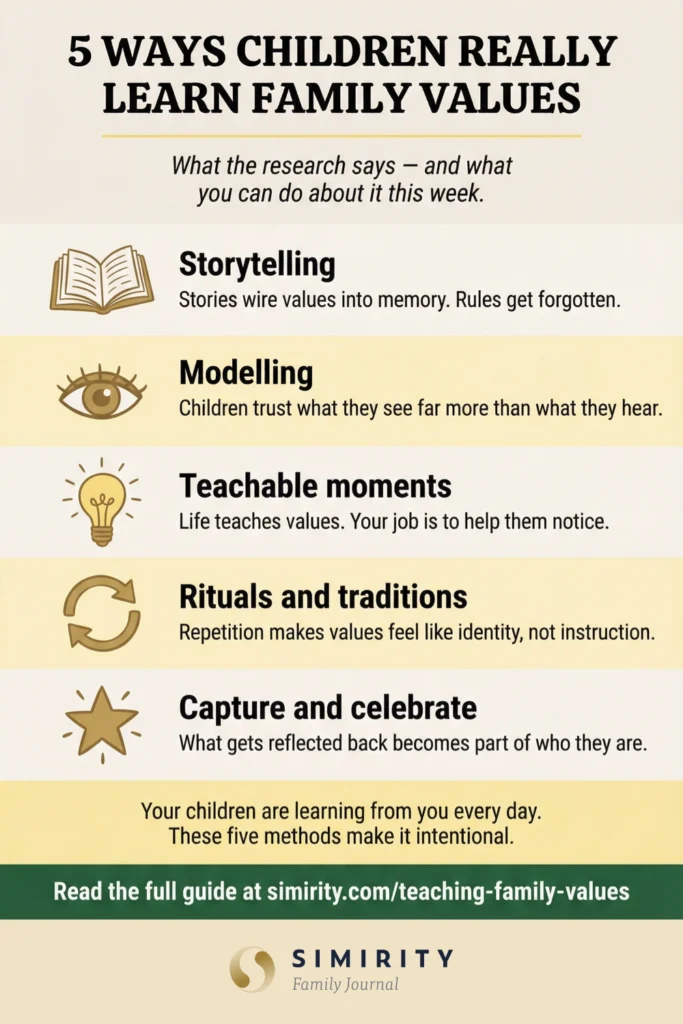
It’s easy to feel like you need to use all five methods at once. You don’t. But it’s worth knowing that they reinforce each other.
- A story plants a seed.
- Modelling shows it’s real.
- A teachable moment helps your child make sense of it.
- A ritual keeps it alive.
- Capturing and celebrating the moments where it shows up turns a value into part of their identity.
That’s the full journey. Most parents are already doing more of this than they realise — they just don’t always see it.
Family Stories Are a Gold Mine for Teaching Family Values
The values that stick with us rarely came from being told. They came from watching someone. A decision that got talked about for years. A moment you didn’t fully understand until later.
Family stories carry a different kind of weight.
Your child knows these people. That changes how the values land — not as advice, but as evidence of what people in your family actually do.
You also get to choose which ones to tell. Your parents’ lives, your grandparents’, your own — there’s more material there than you might think. When your child is struggling, there’s often a story in your family history that speaks to it. You just have to know it well enough to reach for it.
How my family got into storytelling
A few years ago, both of my parents faced serious health scares within a short time of each other. It shook me — not just for the obvious reasons, but for a less obvious one. I suddenly realised how many stories only they knew. Stories about their own lives, their parents, my childhood, our extended family and ancestors. None of it was written down anywhere. If something happened to them, it would simply disappear.
I wanted to capture those stories before they disappeared. But there was no obvious way to do it.
Social media felt wrong — too public, too noisy. Cloud storage was so uninspiring. There was nowhere built specifically for sharing family stories.
So we built the perfect place. Simirity family journal is a private space for family stories — with photos, video, audio and maps, all in one place that belongs entirely to your family. Old family stories about grandparents and ancestors next to new ones about you and your kids. All of it preserved for whoever comes next.
A collection of real family stories is one of the most powerful things you can give your children and future generations.

Overview of Teaching Family Values
The values that feel most like yours — where did they actually come from?
For most people, it wasn’t a conversation. It was a person. Something they did, or didn’t do. A moment you’ve never quite forgotten.
That’s what these five methods are really about, not delivering lessons, but creating the conditions for values to show up naturally. Through the stories you tell, the way you handle things, the moments you notice, the small rituals that quietly become part of who your family is.
Most families are already doing more of this than they think. The question is just whether those moments are visible enough to land.
Of course, before you can teach values, you need to know which ones matter most to your family. If you’re still working that out, our comprehensive list of family values walks through 100+ examples, organised by category, to help you identify what’s already there and what might be missing.
FAQs About Teaching Family Values
What is the most effective way to teach family values to children?
The most effective methods work indirectly: storytelling, modelling behaviour, using real-life teachable moments, building rituals, and celebrating when children live a value. Lecturing rarely works because values develop through experience and emotion, not instruction.
At what age should you start teaching family values?
Earlier than most parents think. Even young children pick up on what their parents do and how they respond to situations. Intentional teaching can begin as soon as a child can follow a simple story or notice fairness — usually around age 3 or 4.
How do you teach values without lecturing?
By making values visible in everyday life rather than talking about them directly. Share stories. Let your children see you make and recover from mistakes. Use real situations as prompts for honest questions. Create small rituals. And when you see a value in action, name it specifically.
How do family stories help teach values?
Stories create emotional connection in a way rules can’t. When a child hears about a real person in their family making a hard choice, they don’t just understand the value — they feel why it matters. That emotional memory is much more durable than any lesson delivered by a parent.
What if my child doesn’t seem interested in family stories?
Keep them short and specific. Avoid making the lesson obvious at the end. The best family stories don’t feel like lessons — they feel like interesting things that happened to real people your child knows. If a story doesn’t land, try a different one. Not every story works for every child at every age.
How do you know if your approach to teaching values is working?
Look for small signs rather than big declarations. Your child pausing before reacting. Bringing up a family story on their own. Calling you out when your behaviour doesn’t match what you’ve said. These are the signs that values are actually landing.

Your family’s past, present & future—woven together in Simirity.
