


Family Bonding Activities: 40+ Ideas Tailored to Your Family

Today, families have more ways to keep in touch than ever before. Still, finding family bonding activities that truly bring everyone closer, not just fill time together, can be surprisingly difficult.
We’ve seen this firsthand. Our family lives in different countries, and we tried every app out there — WhatsApp, Google Photos, video calls. These tools helped us stay in touch, but they didn’t make us feel close. Realising this difference is what inspired us to create the Simirity Family Journal.
Below, you’ll find 40+ family bonding activities tailored to your needs, along with everything we’ve learned about what really helps families bond.
Jump to section:
The Best Family Bonding Activities For Your Family
There are plenty of ideas online, but it’s much harder to find the right one for your family, your situation, and the time you really have.
The family bonding activity finder below asks four quick questions and then suggests ideas that fit your answers. It includes everything from five-minute daily rituals to full-day adventures, with options for families who live together and those who are apart. You can also bookmark your favourite activities and share them.
Connected Vs. Bonded: Why The Difference Matters
You might spend an hour on a video call and end up knowing what someone had for dinner, but still not feel any closer to them.
Being connected just means staying in touch. Being bonded means you actually feel close. These aren’t the same, and that gap explains why many families talk often but still feel a bit distant.
Connection is mostly about sharing information
You tell each other what’s new, hear their updates, and know everyone is okay. That’s important, but it doesn’t automatically make you feel close. Our research shows most families have a weekly catch-up call that’s friendly and follows the same routine. It’s comfortable, but it rarely brings people closer.
Bonding happens when people share something real
You might share a feeling, a memory, or a moment when they open up. It’s about showing who you are, not just what you’ve been doing. When someone shares honestly, it gives others a chance to respond emotionally. Over time, these exchanges build the closeness we call a bond.
We mapped this out as a simplified emotional equation:
The bonding equation
Bonding =
Authenticity and sharing experiences work best together. If you share an experience but aren’t honest, like posting only the highlights from a holiday, it doesn’t build much closeness. And being authentic without a shared experience doesn’t happen often. Emotional distance sits at the bottom of the equation: the more it grows, the weaker the bond, no matter what else you do. That’s why regular small moments of contact matter — they keep emotional distance low.
Bonding doesn’t need big gestures or lots of time. It just needs the right conditions. This is also why storytelling is so powerful for families — a good story is honest, creates a shared experience, and invites support and empathy all at once. You can try this with our First Last Best Worst storytelling game.
If you want to explore this further, our guide to family bonding apps looks at which tools are genuinely designed to create closeness, and which ones simply help you stay in touch. We also have a deeper look at how to strengthen family relationships at every stage of life.
What Makes a Family Bonding Activity Effective?
Not every family outing brings people closer, and not every dinner does either. The activity itself is just a setting — what really matters is what happens during that time.
Decades of research on family closeness show that three things keep coming up in activities that really build bonds. The best activities create all three naturally, without trying too hard.
- Shared attention. Both people are present to the same thing at the same time. This sounds obvious, but it rules out most of what passes for family time: scrolling on separate phones in the same room, half-watching television, or driving in silence. Side-by-side physical activity, a game, a shared task, or a structured conversation all create shared attention.
- Authentic disclosure. Someone reveals something real. It doesn’t have to be profound — a childhood memory, a strong opinion, or a moment of pride or embarrassment. Small authentic exchanges, repeated regularly, build the sense of being genuinely known. Emory University research found that children who knew their family’s real stories, including struggles and failures, not just achievements, had higher resilience and self-esteem than those who did not.
- A real sense of presence. The other person is truly paying attention, not distracted. That’s why relaxed settings like walks, cooking together, or car rides often work better than sitting face-to-face. Without the pressure of direct eye contact, people are more likely to open up. Researchers call this the side-by-side bonding, the kind that happens when people aren’t looking directly at each other. It’s why walking, cooking, and car rides outperform sitting face-to-face.
Biology backs this up. Research published in the Proceedings of the National Academy of Sciences found that just 30 minutes of shared storytelling doubled oxytocin and lowered cortisol in children. These are real changes in body chemistry from just one session. The right activity, done with full attention, can change how people feel about each other.
The 40+ family bonding activities in the finder above were chosen because they reliably create at least one of these bonding conditions. The top-rated activities — like looking through old photos, cooking a family recipe, or talking with a grandparent about their childhood — often create all three. Research on family rituals, including a major review by Fiese et al. in the Journal of Family Psychology, shows that regular shared rituals, even small ones, are some of the best predictors of family closeness and children’s emotional health.
The Seven Categories Of Family Bonding Activities
The activity finder above personalises 40+ family bonding activities to your family’s situation. But if you’d rather browse the different activity types first, here’s a quick overview of the categories we used:
- Everyday rituals — small consistent moments that create security and connection: shared meals, bedtime routines, car conversations, and weekly family check-ins.
- Active and outdoor — walks, bike rides, camping, day trips, and gardening side by side, where physical activity naturally relaxes conversation.
- Games and play — board games, trivia, storytelling games, scavenger hunts, and talent shows that create shared drama and laughter.
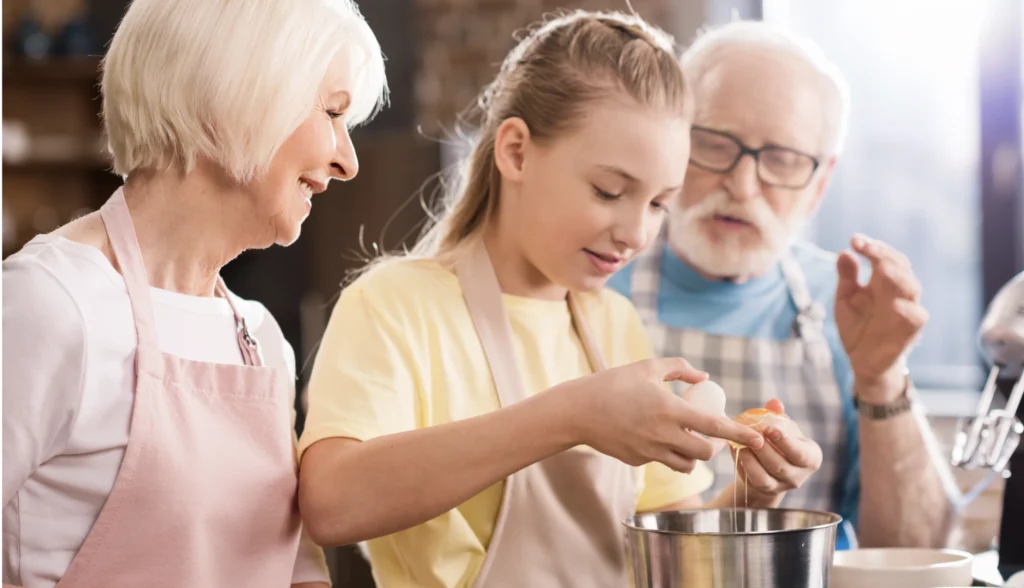
- Creative and arts — cooking, making music, photography, crafts, and film-making, where a shared project creates natural collaboration.
- Storytelling and memory — recording family stories, looking through old photos, building a family tree, and asking questions that surface the experiences that shaped your family. These types of activities are particularly powerful for intergenerational bonding, in which children gain a sense of family identity by understanding the generations before them.
- Across the miles — activities specifically designed for families living apart: scheduled video rituals, virtual game nights, shared playlists, voice notes, and synchronised everyday moments.
- Service and community — volunteering together and acts of kindness that create a sense of purpose beyond the family.
Repeating a chosen activity each week or season turns it into one of your family rituals — a shared experience your kids will remember decades later.
How Simirity Came out of Our Own Family’s Struggle
After living in different countries, we realised what research also shows: staying in touch is not the same as staying close.
We understood that storytelling could help. Sharing real memories, asking deeper questions, and capturing the experiences that shaped us are what create genuine bonds. And unlike a bike ride or a board game night, storytelling is something you can do across any distance. A phone call, a voice note, a recorded conversation — geography becomes almost irrelevant.
The harder question was where to do it.
Social media felt wrong immediately. Our family stories are private, and the idea of sharing them beyond our own family, even accidentally, made us uncomfortable. Shared documents worked in theory but felt sterile in practice. Nobody felt inspired to open a Google Doc and write about their childhood. We tried messaging apps, but long stories got buried under daily chat. Nothing felt like the right home for something that mattered this much.
We also had a creeping sense of urgency. My parents are in their retirement years. The stories they carry — their childhoods, the decisions that shaped our family, the moments of struggle and joy that only they remember — exist nowhere except in their memories.
If we didn’t capture them now, one day they’ll be gone.
That combination of need and frustration is what led us to build Simirity. A private family journal designed specifically for storytelling across generations and distances. It prompts you when you’re not sure what would make a good story. It keeps everything in one place, visible only to the family members you invite. And it’s built to feel warm and engaging rather than like a filing cabinet.

Whichever family bonding activities you choose, the same three conditions apply — shared attention, authentic disclosure, and a felt sense of presence. Build those in and the activity itself almost stops mattering.
If your family also faces the challenge of staying connected across distance, our guide on how to stay connected with family when you live apart shares practical approaches that really work.
FAQ About Family Bonding Activities
What is family bonding and why does it matter?
Family bonding is the process of building genuine emotional closeness between family members over time. It is distinct from simply staying connected: you can be in regular contact with someone and still feel like a relative stranger to them. Bonding happens through shared authentic experiences, mutual support, and conversations that go beyond surface catch-ups. Research from Emory University found that children who have a strong sense of their family’s stories and history have higher self-esteem, greater resilience, and better mental health outcomes than those who do not. It is one of the strongest predictors identified in developmental psychology.
How do you bond with family members you don’t live with?
Distance makes bonding harder, but not impossible. The key is moving beyond logistics-based contact, such as catch-up calls covering news and plans, toward activities that foster authentic sharing. This includes recording and sharing family stories, reading together over video, cooking the same recipe in different kitchens on the same day, building a shared playlist, and establishing a predictable call ritual with a structured activity instead of open-ended chat. Our full guide on how to stay connected with family when you live apart covers the most effective approaches for long-distance families.
What activities strengthen family bonds the most?
Activities that create all three bonding conditions simultaneously tend to be the most powerful: shared attention, authentic disclosure, and a felt sense of presence. In practice, activities like cooking a heritage recipe together, looking through old photos and asking questions, recording a family member’s stories, and regular storytelling games tend to outperform passive activities like watching television.
The activities most consistently shown to strengthen bonds are storytelling, shared meals, and shared problem-solving. See our deeper guide on how to strengthen family relationships through questions, or which bonding apps support each activity type.
How often do families need quality time together?
Frequency matters less than consistency and quality. Research by Fiese et al. in the Journal of Family Psychology found that regularity and predictability of family routines, not their duration or elaborateness, produce the strongest outcomes for children’s emotional health. A daily five-minute ritual that happens reliably is more beneficial than an occasional long event. For families living apart, a fortnightly video call with a structured activity is likely more bonding than a monthly open-ended catch-up.
When are the best times for families to bond?
Natural gathering points like summer holidays, Christmas, Easter, and school events are valuable because they bring people together who might not see each other often. These occasions create shared experiences and conditions for bonding conversations. However, relying only on seasonal gatherings means long gaps between bonding opportunities. Families who feel closest build smaller regular rituals throughout the year instead of placing all the weight on a few annual events. Our guide to bonding at Christmas explores how to make the most of the seasonal moments your family already shares.
Is family bonding different for different age groups?
The conditions for bonding are the same across ages, but the activities that create them vary. Young children bond through play, physical closeness, and consistent rituals. Teenagers often bond more easily in side-by-side activities like driving or cooking where there is no direct eye-contact pressure. Adults bond through shared experience, mutual support, and conversations that reveal values and history. Older adults often hold the richest material for family bonding — stories, memories, and accumulated wisdom — and the most time-sensitive opportunity to share it. The activity finder above is designed to surface the right activities for the specific person and situation you have in mind.
What if my teenager doesn’t want to join in family activities?
It’s normal, and it’s rarely personal. Teenagers are wired to pull towards independence and their own friends, so resisting “family time” is part of growing up, not a rejection of you. The trick is to stop making togetherness the goal and instead back the things they’d happily do anyway, a skill they want to learn, a project, a day out on their terms, and let the connection ride along with the activity. A teenager will sit beside you for something they chose long before they’ll sit across from you for a scheduled chat. The long summer holidays are the easiest window to try it, and if you’re stuck for ideas, our free summer activities for teenagers tool builds a tailored shortlist based on what your teen is actually into.

Your family’s past, present & future—woven together in Simirity.
