


Your Family Story Score shows how well your family’s stories are being saved in the ten areas that matter most to future generations. Take our free assessment to find out how your family is doing.
Family Story Preservation Score
What's Your Family Story Score?
A free assessment of how well your family's story is being preserved
One day, you'll want to hear your mom or dad telling that story again. Or remember exactly who your kids were at this age. Stories make that possible, but only if they're captured.
Find out how well your family's stories are really being preserved, and which ones are most at risk of being lost.
18questions across 10 chapters
100point personalised score
5 minto complete
First, let's personalise your results
Three quick questions — tap one answer each. No right or wrong responses.
For example
Congratulations — you've taken the first step towards preserving your family's stories.
0
Family Story Score — out of 100
Your priority insight
Your score by chapter
Start preserving what matters
Simirity Family Journal gives your whole family — from grandparents to grandchildren — a private, beautiful space to capture stories, share memories, and preserve the moments that deserve more than a WhatsApp message. Explore the demo and see what's possible.
Explore the demoFree guides to help you get started
Not sure where to begin? These free downloadable guides give you a ready-made interview framework — thoughtful questions designed to unlock the stories your family hasn't told yet.
Interview questions to ask your mom
350+ thought-provoking questions across 13 themes — a complete interview framework covering her childhood, your parents' love story, her career, and her reflections on life. Free PDF download included.
›
Interview questions to ask your dad
The same rich interview framework tailored for your father — exploring his career, his own parents, the moments that shaped him, and the wisdom he's accumulated along the way. Free PDF included.
›
Questions to ask your kids
75 revealing questions that explore who your children really are right now — their identity, values, dreams, and memories. Capture their inner world before it changes. Free PDF included.
›
How well do you know your parents?
A fun, revealing quiz that tests how much you really know about your parents' lives, personalities, and stories — and shows you exactly where the gaps are.
›
Why Stories Get Lost
Almost half of people wish they had recorded conversations with a loved one who has passed away. That finding, from a YouGov survey of over 6,000 people, isn’t about families who didn’t care. It’s about families who meant to, who planned to, but ran out of time before they realised how little they had left. Stories are lost not through neglect, but through five common misbeliefs that are surprisingly easy to slip into.
Misplaced Trust
Someone’s saving stories…
The bigger the family, the easier it is to believe the stories are safe. There are so many people, surely somebody must be capturing them.
But responsibility shared across a whole family has a way of slipping through the gaps. Nobody decides to let the stories go. They simply assume they don’t need to be the one to act, and so nobody does.

In a big family, everyone assumes someone else is saving the stories

Life is full, and ‘later’ keeps arriving
Busy Lives
Now Is Not the Right Time
It is hard to think about preserving family stories when daily life feels this full. The plan is real. The desire is genuine.
But capturing stories asks for time and attention that busy families struggle to find, so it gets put off, reasonably and repeatedly, until a calmer moment arrives. For many families, that moment never comes.
Photo Reliance
Photos aren’t the whole story
These photographs are precious, but they only tell half the story. The other half, who these people were, what they felt, what brought them to this moment, lives only in the memories of those who were there.
When those people are gone, the photographs remain. But the stories they carry quietly disappear with them.
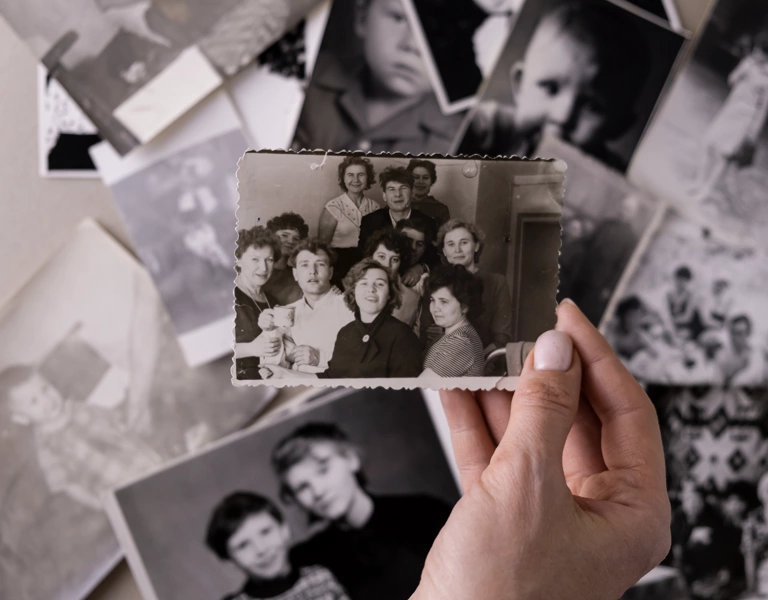
Photos show the moment, not the story behind it
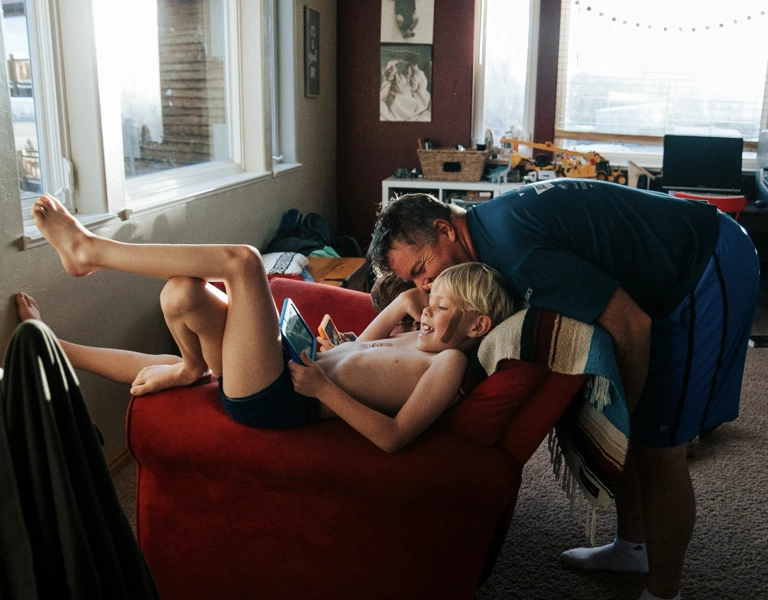
The ordinary days are the ones we miss most
‘Big Moments’ Bias
‘Ordinary’ moments missed
It’s tempting to save the camera for special occasions. But there are so many ordinary moments that both today’s family and future generations will want to look back on.
Family life, especially with children, is filled with countless simple moments that feel too ordinary to record, yet they disappear all too soon. By the time a family realises which moments mattered most, it is too late to capture them.
Memories Fade
Stories feel deceptively safe
There is a common belief that stories are secure as long as the person who lived them is still here. But memory is not a reliable archive.
Research has found that children forget 90% of what their parents told them about their own lives within just 20 years. The details that feel vivid today are already fading. Often the bulk of a family’s stories sits with its elders, whose memories are not what they once were, and who won’t be around forever to tell them.

Memory is not a reliable archive
More Free Family Tools




Questions About Your Score
How is my score calculated?
Your score is based on 18 questions spread across 10 areas of family life, each answered on a sliding scale from 1 to 5. A score of 1 means that aspect of your family’s story is essentially uncaptured and at risk of being lost; a score of 5 means it’s well preserved. Each of the 10 areas contributes to your overall score, expressed as a number out of 100. Before the main questions begin, three short priority questions personalise your results, identifying which areas matter most to you and weighting your score accordingly, so the insights reflect your own situation rather than a generic average.
How were the ten areas of family life chosen?
The ten areas were chosen to reflect the full breadth of what a family represents across generations, not just the milestone moments, but the people, places, wisdom, traditions, heritage and everyday experiences that give a family its character and identity. The goal was a framework complete enough that a family scoring well across all ten areas would have genuinely preserved something meaningful for future generations, and one where a low score in any single area reveals a real and specific gap worth addressing.
What should I do if I score low?
A low score isn’t a verdict, it’s a starting point. The most important thing is to begin somewhere specific rather than trying to tackle everything at once. If your score reveals that your parents’ stories are at risk, a good first step is a single recorded conversation, not a formal interview, just a cup of tea and a handful of questions you’ve never thought to ask before. Simirity’s free guides to questions to ask your mom and questions to ask your dad are a practical place to start. If your children’s stories feel undercaptured, even brief written notes about who they are right now are worth far more than you might think; here’s a questions guide for kids to get you started. The goal isn’t perfection, it’s preservation.
What kinds of family stories do people most regret not capturing?
The pattern is remarkably consistent across thousands of people who have reflected on this. The stories people most wish they had captured fall into a few recurring categories: their parents’ and grandparents’ early lives; the story of how their parents met and fell in love; the wisdom accumulated through decades of experience that was never formally passed on; the meaning and history behind family objects, photographs and heirlooms; and the inner emotional world of people they loved, what they were really feeling during the defining moments of their lives, not just what happened. These are rarely the stories anyone thinks to ask about, and they’re almost never written down anywhere.
How can the Simirity Family Journal help?
Simirity is a private family journaling platform built specifically for preserving the kinds of stories this assessment measures. It gives every family member their own space to write stories, record voice notes and add photos, organised by theme, searchable, and accessible to the whole family across generations. Unlike social media or messaging apps, Simirity is designed for depth rather than surface-level interactions: stories are meant to last and help your family feel closer. If your score has revealed gaps you’d like to start filling, the Simirity demo is a good place to see how families capture stories. No sign-up needed.