


Revealing Questions to Ask Your Kids (That Capture Who They Are)

If you want to capture your child’s inner world before this age slips away, these 75 questions to ask your kids will reveal who they truly are right now.
Your child’s views and opinions on all aspects of life are constantly evolving. What they believe at eight might well be completely different by twelve, and unrecognisable by sixteen. Many parents never think to ask these thought-provoking questions until it’s too late, and then can’t quite remember what their children thought or felt at each stage. They undoubtedly have thousands of photographs showing what they looked like, but nothing capturing what was going on in their mind.
That’s what makes these insightful questions for children aged 8 to 18 so valuable. They’re designed to reveal your child’s inner world—not what happened at school today, but how they see themselves, what matters most to them, and how they make sense of life. Ask them now, and you’ll gain a deeper understanding of your child. Preserve the answers, and you’ll both treasure this glimpse into who they were before everything changed.
Jump to section:
How to Use These Questions
The best conversations happen naturally, not as formal sit-downs.
I’ve found car journeys work brilliantly for deeper conversations—something about not making eye contact helps children open up. Bedtime, family walks, and lazy weekend mornings also work well.
Don’t rush through them. The odd question might flop, while others might lead to a fun and insightful 20-minute conversation—so be ready for either outcome. Some families choose a question of the week at Sunday dinner. Others ask spontaneously when the moment feels right. Do whatever suits your family.
If your child says “I don’t know” or gives a shrug, that’s fine. Come back to it another day, or try a different question. Forcing answers defeats the purpose—you want genuine thoughts, not performance.
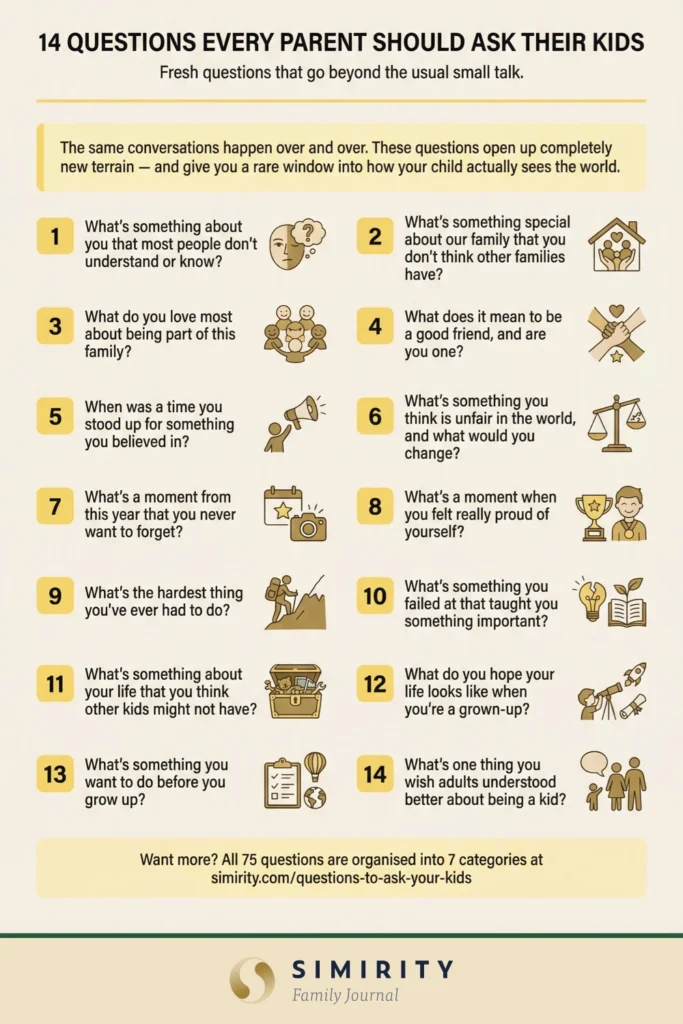
75 Questions to Ask Your Kids
Browse a preview of questions across seven categories — each exploring a different aspect of your child’s inner world. Click any question to bookmark it for later.
The above questions are just a taste of what’s available. The complete guide includes all 75 questions organised by category, with guidance for children aged 8–18.
You’ll get:
- All 75 questions organised into 7 categories
- Tips for revisiting questions as your children grow
- Ideas for preserving and sharing their answers
Build a Personality Time Capsule by Repeating Questions Over Time
I’ve made it a family tradition to ask my boys these types of questions every New Year.
Revisiting their answers from previous years is priceless—watching how they’ve changed, what mattered to them at different ages, how their thinking evolved. It’s like a time capsule that reveals their inner world.

I certainly don’t remember my thoughts and feelings from childhood. That’s the gift I can offer my children, and you can offer yours too. Years from now, they’ll treasure having this rare insight into how they once were.

Preserve their childhood memories in media-rich stories.
How to Preserve Their Answers
I’ve tried different methods of recording these conversations with my boys. Video seemed ideal at first, but I found they performed for the camera rather than thinking genuinely about their answers. Cute, but not really what I was after! Audio recording works far better—a simple voice memo app on my phone captures their voices without making them self-conscious.
The challenge comes afterwards: what do you actually do with these recordings?
I wanted to share them with my wife and my parents, and ensure my boys could access them years from now when they’re curious about who they once were. But I didn’t want these precious recordings buried on my phone or computer, lost amongst thousands of other files.
Some families keep a physical journal, writing key answers alongside dates—though that means losing the actual voice recordings, which seems a shame. Others create shared digital folders on Google Drive or Dropbox for uploading audio files. Both work, but neither felt quite right for what I needed.
What I really wanted was a home for all our family content—these recorded conversations, yes, but also photos with relevant background information, videos, and written stories from older relatives, as well as life lessons worth passing down.
Somewhere private that our whole family could access and contribute to. A proper family journal, not just a storage folder.
It turned out no such place existed, so we built one.

Simirity is our family’s private journal online.
All generations can create stories that incorporate audio recordings (such as the conversations I have with my boys), photos, videos, written memories, documents, maps—whatever helps tell the story properly. We named it after the 2,000-year-old ‘Smriti’ texts that preserved details of life back then.
Now all generations of our family feel closer than ever as we explore each other’s stories. My children read diary entries from their great-great-grandparents. My parents share their life stories. And yes, my boys’ annual audio recordings live there too, building their personality time capsule year by year.
Learn more about the features that could help your family share stories and connect:
More Ways to Spark Family Conversations
These questions are just the beginning. If you’re enjoying deeper conversations with your children, consider exploring your family’s broader story too.
Discover your parents’ stories
Want to capture your own parents’ memories before it’s too late? Our guides to questions to ask your mom and questions to ask your dad help you uncover the stories that shaped them—and ultimately shaped you. Your children will treasure knowing their grandparents’ histories too.
If you prefer a game to uncover interesting stories about your parents, play the how well do you know your family game, with questions covering six aspects of life. You can explore your knowledge of all family members, not just your parents.
Turn conversation into play
Looking for something lighter? Try our would you rather questions for families. It’s a fun game that kids love, but it cleverly reveals their values, priorities, and how they think—and everyone has a good time in the process.
Or try our Family Story Game. Take turns drawing cards with question prompts tailored to your stage of life, so everyone from grandchildren to grandparents gets questions relevant to them.

Your family’s past, present & future—woven together in Simirity.
Tips for Asking Your Kids Meaningful Questions
Timing matters more than you think
Forget formal sit-down conversations. These questions work brilliantly during car rides, bedtime, while making dinner together, or on weekend walks. Choose moments when your child is naturally relaxed and you won’t be interrupted. Avoid asking when they’re tired, hungry, or stressed about homework.
Don’t ask them all at once
One thoughtful question per week creates far better conversations than rushing through a list. This isn’t a questionnaire to complete—it’s about creating meaningful moments. Some families make it a Sunday evening tradition; others ask spontaneously when the moment feels right.
“I don’t know” is a valid answer
If your child shuts down or genuinely can’t answer, don’t push. Come back to it another time, or try a different question. Forced conversations rarely produce honest insights. Sometimes children need time to think, or they’re simply not ready to discuss certain topics yet.
Share your own answers too
These work brilliantly as two-way conversations. After your child answers, share your response to the same question. It shows you’re not just testing them—you’re having a genuine exchange. Children often become more thoughtful when they see you being authentic and vulnerable too. It’s a great way to connect more deeply with them too.
