


The Importance of Family Storytelling: 25 Research-Backed Statistics

What does research really tell us about the importance of family storytelling — and how much difference does it make?
The answer is more surprising than most people expect. Knowing family stories predicts children’s resilience and self-esteem better than almost anything else. Just thirty minutes of storytelling can change a child’s body chemistry. The positive effects of family storytelling can even be seen in mental health nearly twenty years later.
We set out to create the best resource for statistics on the importance of family storytelling, gathering the most compelling data from trusted sources. Instead of a dry list of numbers, we wanted to share these findings as a story families might recognise from their own lives.
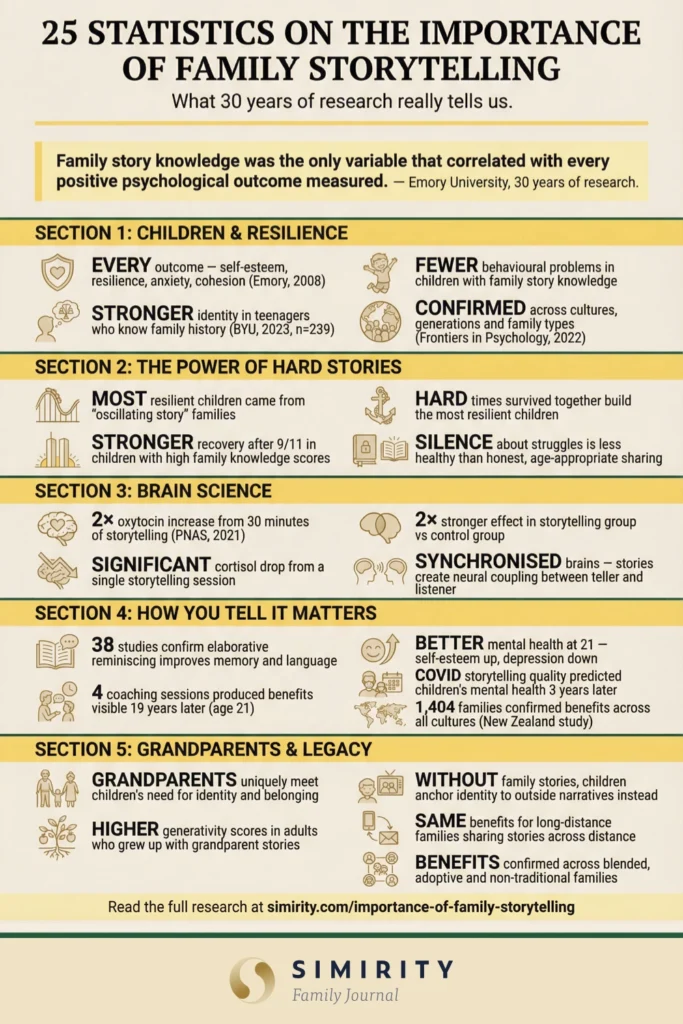
Before diving into all the details, here are three findings that really stood out to us:
STAT 1 — Family story knowledge predicted every positive outcome measured. Self-esteem, resilience, anxiety, family cohesion — children who knew their family’s stories scored better on all of them. (Emory University, 2008)
STAT 2 — 30 minutes of storytelling doubled oxytocin and reduced cortisol. Measurable changes in children’s body chemistry — from a single storytelling session. (PNAS, 2021)
STAT 3 — Four coaching sessions. Nineteen years of measurable benefit. A brief intervention teaching mothers to tell stories more openly produced improvements in children’s self-esteem and mental health that were still visible at age 21. (Journal of Research in Personality, 2022)
The research on the importance of family storytelling covers several key areas, and we’ve organised this article to match:
What Do Children Gain From Knowing Their Family Stories?
The most well-known research in this area comes from Emory University’s Family Narratives Lab. Psychologist Robyn Fivush and her team have studied family storytelling for over 30 years, and their work led to some of the most important findings in developmental psychology.
They created the “Do You Know?” scale — a set of 20 questions measuring how much children know about their family’s history.
Questions like:
- Do you know how your parents met?
- Do you know where your grandparents grew up?
- Do you know about a time your family struggled, and how they got through it?
When researchers compared children’s scores to different psychological outcomes, one pattern stood out above everything else:
Family story knowledge was the only variable that correlated with every positive psychological outcome measured — including self-esteem, internal locus of control, family cohesion, lower anxiety, and fewer behavioural problems.
These aren’t just quiz questions. They show whether a child has been included in the family’s story. The children who could answer more of them were doing better in every area measured.
A 2023 study from Brigham Young University (N=239) found that these results also apply to teenagers: knowing more about family history predicted healthier identity development. A 2024 review in the Personality and Social Psychology Review, one of psychology’s top-ranked journals, called intergenerational storytelling “extraordinarily rich developmental resources.” The benefits were even stronger for children from marginalised communities, where family stories help anchor identity against negative outside messages.
A 2022 systematic review in Frontiers in Psychology confirmed the Emory Lab’s findings: this pattern holds across generations, cultures, and family types. It is not just a Western or middle-class effect.
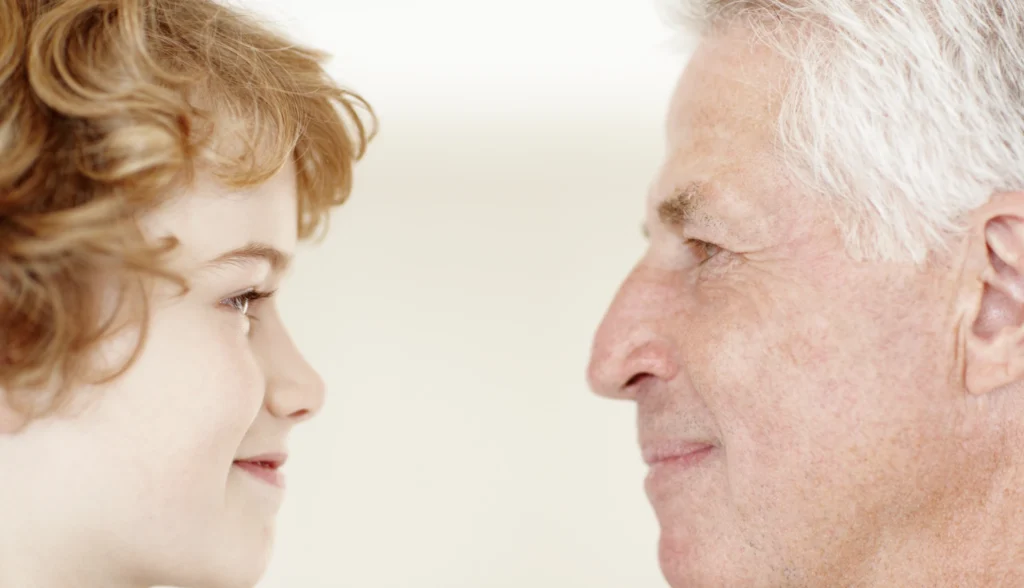
What to test your knowledge of your family? Play our how well do you know your family game, with questions covering six aspects of life.
Why Do the Hard Family Stories Matter Most?
One of the most surprising findings is about which stories matter most. It’s not just the happy moments or big achievements.
The hard times matter too.
Researchers found three types of family stories:
- Ascending stories, where things kept getting better
- Descending stories, where things went wrong
- Oscillating stories, which include both hard times and recovery
When researchers compared outcomes across these groups, the children who did best were not from families that only shared successes.
Families that shared oscillating stories — “we’ve been through hard times, but we got through them together” — raised the most resilient children. Not the families who only talked about triumphs.
The US September 11 follow-up study shows this clearly. Children who scored higher on the family knowledge scale before the terrorist attacks showed much stronger emotional resilience afterwards. Not because their families had prepared them for terrorism, but because they already understood that hard times can be survived. They knew things had gone wrong before, and the family made it through.
It’s important to remember that sharing the tough parts of your family’s story — job loss, illness, a move that didn’t work out, a relationship that ended — is not a burden for your children.
It helps prepare them for life.
Two of the most treasured conversations I’ve had with my parents were tough ones, relating to the loss of loved ones and serious health issues. Neither were easy conversations to have. But we were able to go far beyond the usual scope of conversations, and connected in a way we rarely do.
Based on my experiences, I’d say that the harder the story is, the more potential there is for human connection.
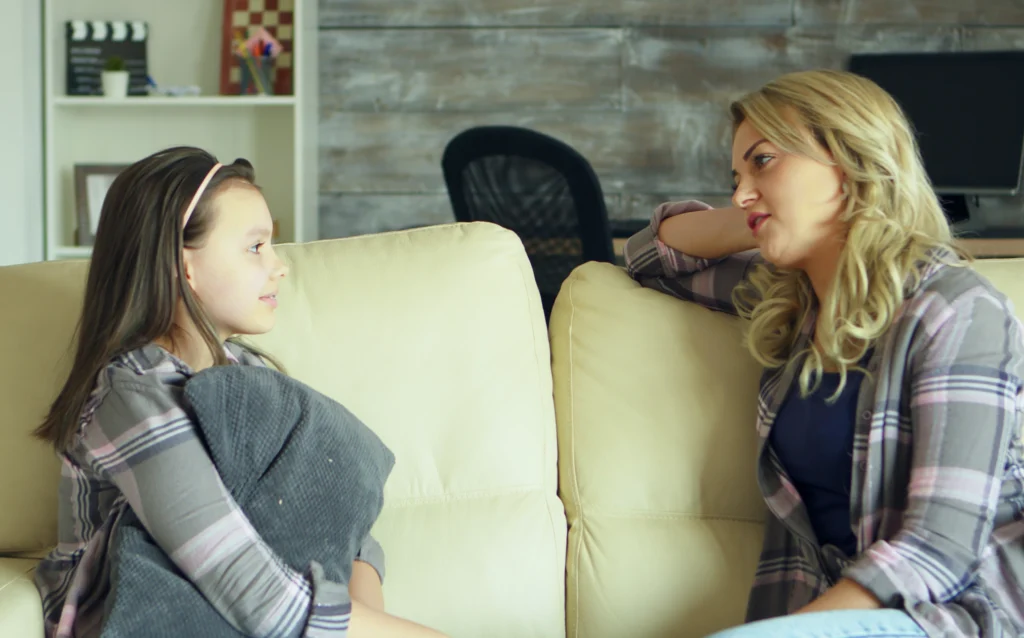

Real-life family stories teach life’s greatest lessons.
How Should You Tell a Family Story?
It’s one thing to know that family stories matter. Understanding what good family storytelling looks like is where the research becomes truly helpful.
Researchers have spent decades studying something called “elaborative reminiscing” — the difference between just telling a child what happened and inviting them into the memory.
A meta-analysis of 38 studies over 30 years, published in Psychological Bulletin, the top review journal in psychology, found that this approach consistently improves children’s:
- Memory
- Language skills
- Understanding of others’ feelings
All of this comes from how parents choose to tell stories.
‘Elaborative reminiscing’ means asking open questions, adding emotional context, and inviting children to help build the memory. This approach leads to much better outcomes for children than simply telling them what happened.
What this looks like in practice
The difference is actually simpler than it sounds. When a child says “remember when we went to Grandma’s and it rained the whole time?”, there are two ways to respond:
- “Yes, it rained.” — closed, done, moving on.
- “Ha — yes! What do you remember most about that? Grandma was so funny that day, wasn’t she? How do you think she felt, having all of us stuck inside for three days?” — open, curious, emotionally engaged.
One response just records what happened. The other helps build a memory, strengthens the relationship, and gives the child a better understanding of both themselves and their grandmother. Research shows that taking the extra thirty seconds for the second approach is worth it.
The 19-year experiment
Some of the strongest evidence for elaborative reminiscing comes from the Growing Memories study, a randomised controlled trial that followed families for almost twenty years. Mothers of toddlers received just four short coaching sessions on how to reminisce more openly. By age 15, their children had better storytelling skills and fewer emotional problems than the control group. At age 21, they reported higher self-esteem and lower rates of depression. Four sessions. Nineteen years of measurable benefit.
Research tracking families during Covid in 2020 found that the quality of family storytelling conversations during lockdown predicted children’s mental health three years later — independently of school disruption, parental stress, or screen time.
The largest population study to date — Growing Up in New Zealand, with 1,404 families across Māori, Pacific, Asian, and European backgrounds — confirmed the same pattern: more elaborative family storytelling was associated with fewer emotional problems and greater prosocial behaviour in children at age 8, across all cultural groups.
What Happens in the Brain When Families Share Stories?
Beyond developmental research, neuroscience helps explain why storytelling works so well at a biological level.
Brain imaging studies from Princeton’s Hasson Lab showed that when one person tells a story, the listener’s brain activity begins to mirror the speaker’s in real time — a phenomenon called neural coupling.
A 2024 follow-up study found the effect was strongest in the brain’s default mode network — the same network responsible for autobiographical memory and identity. Stories don’t just transmit information. They physically synchronise the minds of the people sharing them.
One of the most striking biological findings comes from a clinical study published in the Proceedings of the National Academy of Sciences. Researchers tested storytelling with 81 children in hospital intensive care units. Thirty minutes of storytelling led to a significant increase in oxytocin, the bonding hormone, and a significant drop in cortisol, the stress hormone. The storytelling group showed effects twice as strong as the control group. A well-told story can measurably change a child’s body chemistry.
Stories literally synchronise the brains of teller and listener. Thirty minutes of storytelling can double oxytocin levels and significantly lower cortisol in children.
This is why family storytelling doesn’t just feel meaningful — it is meaningful, right down to the biology.
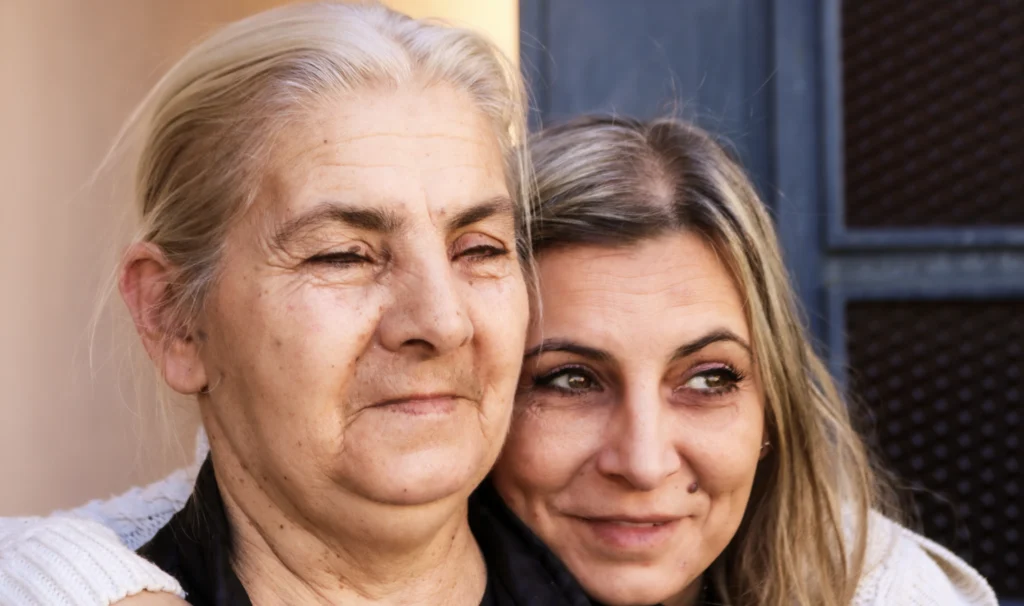
When It Comes to Storytelling, Why Do Grandparents Matter Most?
The Emory research pointed out something important: family stories are usually shared by mothers and grandmothers during dinners, holidays, and car journeys — not in formal family history sessions, but in ordinary everyday moments.
Grandparents have something parents simply can’t offer. They’ve lived through more — career changes, difficult marriages, historical events, migrations, and times when things almost fell apart.
Their stories carry a different kind of weight.

A 2024 review by Weststrate, McLean, and Fivush describes grandparents’ storytelling as a true exchange. Grandparents meet a deep human need to pass on what they’ve learned, what psychologists call “generativity.” At the same time, grandchildren build their sense of identity by hearing these stories. Both generations benefit.
When researchers followed young people into their twenties, those who had grown up with richer grandparent narratives showed higher scores on generativity themselves, a sense of wanting to contribute something meaningful to the world. Stories heard in childhood were still shaping who they were becoming, decades later.
What happens when the stories are never shared
Studies of families who didn’t pass down stories found that young people were more likely to define themselves by outside narratives rather than family ones. Without a strong sense of where they come from, identity becomes harder to anchor.
This is especially true for expat and multicultural families, where the distance from grandparents is both physical and generational.
Research shows that children who know their grandparents’ stories, even through a screen or a shared family archive, do better on identity measures than those who only know their grandparents exist.
3 Key Lessons for Your Family
You don’t need a special plan, occasion, or family history project for this.
The research shows that simply having more open and curious conversations can make a real and lasting difference.
Lesson 1: Make questioning your superpower
So many precious stories can be unlocked by carefully chosen questions. The problem is that most of us use the same old questions on repeat, and don’t take the time to consider what stories you would really like to hear about.
Instead of asking ‘how are you?’ or ‘what have you been up to?’ go deeper using the questions in these resources:
- Family journal ideas that can uncover a wide range of family stories
- Play our Family Story Game. Take turns drawing life-related question cards with questions tailored to your stage of life, so everyone from grandchildren to grandparents gets questions relevant to them.
- 350+ thought-provoking questions to ask your mom and your dad — a must-read for anyone who would like to explore their parent’s past
Lesson 2: Share the hard stories, not just the happy ones
The families with the most resilient children shared the whole story, not just the highlights. Talking about times your family struggled — job loss, illness, a tough move — is not a burden for your children. It helps prepare them.
Lesson 3: Help grandparents to share their stories regularly
Don’t wait for Christmas or special occasions. Make space for grandparents to share their stories regularly, in whatever way works — a question sparked by an old photograph, or sitting them down with a list of the stories you would like to explore.
Wondering how well your own family’s stories are actually being preserved? Take the free Family Story Score assessment and find out in five minutes.
Simirity — The Home of Family Stories
Wanting to connect more deeply with my own family and ensure that our stories live on for future generations, we created a purpose-built app for family stories.
It’s the perfect place to collect everything that relates to your family, from ancestral tales to what your children got up to today.

The research is clear: children who know their family stories are more resilient, emotionally grounded, and healthier. You don’t need to do anything extraordinary — just bring a little more intention to the conversations you already have.
Ready to start preserving your family’s stories?
Or check out our demo app and imagine the stories your family could share.
This article is part of our family statistics collection — if you’d like to explore the broader picture, our roundup of statistics about family brings together the most interesting findings in one place.
FAQ About Family Stories
At what age should I start sharing family stories with my children?
Research suggests it’s never too early to start. Studies show that elaborative reminiscing with children as young as two brings benefits that last into adulthood. You don’t need to share complex stories with toddlers, but the habit of open, emotionally engaged conversation can start from the very first years.
Does this apply to blended families, adopted children, and non-traditional families?
Yes. Research that looked at many different family structures — including chosen and adoptive families — found similar benefits. What matters is having a meaningful family narrative, not the biological or legal structure.
Does this only apply to Western families?
No — and the research is explicit about this. A three-culture study comparing Chinese, Māori, and European New Zealand adolescents found that self-esteem was linked to narrative features regardless of cultural background. Research in Ghana using UNICEF data across 6,752 children confirmed storytelling benefits across all four domains of early childhood development. The style of storytelling varies by culture — the outcomes do not.
What if my family’s history includes trauma or painful events?
The research does not suggest sharing everything, or sharing difficult things without care. What it does suggest is that age-appropriate honesty about the hard parts of your family’s story — delivered with emotional context and a sense of how the family got through it — is healthier than silence. It is the difference between burdening a child with adult detail and giving them the honest, human version of where they come from.
Does this work for families who don’t live close to their grandparents?
Yes — and this is especially good news for expat and long-distance families. The research measured what children know about their family’s history, not how often they see grandparents in person. Families who shared stories across distance — through calls, shared archives, voice messages, or letters — had similar results to those living nearby. It’s the stories that matter, not the distance.

Family is forever—make sure their stories are too.
