


6 Best Storyworth Alternatives for Preserving Family Memories in 2026

If you’re researching StoryWorth alternatives, you’re likely realising that your parents’ stories won’t be around forever and should be saved without delay. For me, it was my parents’ health concerns that inspired me to find the best way to explore and preserve their past.
Family stories are one of those things you don’t realise how precious they are until they’ve gone—and unfortunately, all too many families have learned this the hard way. Traditionally, stories were passed down through word of mouth and/or preserved in books like StoryWorth’s. These approaches work well, but today they’re complemented by digital alternatives that can make family stories even more engaging and accessible.
In this updated 2026 guide, we’ll explore the best StoryWorth alternatives available today, helping you choose the right approach to discover your parents’ untold stories and preserve them as a story legacy that your children and grandchildren will treasure.

Disclosure: This guide is published by Simirity. Our own app is included among the alternatives reviewed. We’ve done our best to evaluate all options fairly.
Jump to section:
What Is StoryWorth and Why Look for Alternatives?
How StoryWorth works
StoryWorth has captured over 10 million stories worldwide, helping families preserve memories through a reliable and time-tested solution.
As the subscriber, you select one family member to receive weekly questions about their life by email. They respond by typing their answer or using speech-to-text, and their answers are shared with family members once submitted. At the end of the year, all responses are compiled into one hardcover life story book.
If you like the weekly question format but want to try it before paying for a subscription, we run a free version. 52 Weeks of Family Stories emails you one question a week to ask your mom or dad, for a year. There’s no book at the end, just the questions.
StoryWorth pricing
StoryWorth restructured its pricing in 2026 and now offers three plans:
- The Basic plan ($59/year) includes one black-and-white book — a downgrade most families won’t want.
- The Color plan ($109/year) includes a full-colour book, a phone recording with transcription, personalised questions, and a built-in proofreader — this is the plan most families actually need.
- The Unlimited plan ($199/year) includes two full-colour books, unlimited storytellers, and 60 minutes of guided phone interviews per person.
7 common reasons people seek StoryWorth alternatives
StoryWorth is the most established service in the memory book space, but like any platform, it involves trade-offs. Here are the key challenges that might cause families to look for alternatives:
- Limited book distribution – Your subscription includes just one physical book. Would you like copies of this family memory book for your siblings? Your children? Additional books cost $39 for black and white, $79 for colour up to 300 pages, or $99 for colour above 300 pages. A family wanting five colour copies faces $316+ in extra costs on top of the subscription.
- Single-person focus – You select one storyteller who creates one book. The concept is that you’re capturing their life in a book. Saving multiple family members’ stories requires separate subscriptions and separate books—$99 per person. This individual approach works well for commemorating one person’s life, but doesn’t easily capture the interconnected stories that make up larger family histories.
- The typing burden – Many older parents or grandparents find typing lengthy stories physically difficult or time-consuming. While StoryWorth recently added speech-to-text functionality, the actual recordings aren’t saved—only the transcribed text appears in the final book. Some also find speaking stories on cue intimidating without a real conversation partner.
- One-way communication – The email prompt system lacks the natural back-and-forth that draws out richer details. When your mom mentions “that summer at the lake,” there’s no opportunity for immediate follow-up: “Which lake? Who else was there? What made it special?” So important details you may wish to capture may get missed.
- Rigid annual structure – The weekly commitment for a year can feel inflexible. Maybe your dad wants to write five stories during winter when he has more time, then take the summer off. StoryWorth’s structure doesn’t accommodate these natural rhythms—it’s one story per week for 52 weeks.
- A finished book can become a closed chapter – There’s genuine joy when the completed book arrives after a year of work. But many families find that it eventually sits on a shelf, rarely opened. Digital alternatives can weave stories into daily family life—appearing in feeds, sparking conversations, and keeping memories actively part of your ongoing connection rather than a project that ends when the book is printed and shelved.
- Format limitations – Physical books are wonderful keepsakes and look lovely, but they’re limited to text and photos. Stories come alive through voice recordings that capture mom’s laugh, videos that show how dad tells his favourite tale, or interactive maps showing the places that mean something to them. These elements can’t exist in a printed book, yet they’re often what make memories most vivid and engaging—especially for children who prefer YouTube-style entertainment.
StoryWorth is the right choice if you want a trusted, low-friction service where your storyteller simply replies to weekly emails and receives a beautiful book at the end.
It works best when you’re documenting one person’s life and a physical keepsake is the goal.
Quick Comparison: StoryWorth Alternatives
Here’s a quick-look guide showing how StoryWorth compares.
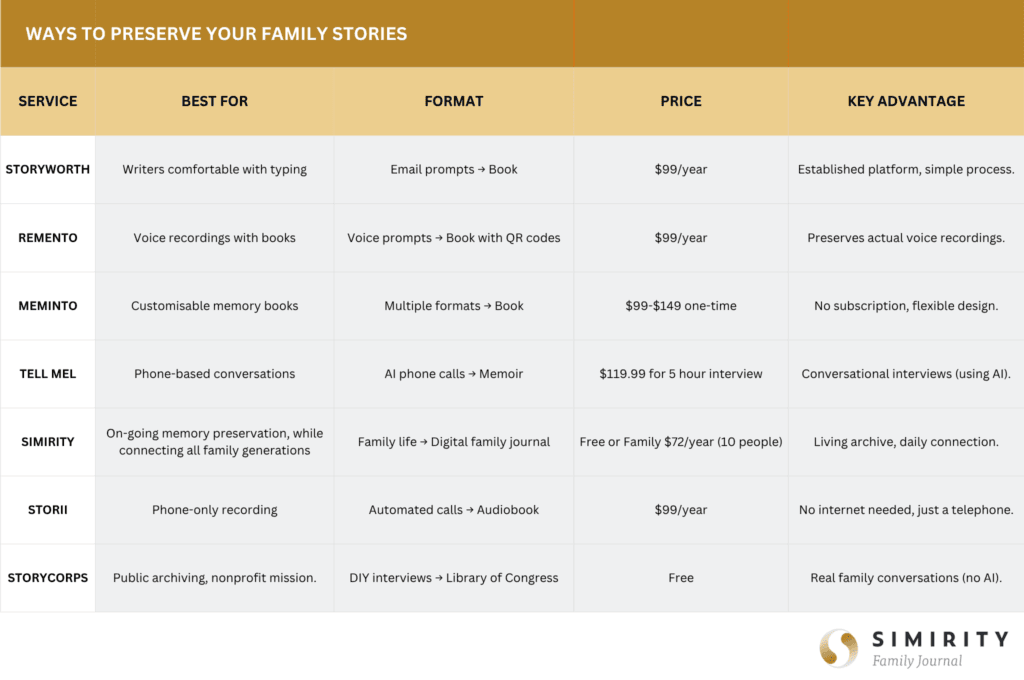
Not sure which option is right for you?
Every family’s situation is unique. What suits a family looking for a printed book for one grandparent might be very different from what works best for a family wanting everyone to stay involved regularly. Just answer four quick questions, and we’ll help you find the perfect option tailored to your needs.
Read on to learn more about the StoryWorth alternatives.
Best StoryWorth Alternatives for Printed Books
Let’s start by examining two of the closest alternatives to Storyworth, both of which offer book printing.

1. Remento – Physical book with audio recordings
Remento gained significant mainstream visibility in March 2025, when founder Charlie Greene appeared on ABC’s Shark Tank and secured a $300,000 deal with Mark Cuban. The investment and exposure have helped Remento scale.
How Remento works
Remento is a top StoryWorth alternative that combines voice recording with AI transcription to create keepsake memory books.
Similar to StoryWorth, each week, storytellers receive prompts via email or text, then record themselves sharing their answers in a video or audio recording using an internet-connected device. The platform’s Speech-to-Story technology transcribes their digital recordings and can transform them into polished written narratives (fixing the little errors and skipping the ‘ohhhh’ and ‘ahhhh’s). At the end of the year, families receive a hardcover book that includes QR codes, allowing readers to listen to the original recordings. So you essentially get a physical book, with the benefit of digital recordings.
Remento Pricing
$99/year or $12/month for one storyteller and one colour hardcover book (up to 200 pages). Books over 200 pages incur a $30 surcharge. Additional copies cost $69 for up to 200 pages, or $99 for 201-380 pages. E-book versions available for $49.99. Additional storytellers can be added for $99 each.
Remento Benefits
- No typing required – Storytellers simply speak their memories instead of writing lengthy responses.
- Preserves actual voice recordings – QR codes in the printed book link to original audio, capturing tone and emotion that text alone can’t convey.
- AI-powered story enhancement – Can adjust tone, length, and perspective of transcribed stories to create polished narratives.
- Family collaboration features – Multiple family members can add photos, help with editing, and support the storytelling process.
Remento Disadvantages
- Limited book distribution – Like StoryWorth, additional copies cost $69-$99 each. Sharing widely with extended family becomes expensive quickly.
- One-way prompts, not conversations – Despite using voice, this isn’t conversational. The recipient receives a question about their life and then records their response alone, without follow-up questions. No one asks them to “tell me more about that” when something interesting emerges, so opportunities to unearth interesting details are being missed.
- A finished book can become a closed chapter – After a year of recording, you get a beautiful book. The risk is that after the initial joy of receiving it, it will rarely be opened. Also, life continues and new stories unfold, but the book can’t be added to with these new stories.
- Editing access ends with subscription – While you can take as long as you need within your year to record stories, once your subscription ends, you lose the ability to edit or add new content. You must pay $99 to renew if you want to continue building the collection or make changes.
- Comfortable with live recording – Users will need to be comfortable with recording their story on cue as a video recording or a voice recording, which isn’t a desirable option for everyone. While their AI tool does tidy up the story, the story is best shared in a logical sequence, and if recording their story gives them ‘stage fright’, they might miss parts of the story that would be remembered if time allowed.
- Transcription quality varies – AI struggles with strong accents, background noise, or multiple speakers. The written story may lose nuance from the original telling.
Choose Remento if your storyteller would rather speak than write, and you want their actual voice preserved alongside the finished book.
The QR codes linking to original recordings make it meaningfully different from a text-only memoir, and the Shark Tank backing from Mark Cuban signals this is a platform with serious momentum behind it.
If voice-first storytelling with a polished printed output is what your family needs, Remento is the strongest option in that category.
2. Meminto – More flexible book creation
How Meminto works
Meminto offers a more flexible approach to creating a family memory book through guided prompts that explore all aspects of life and multiple story creation methods. Users receive weekly prompts to record stories, but unlike the previous options, you can go at your own pace and record them more frequently if you wish.
Stories are added via the app, where you can blend text with voice recordings and videos. Meminto transcribes spoken responses. The platform gives prompts to help you capture the best stories, but you can always add your own customised prompts. Unlike the previous subscription services, Meminto works on a one-time payment model with a 2-year creation window—so you have the time you need, but can also work faster than the story-a-week model that the other services provide.
Meminto Pricing
One-time payment structure: $99 for a 100-page book, $129 for 200 pages, $149 for 300 pages (up to 480 pages available). Additional copies range from $39 to $59, depending on the page count. A digital flip book is available for $39.
Meminto Benefits
- No subscription required – Pay once and take up to 2 years to create your book without renewal pressure or ongoing fees.
- Extensive customisation options – Familiar editing tools similar to Word/Pages give you creative control over design and layout. This really helps you control the look and feel of your book.
- Family collaboration built-in – Multiple family members can contribute stories, questions, and perspectives to create richer narratives.
- AI-enhanced writing assistance – Voice recognition and text optimisation help improve clarity while preserving authenticity.
Meminto Disadvantages
- A finished book can become a closed chapter – Like other book services, once printed, it risks becoming a static keepsake rather than a living family resource that’s actively engaged with.
- Requires hands-on involvement – The flexibility comes with complexity. You’re responsible for design, layout, and editing decisions. Users wanting a simple guided experience may feel overwhelmed.
- Learning curve for editing tools – Despite being similar to Word/Pages, the platform has more features than simpler services. Takes time to master all customisation options.
Meminto is the right fit if the rigid weekly structure of other services feels like too much pressure, or if you want more creative control over the finished book than StoryWorth or Remento allow.
Paying once rather than subscribing annually is a genuine advantage for families who want to take their time. The trade-off is that you need to be self-motivated — there’s no automated prompt system keeping the project moving.
Best Alternatives for Digital Family Stories
If you’re certain that you would like a physical book, the following options are not for you. However, if your priority is preserving family stories in the best possible way, consider these digital options as alternatives to StoryWorth.

3. Simirity – Family journal app
Full disclosure: Simirity is our family business. We created it because we wanted to connect our entire family through storytelling, while capturing and preserving everyone’s memories, from our grandparents’ and ancestors’, down to our children’s.
How Simirity works
Simirity is an interactive family journal app designed to capture everyone’s stories—not just one person’s. It’s a web app, so it works like an app, right from your browser (no download needed).
Unlike the previous services that treat memory preservation as a one-time project for a single person, Simirity is an ongoing family venture where everyone participates.
Your parents’ stories and memories live alongside your own, your children’s, your siblings’—creating a living archive where the whole family discover new aspects about each other, not just learning about one person who wrote a book.
Simirity is a private space for both milestone moments and everyday life. Because sometimes the most valuable family memories aren’t the wedding days or graduations—they’re Tuesday night dinners, intriguing insights shared by your children, your dad’s terrible puns, and the small rituals that define your family.
Books like StoryWorth’s capture the big events, whereas Simirity captures life itself.
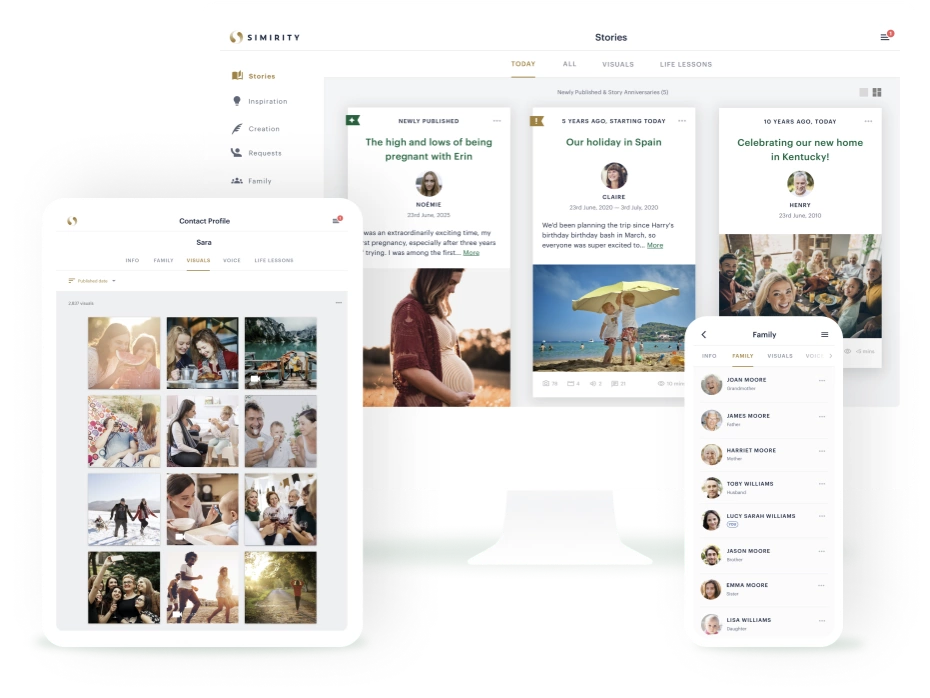
Storyworth gives you a printed book of one person’s answers. Here’s how much a single Simirity story can hold instead. Open the example below.

Simirity Pricing
Free to use with unlimited text-based stories and the ability to connect your whole family. An optional annual family subscription costs $72 for up to 10 people, offering enhanced access and the ability to add photos, videos, voice recordings, and other media files to your stories.
Simirity Benefits
- Built for entire families, not individuals – Designed specifically for intergenerational storytelling where grandparents, parents, and children all share their stories in one connected space—a digital memory book for the entire family, not separate books for different people.
- Old stories resurface naturally – Receive alerts about old stories on their anniversary, so you’ll relive what you all did a year ago, 10 years, even 100 years ago. Your family memories stay woven into daily life, not lying forgotten on a shelf.
- Rich multimedia storytelling – Write by all means, but also upload photos and videos, voice-narrate your photos, voice-record your stories, attach documents, pin stories on a map, and embed YouTube videos and Spotify playlists. Digital stories have so many more options for creation, which makes them far more engaging and immersive (especially helpful to capture younger generations’ imagination).
- Uses storytelling to deepen family bonds – Simirity is a family bonding app that inspires families to share more than they would in a message app or on a weekly catch-up call. Share memories and thoughts about all aspects of life that ignite meaningful conversations and deepen your connections.
- Unlimited storytelling with hundreds of prompts – This is a digital journal, so you can write as many (or as few) stories as you wish about any and every topic. You’re not limited to 52 stories like the books, but equally, if 52 stories sounds too many, you can add fewer. If you’d like inspiration, there are hundreds of story prompts and questions to ask your mom and your dad that help you preserve a wide-ranging account of your family’s life.
- Ongoing connection, not deadline-driven – Stories are shared continuously by all interested family members, creating regular touchpoints rather than waiting a year for a finished product that only explores one person’s life.
- Granular privacy controls – Unlike a book where everyone reads the same stories, story authors in Simirity can choose exactly who sees each story—their entire family, selected individuals, or just their partner and children.
- Comprehensive family profiles – Create detailed profiles for everyone from young children to ancestors, capturing personalities and relationships across generations. A bit like a family tree, but going beyond dates of birth to share their stories too.
- Life lessons archive – There is a dedicated space for families who want to preserve wisdom and advice that can help their family members navigate life’s challenges. ‘Life Lessons’ are text blocks that can be added to any story, and all lessons are gathered on a master page where people can search for the advice they need. It’s a great way to encourage younger generations to turn to their families for advice instead of online influencers.
- Co-authoring capabilities – Multiple family members can contribute to shared stories, ensuring everyone’s perspective gets captured.
- Voice recording options – Less tech-savvy family members can contribute through voice recordings, which can be added to stories by other family members who are more comfortable with the platform.
- No subscription pressure – Loved ones’ stories remain accessible without ongoing fees; upgrade only if you want enhanced features.
- Your stories are always yours — Download any story at any time, with all its media files, and keep a personal copy. No content is held hostage by a subscription.
Simirity Disadvantages
- No physical book output – If your goal is to create a tangible heirloom to hold and pass down, Simirity doesn’t currently produce printed books; it only offers story downloads in PDF format. A purely digital approach may not satisfy families who want traditional keepsakes.
- Initial setup to overcome – Unlike a book that anyone can pick up, everyone will need their own Simirity account in order to create their profile, connect with family members, and add and read stories. So getting started takes some effort, but once done, you’re set up for life.
- Requires ongoing family engagement – Success depends on family members visiting the app, with some individuals creating a story or two every month for people to engage with.
- Less structured without scheduled prompts – No automatic weekly reminders means families need self-discipline to add stories consistently. Easy to have good intentions that don’t materialise.
- Digital-only format may not feel “finished” – Some families want the closure of a completed project. An ongoing digital archive never reaches that satisfying “done” milestone.
- Technology barrier for some family members – Requires the family to use the app/platform. There are account admin and story co-authoring tools, but those uncomfortable with digital tools may struggle without help.
Choose Simirity if your goal is ongoing connection across your whole family, not a one-off project for one person.
While the other services on this list capture a single storyteller’s memories in a book, Simirity builds a living archive where grandparents, parents, and children all contribute — stories accumulate over years, resurface on anniversaries, and stay woven into daily family life rather than sitting on a shelf.
If a digital approach works for your family and you want something that grows with you, Simirity is built for exactly that.
4. Tellmel.ai – AI phone interviews with your parent
How Tell Mel works
Tellmel.ai uses conversational AI technology to conduct actual phone interviews with your loved one.
After signing up, “Mel” (the AI biographer) calls you for an onboarding chat to plan personalised questions. Then Mel calls your loved one weekly for 10-15 minute conversations, asking thoughtful follow-up questions that help draw out detailed, authentic stories. After each call, the AI transcribes and transforms the conversation into digital stories that can be shared with family.
Tell Mel Pricing
Pricing is based on hours of conversation time. Visit tellmel.ai for the latest rates — plans include phone conversations, transcription, and polished memoir chapter creation.
Tell Mel Benefits
- Genuine conversational format – Intelligent AI asks thoughtful follow-up questions that naturally draw out detailed, authentic stories.
- Completely phone-based – No apps, logins, or writing required. Works on any phone, just like talking to a friend or family member.
- Multilingual storytelling – Conducts conversations in 10 different languages, then delivers the final memoir in English, breaking down language barriers.
- Polished memoir chapters – Each conversation is transcribed and transformed into beautifully written chapters that capture your loved one’s voice.
- Flexible editing options – Request edits or additions to any chapter anytime to ensure the memoir accurately reflects their memories.
- Accessible for hearing aids – Works with hearing aids that connect to phones, making it viable for many seniors with hearing challenges.
Tell Mel Disadvantages
- Higher price point – Premium conversational AI technology costs more than basic prompt-and-record services.
- Limited distribution format – Creates digital stories, but no physical book.
- Phone-only format – No video option means you miss visual elements and body language that add richness to storytelling.
- AI may not feel natural to everyone – While sophisticated, some storytellers find it awkward talking to AI rather than a real person, even if it’s conversational.
- Potential for a closed chapter – The outcome will be digital stories on a website that the family may rarely visit. Stories risk of becoming forgotten rather than a living family resource.
Tell Mel is for families who want conversational depth, not just answers to weekly prompts. The AI’s ability to ask intelligent follow-up questions makes it the closest thing to having a professional interviewer call your loved one each week.
If budget allows and your storyteller would thrive with that kind of gentle, curious prompting, Tell Mel produces some of the richest stories of any service in this guide.
5. Storii – Audio recordings by telephone
How Storii works
Storii provides automated phone-based recording where the service calls storytellers on their regular phone (landline or mobile) at scheduled times.
An automated voice asks pre-selected questions from a library of over 1,000 prompts, and storytellers record answers by speaking (up to 10 minutes per call). Recordings are transcribed and stored in a dedicated profile that the family can access. Stories can be downloaded as audiobooks or PDF transcripts (no printed book option).
Storii Pricing
Monthly plan: $9.99/month for basic features with manual call-in option. Annual plan: $99/year for automated weekly calls (up to 3 calls per week). Gift Box: $119, including an annual subscription in presentable packaging.
Storii Benefits
- No internet or smartphone required – Works with any phone, including landlines, making it an excellent choice for seniors with limited tech skills.
- Extensive question library – Over 1,000 curated life story questions available to inspire thoughtful responses and unforgettable tales.
- Automated scheduling builds habits – Schedule regular calls (up to 3 calls per week) at times that suit the receiver, to help create consistent storytelling routines.
- Dual format output – Creates both audiobook and written transcript formats, giving families options for how they engage with stories.
- Family access through multiple platforms – Family members can view and listen to stories through the app or web interface.
Storii Disadvantages
- Being put on the spot by a robotic voice – Some people might find it hard to receive an automated call that isn’t from a real person, and then being asked to share their story without any follow-up questions (this is not a conversational AI like Tell Mel, which actually engages in conversation).
- Phone-only interaction – Recording their story by voice recording doesn’t suit everyone’s storytelling style and limits their ability to think over and prepare their story.
- Missing other media – Photos and videos that might be the perfect addition to their stories can’t be added; it’s limited to what you can share over the phone.
- One-way recording, no follow-up – Like Remento, you answer the prompt and stop. No dynamic conversation to explore interesting threads or draw out deeper details.
- No book, but you can download a PDF – Stories are all added to the recipient’s online profile for family to access, but there is no book by default. A PDF download is available.
Choose Storii if your loved one is genuinely not comfortable with apps, browsers, or anything requiring a login — but can answer a phone.
It’s the most accessible option on this list for the least tech-confident storytellers, and the 1,000-question library means there’s no shortage of prompts to keep things going. The output is modest compared to other services, but the simplicity is the point.
6. StoryCorps – Audio interview
How StoryCorps works
StoryCorps is a nonprofit oral history project that records, preserves, and shares stories of Americans from all backgrounds.
Using the free StoryCorps app, two people who know each other conduct a recorded interview. Users can prepare questions using the provided prompts or create their own. Completed interviews can be uploaded to the StoryCorps Archive and the Library of Congress, creating a permanent historical record. Or you can opt to keep your recording private and share it only with your family.
StoryCorps Pricing
Completely free to use. The app, recording, archiving, and Library of Congress submission are all provided at no cost as a public service.
StoryCorps Benefits
- Entirely free to use – No subscriptions, fees, or hidden costs. The app, recording, archiving, and Library of Congress submission are all provided at no charge.
- Engaging discussions – It’s not a straightforward question-answer format like on Storii. There’s no AI asking follow-up questions like with Tell Mel. This is the best option for capturing stories—real human-to-human discussions, with words capturing the details, and people’s voices preserving their personality.
- Choose to make it public or private – It’s up to you who gets to access your discussion.
- Permanent historical archiving – Your stories can become part of the largest collection of human voices ever gathered, preserved for future generations at the Library of Congress.
- Extensive question resources – Access to a comprehensive question library and preparation materials to help create meaningful interviews.
- No commercial agenda – Nonprofit mission focused purely on preserving stories, not selling products or books.
StoryCorps Disadvantages
- Single interview session focus – Designed for one-time conversations, not ongoing story collection. Doesn’t build a comprehensive family archive over time.
- No polished output or book creation – You get raw audio recordings, not edited memoir chapters or printed books.
- Stories may become public – While privacy settings exist, the mission is public archiving. More personal stories may feel inappropriate to share.
- In-person requirement – The app is designed for two people in the same room. There is a remote option (StoryCorps Connect), but it adds complexity.
- No integration into daily family life – Once archived, stories sit in the Library of Congress. They don’t provide stimulation for ongoing family connection by making stories accessible in daily life.
StoryCorps is the right choice when authenticity matters more than output, and budget is tight. A real conversation between two people who know each other will always produce richer stories than a prompt answered alone — and StoryCorps is built around exactly that.
If your goal is one powerful recorded interview rather than a year-long project or a printed book, StoryCorps delivers it for free.
Ready to Preserve Your Family’s Stories?
The goal isn’t finding the perfect service—it’s getting started before it’s too late!
Your parents’ stories exist in their memories right now, but they won’t stay there forever. Every week you wait is another week of stories that could slip away, another conversation that doesn’t happen, another memory that fades.
The “perfect” approach is whichever one actually gets used – whether that’s a beautifully bound book, weekly phone calls, or an ongoing digital archive. What matters isn’t the format; it’s that you’re preserving these precious family memories while you still can.
Get started right away, by reviewing hundreds of family story ideas below.
Share
