


Why Stories Are Important for Families (Photos Aren’t Enough)

We asked parents a simple question: why do family stories matter to you, and what are you actually doing to preserve them? Their answers were revealing and somewhat concerning.
In this post, we share the 5 main reasons why stories are important for families. We also expose one common mistake most families are making, and how you can avoid it.
Jump to section:
5 Reasons Why Stories Are Important for Families
Family stories matter for all kinds of reasons. When we spoke to parents though, five kept coming up — and they’re worth considering in relation to your own family.
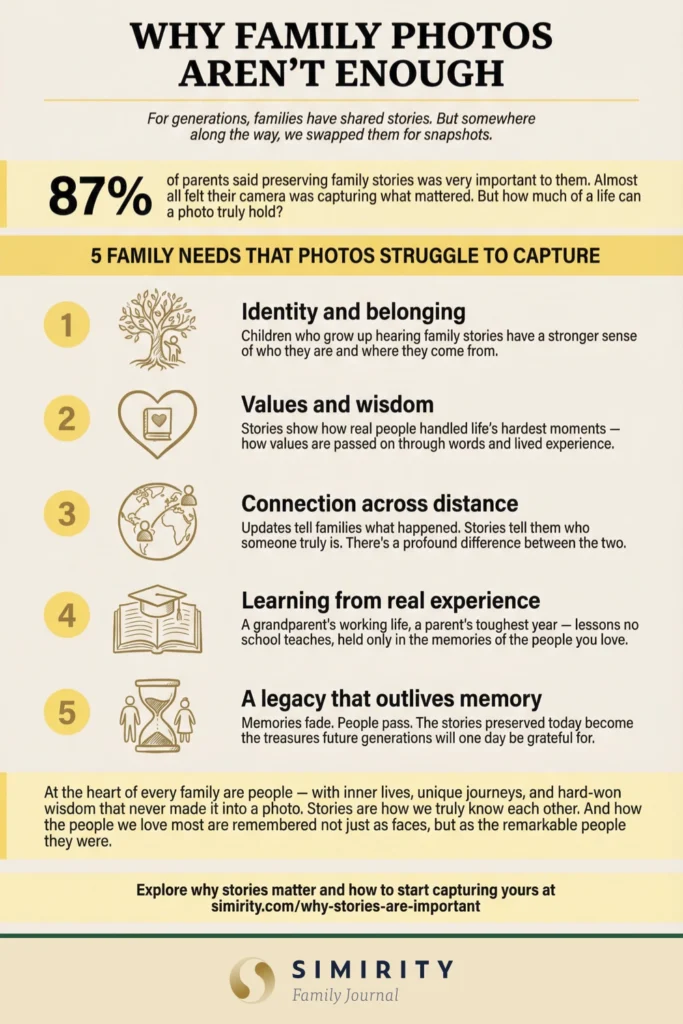
1. Identity and belonging: Children who grow up hearing family stories have a clearer sense of who they are and where they come from.
2. Values and wisdom: Stories are how families pass on what they actually believe — not through lectures, but through real experiences that show how people handled life’s hardest moments.
3. Genuine connection across distance: Regular updates keep families informed. Stories keep them close. There’s a fundamental difference between knowing what someone did and understanding who they are.
4. Learning through real experience: A grandparent’s working life, a parent’s toughest year, a sibling’s big decision — these are lessons no school teaches, available only inside your own family.
5. A legacy that outlives memory: Memories fade. People pass. The stories we preserve today become the treasures that future generations — including grandchildren not yet born — will one day be grateful for.
For a deeper look at the research behind these benefits, read our guide to the 5 powerful benefits of sharing family stories.

Your family’s past, present & future—woven together in Simirity.
The Problem With How Stories Are Shared and Preserved
In a 2025 Simirity survey, we found that 87% of parents say preserving family stories is “very important” to them.
But when we ask how they’re actually doing it, the answer is almost always the same — their camera.
It makes complete sense. A phone is always in your pocket, and a photo takes one second. But think about those five reasons above. How many of them can a photograph actually capture? Identity, values, genuine connection, lived wisdom, lasting legacy — a camera captures the surface of a moment beautifully. What it can’t capture is everything beneath it.
My journey to realisation
As a new dad, I passionately took on the role of saving my children’s childhoods in a never-ending feed of photos and videos.
We love those moments, but we’ve since realised that so much from their childhood is missing from our records. Friendships, sayings, habits, games and so on, all came and went — many of which have now fully faded from memory. Even our children’s first words are somewhat fuzzy.
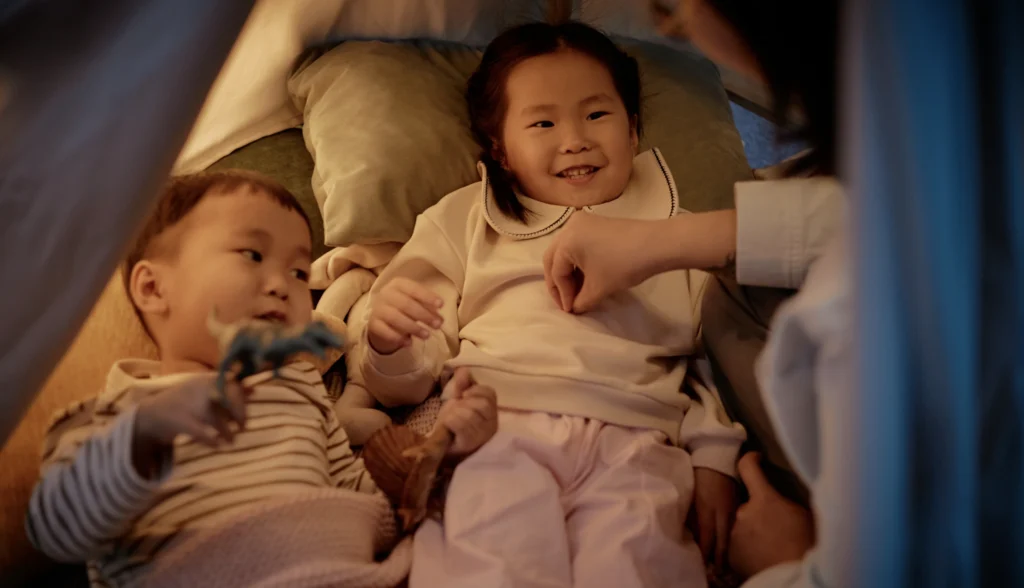
As a son with parents well into their retirement, I was horrified at the realisation that as we go back in time, we have ever fewer photos to keep old memories and family stories alive. My parents didn’t grow up with a camera in their pocket as today’s generations do, and huge sections of their lives are not saved in photos. And the lives of my grandparents seem to be summarised with only a handful of images. Yet my parents, grandparents and ancestors lived rich lives, filled with stories, thoughts, ideas and personalities that can both enrich and educate the younger generations of our family.
And my own life — which one day my children or grandchildren might be interested in hearing about — is poorly conveyed through photos. My photo feed used to look like I was permanently on holiday. Far from reality.
The camera is the shortcut we all reach for. But as with all shortcuts, it comes at a cost — and in this case, that cost is the stories that never get told.
The Cost of Lost Stories
Forever unanswered questions
Many of us don’t realise what we’re missing until it’s too late. A loved one passes, or suffers from dementia, and so many stories simply disappear irreversibly from family knowledge.
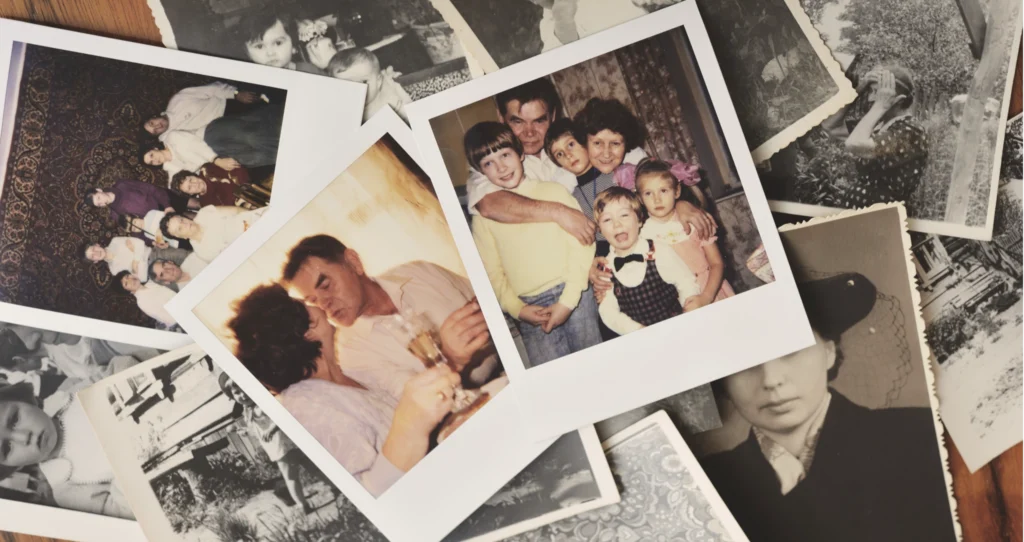
For many people, failing to share and pass down this information is one of the true regrets in life. The solution is simple, just not easy — find the time to ask the questions while you still can. What was your childhood really like? What was the hardest thing you ever went through? What do you wish you’d done differently?
Asking questions is such an underrated skill, with such potential to ignite conversations you’ll treasure forever.
We’ve spent a lot of time thinking about which questions unlock the best stories. These resources are a good place to start:
Feeling less close
Stories aren’t just about the past. They’re the invisible thread that keeps families close in the present.
When families only exchange updates — what happened, where they went, what the kids are doing — relationships stay warm but shallow. Over time, without the deeper context that stories provide, even close families can start to feel like friendly strangers.
This is particularly true for families spread across different countries. Physical distance is hard enough. But the emotional distance that comes from years of surface-level communication is harder still, and far less talked about.
Research at Emory University has shown that children who know more about their family’s history demonstrate higher self-esteem, stronger resilience, and better emotional health than those who don’t. The study found that knowledge of family stories was the single best predictor of children’s emotional wellbeing — yet these are precisely the stories that get lost when families stick to surface-level updates.
Weakened family identity
Children raised without feeling connected in the same way to family members who came before them, feel less rooted in their family and have a reduced sense of identity.

Family heritage is not just about knowing which country your grandparents came from and what jobs they had — it’s more about getting to know who they were, what they stood for and the path they took through life. These stories are a true gift that can strengthen their personal identity, inspire them and even provide a context to their own life and upbringing.
How You Can Start Preserving Family Stories
The most common reason families don’t preserve stories isn’t indifference — it’s not knowing where to begin. The good news is that starting small is not only acceptable, but it’s also the right approach.
The simplest way to start is with a single question. Here are a few to start with:
- What’s a memory from your childhood that still makes you smile?
- What’s something you believed at 20 that you no longer believe now?
- What was the hardest decision you ever made, and do you think you got it right?
- What do you wish your children understood about your life before they were born?
- What family tradition matters most to you, and why did it start?
Refer back to these question resources for hundreds of questions that your family can explore.
Beginning with what matters most
You don’t need to preserve everything at once. In fact, trying to do so is the fastest route to doing nothing at all. Instead, focus on the stories that carry the most weight — the ones most at risk of being forgotten.
In my opinion, these three categories are worth prioritising: meaningful life moments, meaningful places and thoughts on life. These are the stories future generations will appreciate and learn the most from.
From scattered memories to preserved narratives
Most families already have aspects of their stories saved somewhere — in a message app, in a photo album, in a Facebook feed. The problem is that scattered stories like those don’t add up to something a family can easily access, nor pass on to future generations.
Is there a single place where your children can access family stories?
What’s needed if you really want to get the most from your family stories is a dedicated home for all your stories — somewhere private where they can easily be found, added to, and shared across generations without getting buried under everything else.

Family is forever—make sure their stories are too.
Start Storytelling in Your Family
Past: Involve family elders with historical stories
One of the things I loved about capturing historical stories in my family is how it engaged the elder generations, and pulled all generations together as we learned so much about our family’s past.
My retired parents commented so many times how much they were enjoying revisiting these old stories, finding supporting photos and even reaching out to relatives for extra information. It was especially enjoyed during those long winter months! But even during the summer, as they are retired, saving old stories — often prompted by my sister and I — was easily incorporated into their day.
And I personally found it very meaningful to see these stories captured, ready for my kids and future generations, knowing full well that they would have been lost had we not taken action.
Present: You’ll quickly realise what’s story-worthy
Once you get into the practice of saving family stories, a subtle shift happens — you start to realise in real-time which moments you’re living through are worth saving in stories. Sometimes it’s because you know a grandparent or cousin would appreciate them, other times you picture yourself revisiting this moment in 20 years, feeling ever so grateful that you caught it.

From that moment on, capturing stories becomes a knee-jerk reaction to life events. The key is to find a process that helps you save them quickly and efficiently. Stories don’t need to take a lot of time — they might be as simple as a photo and a 60-second voice note.
Future: The gift family gets to enjoy time and time again
There’s something special about sharing a family story that is quite unlike the other things I do in my day-to-day life. Usually, our actions reap the reward in the moment, but when saving a story I get the buzz of knowing I’m making family happy both today and in future years.
Family stories feel like gifts that keep on giving — putting smiles on people’s faces for years and years to come.

Simirity—because one day, you’ll wish you’d captured their stories.
Where and how to preserve your stories
General-purpose tools like WhatsApp, Google Drive, and social media were built for communication and storage, not for storytelling. They’re brilliant at what they were designed for. But they weren’t designed to organise stories across generations, prompt meaningful contributions, or create something a family can explore and build on together over time.
What’s needed is a dedicated space for family storytelling in private.
Think of it as a step up from the typical family photo sharing and messaging — providing a more complete, authentic and enduring record of your family’s life experiences.
Physical versus digital storytelling
While you can save stories in book form, a journal perhaps or by encouraging family members to fill out life stories books, there is so much to be gained by digital storytelling:
- Always accessible — on any device, anywhere in the world
- Easily shared across your entire family instantly
- Multimedia — photos, video, audio and text in one place
- Searchable — find any story in seconds
- Collaborative — every family member can contribute
- Organised — stories sorted by person, theme or date
- Interactive — family members can respond and add to stories
- No geographic limits — connects families across continents
- Future proof — grows as your family grows
The birth of Simirity Family Journal
As a family wanting to share and preserve our stories without big media companies looking over our shoulders, we were disappointed with the options available.
That’s why we created the Simirity family journal.
Simirity is not a generic platform for storing content, but a space built specifically around how families tell and share their stories — blending written entries with photos, videos, voice recordings, life lessons, and more.

Take a look inside our demo account and see how your family’s stories could come to life, or explore the most popular ways families are using Simirity today:

Your memories, their legacy—keep family history alive.
Recommended

Statistics About Family: 10 Insights on Modern Family Life
Read more: Statistics About Family: 10 Insights on Modern Family LifeStatistics About Family Relationships: The Shape of Love Across a Lifetime
Read more: Statistics About Family Relationships: The Shape of Love Across a LifetimeFamily Size Statistics: The Incredible Shrinking Family
Read more: Family Size Statistics: The Incredible Shrinking Family