


300+ Would You Rather Questions for Families With Free Game

As a parent, I’ve tried dozens of ways to get meaningful conversations going, especially between our children and their grandparents. Most fall flat. Would you rather questions are the exception.
These thought-provoking questions are genuinely fun for all ages, are surprisingly good at revealing people’s characters, and leave everyone feeling a little bit closer.
Would you rather questions are hypothetical dilemmas that ask each player to choose between two options. There’s no right answer, which is exactly what makes them work for families. Everyone can play, and the explanation behind each choice tends to reveal far more about how someone thinks than a direct question ever would.
Ready to dive in? Jump straight to the game or browse all 300+ questions — you can bookmark your favourites as you go.
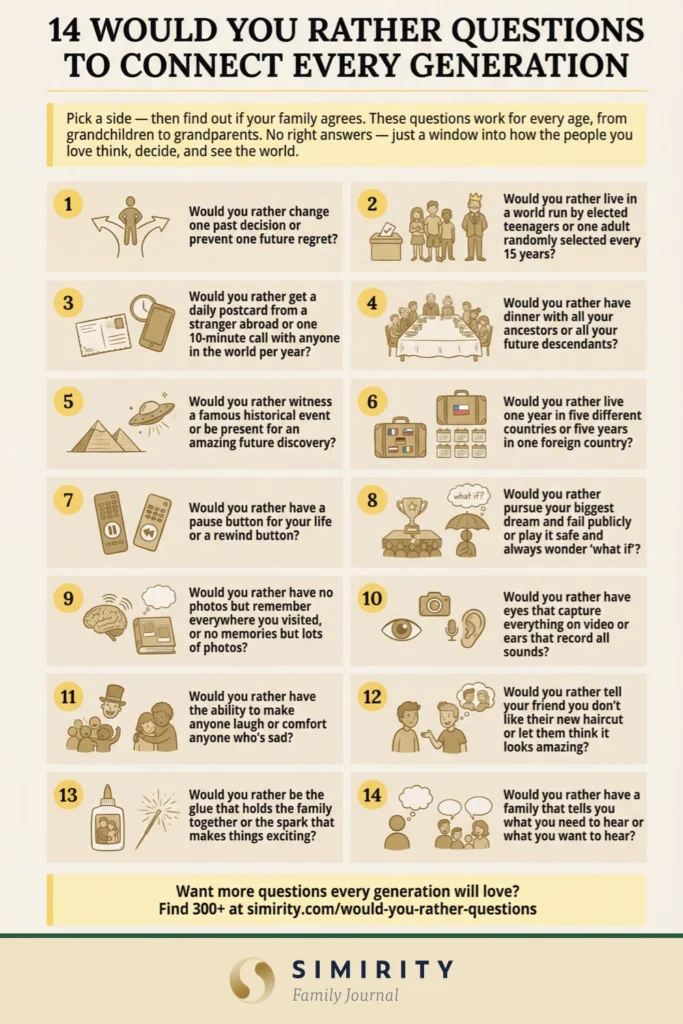
We’ve gathered some great questions and crafted our own to make the ultimate list of thought-provoking and family-friendly would you rather questions. We have been searching for fun questions suitable for everyone over the age of 10, with the added benefit of helping family members get to know each other better.
Silly questions like ‘Would you rather have spaghetti for hair or marshmallows for hands?‘ have been skipped in favour of more thought-provoking and engaging dilemmas, to ensure that adults do not find them tedious.
Want a quick taster of this icebreaker game before you explore the full list? The video below covers our 30 favourites.
Jump to section:
How to Use These Questions
The game below handles everything — just play. Or if you’d rather choose your own questions, browse the full list further down and save the ones that feel right for your family.
One tip either way: always follow up with why. That’s where you can really learn something about the people you are playing with.
Would You Rather Questions Game
If browsing through 100’s of questions feels overwhelming, why not turn it into a game instead?
The would you rather game below offers questions tailored to each player’s life stage. Children get simpler questions that they can relate to, while parents and grandparents receive prompts based on their experiences. Everyone can join in, have fun and learn something about each other.
The Would You Rather Game
Set up your players
Good fun — and you learned something new.
These dilemmas have a way of revealing what people really think.
Bookmarked questions
Keep the conversation going with the Family Story Game
The Family Story Game includes Would You Rather questions plus hundreds more across Fun & Uplifting and Deep & Thoughtful categories — all tailored to each player’s life stage, so everyone from kids to grandparents can keep discovering more about each other.
Play The Family Story Game →Browse & Bookmark Would You Rather Questions
The questions are organised into twelve categories, ranging from personal choice to family legacy.
Found a dilemma worth debating? Tap any question to save it to your list. Browse all twelve categories — then copy your favourites in one click and bring them to your next family gathering.
Share this questions tool
Help a friend or family member spark better conversations with the people they love.
If you would prefer to work from paper, download our printable would you rather questions list.
The Family Legacy section had something extra — a reveal on each question showing how Simirity helps. We built Simirity ourselves, as a family, to help with those challenges.
Simirity is your family journal of cherished memories.
Beyond photos, videos and voice notes, Simirity app uses real-life stories from your family’s past and present to enrich family relationships while storing cherished memories for tomorrow.
Your stories blossom into rewarding conversations that take your family beyond everyday small talk—creating moments of genuine connection that you’ll treasure forever.
Want to see it in action? Explore our demo account and picture preserving your family’s experiences in stories like these:

Why Would You Rather Questions Work for Families
Modern family life presents greater challenges to meaningful connection. With busy schedules, geographic separation, and screens competing for attention, intentional conversation moments have become increasingly rare. Many families find themselves defaulting to surface-level catch-ups about school and work, missing opportunities to truly understand each other’s thoughts, values, and inner worlds.
These family-friendly would you rather questions serve a purpose beyond entertainment.
They create structured opportunities for families to discover how each member thinks, what matters to them, and how they approach life’s choices. The questions are engaging to answer and naturally lead to deeper discussions as family members enquire why others chose as they did.
If you’re not sure when to fit these questions into your busy lives, here are 7 great family occasions, ranging from family dinners to road trips, where would you rather questions can be invaluable.
Would You Rather Questions is a Fun Game For Sharing Our Values
The answers to would you rather questions reveal our personal values — sometimes pitting them directly against each other.
Playing this game regularly with our children is one of the most effective ways I’ve found to share our views on what makes a happy, healthy life, while learning a surprising amount about how they see the world. It’s a window into family values that few other games can match.
When the Conversation Is Hard to Start
Some of the most important conversations with our children are also the hardest to have directly. Bring up bullying face-to-face and many kids shut down.
Ask about peer pressure and you get a shrug. But frame the same topic as a would you rather question and suddenly the conversation opens up.
It works because it feels like a game, not an interrogation. Children (and teenagers especially) are far more willing to share their real views when they don’t feel put on the spot. The question does the hard work of getting there indirectly.
If there are topics you’ve been wanting to raise, this guide to gamifying difficult conversations might help.

Other Ways to Connect With Your Family
Would you rather questions open up the kinds of conversations families rarely have otherwise, whether you’re around the dinner table or on a video call with relatives who live apart. A single question can reveal what someone values, how they think, and what matters most to them.
Those deeper conversations have real, lasting benefits: over three decades of research on family conversation show consistent improvements in children’s academic performance, mental health, and resilience. Not bad for a simple question game.
If you enjoy exploring new and diverse topics with your family, why not also try:
- 350+ thought-provoking questions to ask your mom and questions to ask your dad — this is a must-read for anyone who would like to connect with their parents by exploring their past.
- Digital storytelling for families — together, capture the laughter, voices, and little details that make your family unique.
- Explore these activities for retirees to find shared hobbies that all generations can enjoy.
- Family conversation starter game with 200 story prompts that uncover stories you wouldn’t normally get around to sharing.
Meaningful conversations like these are the ones you will cherish for the rest of your life. It’s easy to get stuck in a rut and have the same old family discussions – escape mundane conversations and connect more deeply with your family.
FAQ About Would You Rather Questions
What are Would You Rather Questions?
Would you rather questions are hypothetical dilemmas where players choose between two options. With no right answer, they work for all ages and naturally spark the kind of explanation — “but why did you choose that?” — where the real conversation begins.
How do you play Would You Rather?
One person reads a question aloud. Everyone answers — usually by raising a hand or calling out their choice — then explains their reasoning. The explanation is the most valuable part: it tells you how someone actually thinks, not just what they chose. Most families play in rounds of 5–10 questions.
What age are these Would You Rather questions suitable for?
The questions on this page are designed for ages 10 and up, though many work well with younger children too. The 12 categories range from light-hearted and silly to more reflective — so you can easily pick the right ones for your group. Category 11 (Questions to Help Children Open Up) is specifically designed for younger family members.
How many Would You Rather questions should we do in one session?
5 to 10 questions is the sweet spot for most families. Fewer than 5 and it feels too short; more than 15 and it can lose energy. We recommend picking one category per session and working through it together — that way it feels focused rather than endless.
Can you use these questions with grandparents?
Absolutely — in fact, the generational mix is one of the best things about Would You Rather questions. Grandparents often give the most surprising answers, and the differences between generations spark some of the richest conversations. The Family Legacy category (Category 12) is especially well-suited to cross-generational groups.
What’s the difference between funny and deep Would You Rather questions?
Funny questions (like choosing between superpowers or silly scenarios) are great icebreakers and work well with mixed ages and energy levels. Deeper questions (like ethical dilemmas or life reflections) tend to generate more meaningful conversation but need the right mood and setting. We’ve separated both into distinct categories so you can choose what fits the moment.
Do I need to print these questions or is there an easier way to use them?
You can use the free would you rather questions game to get started quickly and involve the whole family. You can also download all 300 questions using the download button above.
Are these questions suitable for video calls with family?
Yes — Would You Rather questions work particularly well on video calls, where it can be hard to keep everyone engaged. Because each question gets an immediate yes/no answer, everyone participates quickly. We originally developed many of these with long-distance families in mind.
Can I use these questions in a classroom or group setting?
Many teachers and youth group leaders use Would You Rather questions as conversation warm-ups or discussion starters. They’re non-threatening, require no prior knowledge, and generate genuine discussion. For classroom use, we’d recommend the Personal Choice, Social, and Light-Hearted Ethical Dilemma categories.

Keep your kids connected to their family & cultural roots.
