


How to Start Family Conversations: 7 Moments Actually That Work

Knowing how to start family conversations is one thing. Knowing when to do it is what makes the difference.
I learned this the hard way, collecting conversation games and questions that sat unused for weeks, because I’d never thought about where they’d actually fit into family life. Once I mapped specific games to specific moments—dinners, car rides, video calls—the conversations finally started flowing.
Below are seven tried-and-tested moments that transform ordinary family moments into quality time together.
Jump to section:
Need a conversation starter right now?
Spin through the deck below — 14 categories, 100 story ideas, all designed to get families talking.
How To Start Family Conversations Using Games
A family conversation starter is any prompt, question, or game that gives family members something specific to react to, removing the pressure of starting from scratch.
The right conversation starter depends on the moment and the people involved. For playful, reveal-your-values conversations, our 300+ Would You Rather questions for families are hard to beat.
For unlocking untold family stories, the Family Conversation Starter Game uses 200 everyday object prompts in a simple 3-2-1 format. Whichever you choose, knowing when to use it makes all the difference—and that’s exactly what this guide covers.
7 Moments to Start Family Conversations
Here are my family’s favourite times for using these questions.
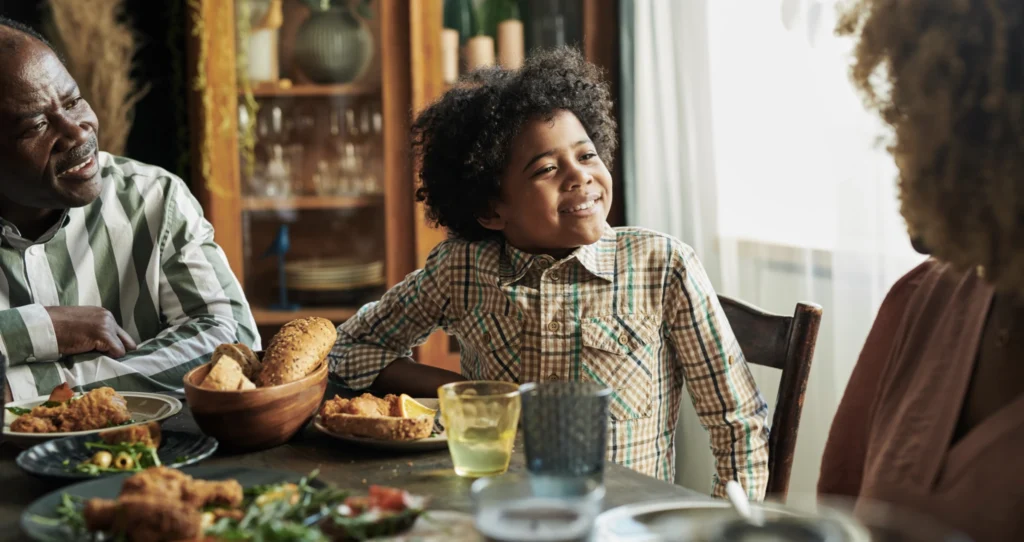
1. Sunday dinner table tradition
The scenario: At Sunday dinner, one family member picks three questions to ask during the meal.
Why this works:
- Creates a predictable routine that everyone looks forward to
- Gives each person a turn at leading the conversation
- Transforms the quietest meal of the week into the most memorable
The research backs this up, too. Decades of studies on family mealtimes consistently link regular shared meals to better academic outcomes, improved mental health, and stronger family bonds in children.
How we do it: In our house, it’s usually me picking the questions, but ideally you would take turns so everyone has their turn at leading the conversation and selecting the questions that they find most interesting. It doesn’t happen every week, but I know the kids like it as they keep asking for it!
2. Long car journey entertainment
The scenario: Road trips lasting two hours or more.
Why this works:
- Requires zero materials—just voices and imagination
- Everyone participates equally (even the driver)
- Time passes surprisingly quickly when everyone’s engaged
How we do it: We usually start around the one-hour mark, when the initial conversations have died down. Sometimes we would make up our own questions and other times we’d refer to the list of 300 questions. Some questions pass by within a minute, while others keep us engaged and debating for several miles of the drive.
3. Video call with distant grandparents
The scenario: Weekly or monthly video calls between grandchildren and grandparents who live far away.

Why this works:
- Gives structure to calls that often sees children’s attention wane and run off and do something else
- Helps grandparents and grandchildren get to know each other far better
- Creates shared talking points that last beyond the call
How we do it: My parents and my sister’s family live in different countries from us. We have our regular calls, and try to involve the kids whenever possible. When we’ve covered the usual catch-up call topics, if time allows, we get into the habit of throwing in a few conversation questions to keep the kids interested and participating in the call. It felt a little strange at first, but the kids cite this as the best part of the calls, and often, I have to agree, they are not wrong!
4. Holiday gathering icebreaker
The scenario: Christmas, Thanksgiving, or family reunions when extended family gathers and conversation feels forced.
Why this works:
- Breaks awkwardness between cousins who rarely see each other
- Gives shy family members an easy way to participate
- Creates laughter and connection across different ages
How we do it: I assume the role as the question master, and I usually prepare a dozen or so questions that I think everyone will enjoy. They work very well as an icebreaker after the initial welcomes, and once everyone’s settled in perhaps with a cup of tea and cake by your side. It’s fun for us as adults, but the main benefit is gently reconnecting the kids with extended family that they don’t see so often.
5. Bedtime wind-down conversation
The scenario: The last 10 minutes before lights out, when kids are calm and often more open to talking.

Why this works:
- Creates a peaceful transition from activity to sleep
- One-on-one time with each child
- Kids often share more in these quiet moments
How we do it: We don’t have it as a nightly thing, but periodically when the mood feels right, we’ll ask a few questions to get a gentle and calm conversation flowing. You have to be careful, of course, as you don’t want to get them all excited, so we pick our questions wisely.
6. Playdate icebreaker (new friends)
The scenario: When your child has a friend over and they haven’t quite bonded yet.
Why this works:
- Provides structure without being obvious
- Helps kids discover shared interests
- Eases parental anxiety about whether kids are getting along
How we do it: No need to jump into the questions right away if they’re having a great time, so you just stand by and see how they get on. If you can see that they’re not quite sure what to do, we sit them down with a drink and I explain the game and pick some suitably funny and entertaining questions to get started with. We usually only need half a dozen or so before they’ve connected and are ready to go on and play.
7. Rainy day family bonding activity
The scenario: Unexpected indoor days when outdoor plans are canceled and everyone’s disappointed.

Why this works:
- No preparation needed—questions work anytime
- Turns boredom into connection
- Lifts mood through engagement
How we do it: When it’s apparent the kids are bored and crying out for tablet time, this question game is a great delaying tactic that shifts their focus.
Making It a Habit (Not a One-Time Thing)
The difference between knowing how to start family conversations and actually making them part of family life comes down to one thing: starting small.
Pick just one scenario from this list—whichever fits most naturally into your current routine. Use it consistently for a few weeks, and let family members get comfortable with the format.
I suspect once you’ve tried it once, your kids will remind you to try it again on subsequent occasions. Ultimately, the challenge is having enough questions to keep these conversations flowing!
6 Tips for Starting Family Conversations
1. Prepare your questions beforehand
If possible, don’t wing it—choose 5-10 questions before you start. Print them, bookmark them on your phone, or add them to your phone notes so they are always available.
When the moment hits and you want to get stuck into the questions, you really don’t want to scramble to think of one and risk having the momentum die. Having questions ready keeps energy high.
Alternatively, play a game like our free would you rather questions game, where conversation starter questions are chosen at random.
2. Start with easy icebreakers
Begin with obviously fun questions (“Would you rather spend a day exploring space on a rocket ship or diving deep in a submarine?”) before moving to deeper ones (“Would you rather be feared or loved?”). This warms everyone up and establishes that the activity is enjoyable, not interrogation. Save more meaningful questions for later in the session.
3. Always ask “Why did you choose that?”
The real value of this game isn’t in the initial answer—it’s in the explanation.
When someone says “I’d rather explore space on a rocket,” ask “Why?” or “Where would you go?” These follow-ups transform simple choices into opportunities for family connection. This is where you learn how your family really thinks.
4. Take turns being question master
Let different family members lead each session.
When kids choose questions, they feel ownership. When grandparents choose, they guide conversations toward topics they value. Rotating this role prevents one person from dominating and keeps everyone engaged.
5. Keep the tone playful, not serious
These work best when they feel like a game, not a must-do task enforced by mom or dad.
Laugh at silly answers. Don’t correct “wrong” reasoning. The moment it feels like a test or therapy session, kids disengage. Fun and lightness create the safety for deeper sharing to happen naturally.
That same principle holds when the topics are genuinely difficult. If there’s something you’ve been wanting to raise — bullying, peer pressure, how your child is feeling at school — the game format gives you a way in without it feeling like an interrogation. This guide to using would you rather questions for difficult conversations with kids shows you exactly how.
6. Preserve answers for the future
Some of these conversations will be priceless in 10 years.
Record audio on your phone, shoot quick videos, or write answers in Simirity Family Journal alongside photos from that time. Future you—and future them—will treasure hearing how they answered the questions at age 7, or 14, or 40.

Your family’s past, present & future—woven together in Simirity.
Conversation Starters to Try Next
Once you know how to start family conversations, you’ll want a reliable bank of prompts. Here are our best resources:
- The Family Story Game is an easy way to start sharing life stories. It uses questions tailored to each player’s stage of life — so a grandparent draws different cards to a teenager — making it easy for everyone to contribute without feeling singled out.
- 150+ questions to ask your kids for one-on-one moments that reveal their inner world—friendships, dreams, worries, and how they see themselves.
- 350+ questions to ask your mom and questions to ask your dad that explore their past, values, and life experiences before those stories are lost.
- The ‘first last best worst’ storytelling game that uses prompts to uncover untold family stories.
Each approach creates different pathways to understanding the people you love—try them all and discover what resonates with your family. You can also explore all our free family tools for even more ideas.
FAQ About Starting Family Conversations
What are the best conversation starters for family?
The best family conversation starters are ones that give everyone — regardless of age — something to respond to without needing specialist knowledge or a right answer. Hypothetical dilemmas like ‘would you rather’ questions, object prompts, and story-trigger games all work well. See our Conversation Starter Game for 200 object prompts that unlock untold family stories.
How do you start a family conversation?
The easiest approach is to pick a specific moment — a car journey, Sunday dinner, or a video call — and have a handful of ready-made prompts to hand. Structured games give family members something concrete to react to, which removes the pressure and gets conversations flowing naturally.
Why is it so hard to have meaningful family conversations?
Most family conversations stay surface-level because open questions like “How was your day?” produce one-word answers. The fix is structured prompts that give people something specific to respond to. An unexpected question or object prompt bypasses the usual social defences and surfaces stories that rarely come up otherwise.
What are good topics for family conversations?
The best topics are ones where every generation has a different memory or perspective. Hypothetical dilemmas, childhood objects, and life-stage questions all work well because they require nothing but lived experience — no specialist knowledge, no right answers.
How do you get teenagers to open up in family conversations?
Teenagers respond better to games than to direct questions, which can feel interrogative. Playful formats where there’s no right or wrong answer reduce the pressure and make participation feel like a choice. Car journeys and bedtime tend to work better than sit-down meals, where teenagers can feel under the spotlight.
If there are specific topics you’ve been wanting to raise, this guide to would you rather questions for difficult conversations covers exactly how to approach them.
How do you start conversations at a family gathering?
Prepare 8–10 icebreaker questions before the event and introduce them once everyone has settled — after the initial hellos but before the energy dips. Start with light, low-stakes questions and let different family members take turns picking one, so no single person dominates.
How do you make family conversations a regular habit?
Consistent family communication doesn’t require long sessions, it just requires a regular slot. Attach a simple question game to one moment you already have — Sunday dinner, the school run, or a weekly video call. Consistency matters more than frequency. Most families find that once they’ve tried it, the children start asking for it again — and that’s when it genuinely becomes part of family culture.
How long should a family conversation last?
There’s no magic number. A five-minute exchange on the school run can be just as valuable as a twenty-minute dinner table session — it’s the quality of the question and the connection it creates that matters, not the clock. In practice, most families find that 10–15 minutes is a natural sweet spot: long enough to go somewhere interesting, short enough that nobody feels trapped. Start shorter than you think you need to. One good question that sparks a genuine answer is worth more than an hour of forced conversation.

Family is forever—make sure their stories are too.
Share
