


Prioritising Family Values: What to Do When They Conflict

Most families share core values such as honesty, togetherness, ambition, and hard work. The real challenge isn’t having values, but knowing which one to follow when they conflict.
Should you take the promotion or be home for dinner? Push your child harder or give them a break? Tell the truth, even if it hurts?
Prioritising family values isn’t about choosing favourites. It’s about understanding what matters most so that, when life forces a choice, you can decide with confidence. In this guide, we’ll show you how.

Jump to section:
The Real Problem: When Values Conflict
Even when people agree on values, they often make very different choices.
Why does this happen? If two people both value ‘family unity’ and ‘personal growth’ and get the chance to spend a year abroad, one might go while the other stays. The difference lies in which value they prioritise. The person who leaves is prioritising ‘personal growth’ over ‘family unity’. So, it’s not just about choosing your family values; you also need to decide which ones matter most.
Family dynamics research shows that value conflicts don’t mean something is wrong. They show that you truly care about more than one thing. Two parents can hold identical values and still arrive at different decisions.
It’s also important to know the difference between a conflict, a compromise, and a decision:
- Conflict: when two values are at odds
- Compromise: when you try to respect both, at least a little
- Decision: when you let one value take the lead, even if just for now
Learning to handle all three helps families move forward without always doubting themselves.
Five Real-Life Scenarios When Values Collide
Scenario 1: Career ambition vs family presence
Someone might value professional success and ambition, but also care deeply about spending quality time with family and being there for important moments. If they focus on their career, it can affect their family life. But if they turn down career opportunities, they might worry about missing out on growth or advancement.
The real question: is this trade-off temporary or permanent, and which value matters most right now?
Scenario 2: Independence vs safety
Your teenager wants more freedom and you want to keep them safe. Both are legitimate family values, and they’ll clash repeatedly across the teen years. Understanding the dynamics of snowplow parenting can help you see when protection tips over into over-control.
The real question: is the risk real or just feels that way, and is the deeper issue actually about trust?
Scenario 3: Academic achievement vs mental wellness
High expectations for academic performance are healthy. But you don’t want the mental health cost to be too great. Persistent anxiety, withdrawal, and burnout are signs that well-being needs to come first.
The real question: are you protecting your child’s future or putting it at risk?
Scenario 4: Honesty vs kindness
Sometimes the truth hurts. That doesn’t mean you shouldn’t say it. But if honesty only causes pain and serves no real purpose, it stops being a value and starts being a bad habit.
The real question: will saying this actually help, and can it be said kindly?
Scenario 5: Personal growth vs family tradition
When a family member steps away from a tradition, it can feel like rejection. It rarely is. Strong families create enough safety for individuals to explore their own path.
The real question: is this tradition something your family genuinely loves, or just something no one has felt free to question yet?
A Framework for Prioritising Family Values
Knowing your family values is an important step, but it’s just the beginning.
When those values come into conflict, you need to know which ones come first.
It’s not about making a strict order, but about understanding what matters most to your family right now.
This makes decisions clearer and helps turn disagreements into more helpful conversations. Here’s how to make this exercise work in practice:
Step 1: Gather your values. Each family member who is old enough should rank the values independently. What words come to mind when you think about what matters most to your family? You can use a list of values for ideas if needed. Try to come up with 10 to 15 words before narrowing them down.
Step 2: Compare and discuss. Put everyone’s rankings side by side. Where do you agree? Where do you differ? The differences are often the most interesting part. If a child ranks ‘fun’ above ‘hard work’, that’s not wrong — it just gives you something to talk about.
Step 3: Look for your top three. Don’t try to get everyone to agree completely — that’s not the goal. Instead, see which two or three values show up near the top for most family members. These become your anchors.
Families usually find that they agree on more than they expected, and that the conversations sparked by their differences can be really valuable.
Key Insight: Your Priorities Shift Over Time
I personally find it very helpful to keep reminding myself that I can do anything in life, just not all at once.
The same is true for you.
I find this idea of ‘not all at once’ to be liberating and encouraging. Perhaps you’re making a sacrifice now in one respect or another, but it need not be like that forever. Life is a journey of shifting priorities.
I see that clearly with my parents. For so many years, they were entirely dedicated to their family, their financial responsibilities, and their careers. And now, in their retirement, it seems to be all about gardening, caravanning and eating well!
So whatever values your family adopts today, they are worth reviewing further down the road — inevitably, your priorities will have shifted.
Three Practical Tools for Tough Decisions
When a value conflict comes up in the heat of the moment, these three tools can help you make a clear decision.
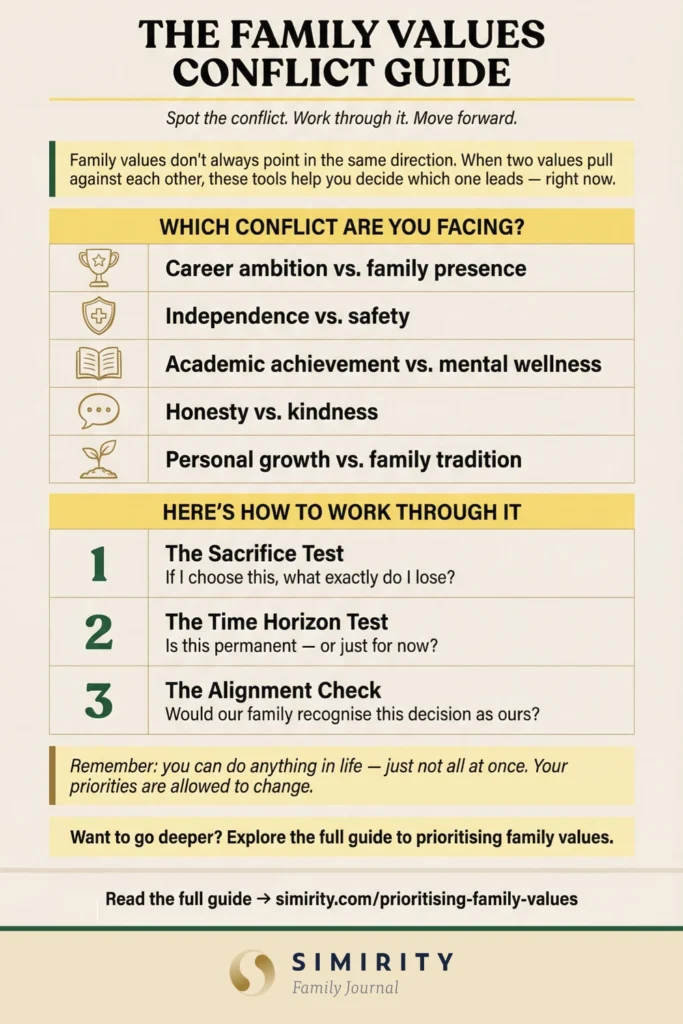
Tool 1: The Sacrifice Test
Every value conflict means choosing one thing over another. The Sacrifice Test helps you name what you’re giving up, so the decision is a real choice rather than something that just happens.

If I choose this path, what from the other value do I actually lose?
For example, a parent considering a new role that requires more travel might frame it as: “If I prioritise career advancement right now, I lose regular bedtime routines for six months. Is that a loss I can live with, and can we compensate for it elsewhere?”
This test works because it makes you get specific. Saying “sacrificing family time” is vague. But saying “missing my son’s Saturday football sessions for the next three months” is something you can actually think about.
Tool 2: The Time Horizon Test
Some value conflicts seem permanent, but they are actually temporary. The Time Horizon Test helps you tell the difference.

Is this a short-term priority shift or a permanent one?
A child taking a gap year to travel isn’t permanently abandoning academic achievement — they’re just delaying it. A parent working intensively for two years to build financial security isn’t permanently absent — they’re investing in the family’s future. The context changes everything.
This test also works the other way. If you see that a decision is permanent and can’t be changed later, it deserves more thought and discussion.
Naming the time frame doesn’t make the choice easy, but it usually helps lower the stress.
Tool 3: The Alignment Check
When a decision feels off but you can’t quite explain why, the Alignment Check helps you surface the reason.

If our family’s top three values were watching this decision, would they recognise it as ours?
For example, if a family values honesty but chooses to stay silent about something important to avoid discomfort, that’s a misalignment. If a family values togetherness but often lets screens replace conversation at dinner, that’s also a misalignment.
The Alignment Check won’t tell you what to decide, but it will show if your choice matches your family’s values. It works best as a regular family reflection tool, not just during tough decisions.
When Conflicts Don’t Resolve Neatly
Not every value conflict has a clear answer. Some situations truly don’t, and it’s important to say that openly.
There will be decisions where you honour one value and grieve the other. Where two family members prioritise differently and neither is wrong.
In those moments, what families often need is a way to make peace with the decision they made. One of the most effective ways to do that is simply to talk about it. Not to go over it again and again, but to name it: what the conflict was, what you chose, and why.
Family psychology research shows that families who talk openly about difficult decisions give something valuable to the people around them. A child who understands why a hard call was made doesn’t just learn the outcome — they learn how their family thinks, what it stands for, and that difficult decisions are a normal part of caring about more than one thing.
Our family built the Simirity family journal as a private place where families can share and preserve stories like these.

Summary of Prioritising Family Values
Prioritising family values isn’t something you do just once. It’s an ongoing practice that gets easier with time and becomes more important as your family grows and changes.
Conflicts will still happen. But when you know what matters most right now, you can handle them with more confidence and less guilt. Choose your anchors, use the tools, and let yourself adapt. When decisions are tough, remember that struggling with them shows you care.
Want to explore your family’s values further? Read our guide on family values examples and how to define family values.
FAQ About Prioritising Family Values
What if my partner and I prioritise values differently?
This happens more often than most couples admit, and it’s not really a problem to solve but a conversation to keep having. Start by finding the values you both agree on and rank similarly. Use those as your shared anchors. The differences often lead to the best discussions and the most creative solutions. Couples who assume they’re aligned without checking are often surprised, while those who check in regularly are better at handling conflicts.
Should I explain my value priorities to my children?
Yes, but do it in age-appropriate ways. When children understand the reasons behind a decision, even a tough one, they feel respected instead of just managed. You don’t have to share every detail. But saying, ‘we’re choosing this because family time matters more to us right now than extra income,’ gives your child something meaningful to remember. It also shows them how to think about values for themselves.
Can we change our value priorities after we’ve set them?
Not only can you change your value priorities — you should expect to. Different stages of life change what matters most. A parent who focused on their career at 35 might focus on being present at 45. A family that valued adventure when the kids were young might find that stability becomes more important as they grow older. Checking your priorities each year, or when something big changes, is highly recommended.
What if a situation involves three or more conflicting values?
Start by figuring out which two values are most directly in conflict in this situation. Usually, one or two are the main issues, while the others are less central. Use the Sacrifice Test and Time Horizon Test on those two first. If you’re still unsure, the Alignment Check can help: which choice best matches your family’s identity as a whole?
How often should we revisit our family’s value priorities?
Once a year is a good starting point, maybe tied to a natural reset like the start of a school year or a family birthday. Besides that, review your values whenever something big changes: a move, a new job, a child starting a new stage, or a major family decision. Often, the conversation is more valuable than the final answer.
What if my children value things differently than I do?
That’s healthy and something to celebrate, even if it feels uncomfortable. Your job isn’t to copy your values onto your children, but to give them a strong enough foundation so they can develop their own with confidence. The goal is for your child to explain why they believe what they do, not just to agree with you. Families that allow for different values usually become stronger, not weaker.

Your family’s past, present & future—woven together in Simirity.
